




Ross Gittins makes it sound so easy to increase tax on large companies for exported gas, so why isn’t it being done (“There’s an easy way to plug a budget black hole, at no cost to voters”, April 15)? Many of our independent politicians are screaming this from the rafters, too. The companies that oppose this must live with reduced profits or leave. There will be plenty of others to take over their lucrative contracts, as has been proven by Norway’s model of selling natural resources. Gittins is correct in saying the government needs to step up and amend all new contracts with big gas exporters to increase profits for the owners of the gas – the Australian people. Mark Nugent, Lugarno
Most Australians agree with Ross Gittins that we need to properly tax the gas companies who operate on our shores. We deserve a fair return for resources extracted, and we need to see gas producers pay for the enormous climate damage their operations cause. Right now, the public is left carrying the costs: worsening climate impacts, rising insurance premiums, and the hefty bill for cleaning up ageing gas infrastructure. The industry’s business model shifts environmental and economic burdens onto the community, and the Albanese government is allowing it to continue. Every day we wait to impose a 25 per cent tax on gas exports costs us almost $50 million. Where is the political will to implement this fair and economically sensible measure? Amy Hiller, Kew (Vic)
Ross Gittins reminds us that politically, the 25 per cent tax on gas exports is low-hanging fruit that could be “plucked at no cost to voters and little, if any, threat to the gas industry”. Much of our security depends on reducing our dependence on oil and gas, and this seems like a smart place to invest the $17 billion per annum arising from this tax. The ground is prepared. EVs are mainstreaming, electric trucks are fast and efficient and even Fortescue plans to go all-electric by 2028 (“Mining giant speeds up plan to eliminate diesel amid global crunch”, April 10). This tax represents an opportunity for Anthony Albanese to play the long game; to reflect voter sentiment, to push back on big business and, most importantly, to invest in a safer climate for all. There’s an opportunity here to reap well from what we sow. It’s time to pluck. Karen Campbell, Geelong (Vic)
Taylor fails test
Opposition Leader Angus Taylor proposes screening migrants from countries ruled by “fundamentalists, extremists and dictators” (“Demonisation of migrants an unedifying ploy”, April 15). Migrants are already rigorously screened, but more to the point, those fleeing such regimes are not their advocates, they are their victims. They come to Australia to escape repression and to embrace democracy, the rule of law and basic freedoms. To judge them by the governments they have fled is perverse. If anything, people who have lived under tyranny often understand and value Australian democracy more deeply than those who take it for granted. The real failure to grasp “Australian values” lies not with those escaping or emigrating from cruel regimes, but with those who would exclude them on such flawed reasoning. Vivien Clark-Ferraino, Duckmaloi
I am wondering how Angus Taylor has formed his view that migrants from countries with fundamentalist regimes are less likely to share our values. These migrants have chosen to leave their homes to seek a fairer and less repressed life. They seek a future for their children where good education and opportunities abound, where they can speak their mind, pray with safety, offer their skills and loyalty to their new country and become solid citizens. They may not drink beer, attend footy games or speak our slang, but my experience is that they are contributing to the fabric of Australia in a most positive way. Annabel Marley, Cootamundra
Opposition Leader Angus Taylor’s move to the right in an attempt to harvest voters who have drifted to One Nation shows the conundrum in which the Coalition finds itself. They may be successful in regaining a few punters, but they further alienate former urban supporters who have deserted to the teals and independents. What Taylor’s announcement illustrates is a stagnant party, reverting to their tested anti-immigration rhetoric, championed by John Howard. Once a true “liberal” party, a supposed broad church, it now appears to be a cheap imitation of One Nation, devoid of genuine policies, harking back to the “good old days” of the White Australia policy. Craig Jory, Albury

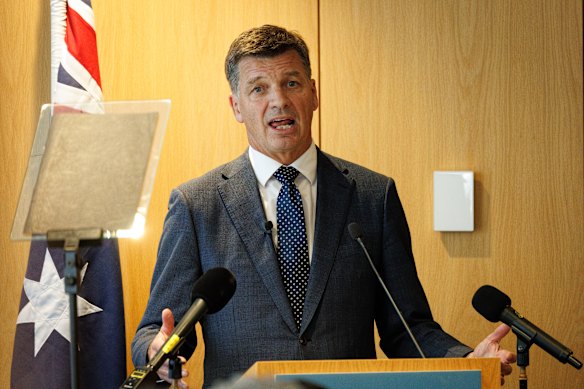
Taylor’s Australian values test targets migrants, overseas visitors and refugees. This will allegedly save us from major crime, terrorism and social disruption. But remember Port Arthur, Milperra and Christchurch, to name but three massacres perpetrated by Australian citizens. Crime is endemic to all societies and cultures, including Australian citizens, and the simplistic, divisive and cheap politics of dog whistling just doesn’t cut it. Murray Patchett, Kentucky
I came to Australia from Scotland with my parents and brother. I have been here 60 years, which would make me more of an Australian than Angus Taylor. I worked all my life, paid all my taxes and contributed to the Australia economy in that time. Now Taylor says I am a foreigner because I am only a permanent resident and not a citizen. How desperate can the Coalition be when they have to adopt One Nation policies like this? The only good thing coming out of this is it will take at least 10 years before this desperate Coalition has a chance of getting into government. Colin Mcneill, Balgownie
Angus Taylor ignores the fact that we are a nation built on immigration (“One Nation is Taylor’s real target with migrant stance”, April 15). Immigrants fill vital roles as nurses, doctors, teachers, and builders, as well as agricultural and gig-economy workers. With our burgeoning older generation, service jobs are an ever-increasing need as well. Maybe Taylor and Pauline Hanson can tell us how we’ll fill these shortages after their policies drastically curtail a primary source of labour? Especially when so many Australians avoid the care industry and labouring jobs, while our birth rate declines. Larry Woldenberg, Forest Lodge
When I grew up in the 1950s we celebrated the empire with cracker night, stood for the Queen at movies, tolerated sex, race, age and disability discrimination and sexual harassment in the workplace. Homosexuality was illegal and Indigenous communities were not counted in the census. Australians drank tea and beer and nobody played soccer. Today, all this has been swept away, suggesting our beliefs and values have undergone a dramatic shift. So, Angus Taylor, why require immigrants to meet some arbitrary standard, as if our values are fixed in time? Lorraine Phillips, Wollongong
The compulsory vote in Australia means that a political party has to appeal to the centre to be a party of government. You cannot win by galvanising a loud fringe minority and getting them out to vote. That only works in countries where a significant portion of the population doesn’t vote. In Australia, you may gain some voters by appealing to the fringe, but you will lose more because you moved away from the centre. James Lawrence, Coogee
Support, not slogans
The government’s “Every Little Bit Helps” campaign has unsurprisingly ignited a firestorm of fury (“Labor under fire for confusing, condescending fuel-saving campaign”, April 15). While Australia exhales during the two-week ceasefire, the bills are still arriving. As a year 12 student, I believe spending $20 million on slogans is simply an insult to farm families and rural students struggling through the fuel and fertiliser crisis. The education gap between rural and urban Australia remains one of our country’s most shameful failures. In 2022, year 12 completion was 24 per cent higher in cities than in rural areas. Energy and fertiliser shocks didn’t create this inequity, they just ripped the wound open. When agricultural costs explode, farm families’ razor-thin margins vanish. At kitchen tables, parents are forced into impossible choices, and education rarely wins. Next week, as city students head back to class, their rural counterparts become invisible casualties. Education is not a luxury, regardless of postcode, and $20 million can be a lifeline, not a line item. Use it to expand boarding scholarships, deliver targeted regional subsidies and bring online classrooms to remote doorsteps. These are not radical ideas; they are the bare minimum owed to rural students who are being asked to pay the price of a war they did not start, in an equity crisis they did not create. Joseph Budden, Bellevue Hill

Trump’s doctor complex
Donald Trump can delete a ridiculous post with impunity, but he can’t take back his disastrous, rash decision to join Benjamin Netanyahu’s war (“Trump scrubs post of him as Jesus, claims it showed him ‘as a doctor’,” April 15). We can only hope that his demented midnight ranting doesn’t result in the launch of a nuclear weapon. Also, the man with the halo that Dr Trump is blessing in the deleted post looks a lot like Jeffrey Epstein. What’s that all about? Surely, the Republicans cannot prop this man up any longer. They need to deploy the 25th Amendment, for all our sakes. Alison Stewart, Riverview
I don’t believe for one nanosecond that the AI-generated image of Trump masquerading as Jesus was his own idea. But I’d really like to know just who the idiot was that conceived and created it. And what price said person had to pay when it failed so miserably. Sacked, hopefully, and sent to purgatory. Donna Wiemann, Balmain
More worrying than the image of Trump posing as Christ is the fact that the person he is trying to heal looks remarkably similar to Jeffrey Epstein. Warwick Harty, Maroubra
Is Trump aware of who the Pope’s boss is? Also, that Biblical image posted of himself could not possibly be of Trump as a doctor. The Hippocratic oath states, “First do no harm”. Pauline McGinley, Drummoyne
Peace negotiations

Rinehart’s royalties
I was deeply moved by mining magnate Gina Rinehart’s recent call for us to extend “compassion and the Aussie spirit” toward Ben Roberts-Smith after his arrest for alleged war crimes. However, my heart now bleeds for Rinehart herself (“Rinehart ordered to hand rival iron ore family millions in high-stakes court ruling”, April 15). Just as she was championing the Aussie spirit for another, the Supreme Court of Western Australia saw fit to order her company, Hancock Prospecting, to share mining royalties with the heirs of Lang Hancock’s former partner, Peter Wright. Is there anything less in keeping with the Aussie spirit than being forced to share our wealth? To nut out an agreement in 1982 to avoid future family squabbles, only to have a court decide decades later that the spoils of the Pilbara must be split, is a tragedy that would tug at the heartstrings of any true patriot. If we can’t find compassion for a woman losing hundreds of millions of dollars in royalties, have we lost sight of our values entirely? Chris Andrew, Turramurra
GPs’ role reduced
GPs once performed hysterectomies, cholecystectomies and appendectomies. We did intensive family planning courses to cover all areas of contraception. With nurse practitioners and now pharmacists administering vaccines and offering scripts for specific items, our roles are being eroded at an alarming rate (“NSW pharmacists to prescribe contraceptive pill”, April 15). Why on earth would an aspiring medical student choose general practice these days? Instead, why not either increase trainee places or recommence a co-payment for consults? Ashley Berry, Wollongong
Road back to rail
Spot on, Stephen Miller, we need to make better use of rail freight (Letters, April 15). Even with B-dubs converting to electric, the highways are being ripped to shreds and rail everywhere needs to come back to the regions. The regions are the food bowls of the nation, a fact noted by 19th-century leaders who built rail “so the people would come”. So many woes of inner-city living could be addressed if rail for passengers and freight were prioritised. Where would the money come from? Binning AUKUS would be a good start. Deni McKenzie, Armidale
Your correspondent, who advocates for more rail freight to reduce the use of diesel, is quite right, but any such moves would face strong resistance. I attended a government conference many years ago that recommended setting up accumulation points in each state capital to feed freight from trucks onto the rail system. It soon became apparent that the major trucking companies would have a stranglehold on the operation of these depots and would ensure their failure in order to protect their own interests. The recommendations never went beyond the talking phase and I expect that this would happen again. Richard Kirby, Campbelltown
Sacrifice to save 2SER
Sydney community broadcaster 2SER, which operates out of University of Technology Sydney, is in danger of closing down soon as its funding has been withdrawn (“Sydney community radio station 2SER could shutter in July as funds run out”, April 15). Come on all of you universities, colleges and other institutions, knock a few dollars off those fat salaries you pay your numerous consultants and save this valuable asset. Coral Button, North Epping
Clothing chemicals
There is currently a Senate inquiry into the impact of microplastics, forever chemicals and other toxic materials on human health, which tells us many people are worried about this issue (“Lululemon faces ‘forever chemicals ’ problem”, April 15). What is in our clothes and household textiles? We have no idea. There is no requirement for clothing/textile labels to give details of chemical dyes and treatments used in production or information about their toxicity. We need data, research and regulation. For a start, there needs to be a public chemical registry for textile-related additives and routine biomonitoring for these chemicals in Australian populations. Jill Robinson, Randwick
- To submit a letter to the Sydney Morning Herald, email letters@smh.com.au. Click here for tips on how to submit letters.
- The Opinion newsletter is a weekly wrap of views that will challenge, champion and inform. Sign up here.
Read the full article here


