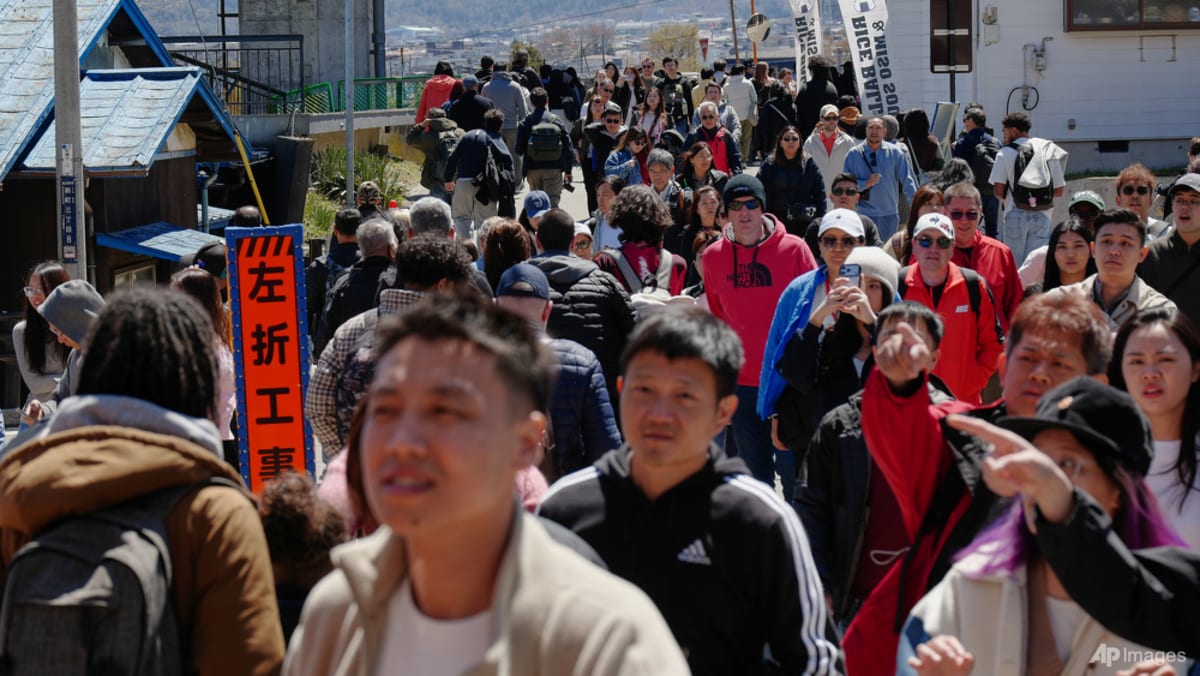
10,000 TOURISTS A DAY “THREATEN RESIDENTS” DAILY LIVES
“This area is primarily an ordinary residential neighbourhood, where balancing (tourism) with the safety of people’s living environment has become difficult,” Masatoshi Hada, manager of the Fujiyoshida Economics and Environment Department, told The Associated Press. “We decided not to promote a festival that would invite more visitors.”
Even without the festival, foreign tourists packed the area on a sunny day in early April when cherry blossoms reached their prime. The narrow streets up to the popular Arakurayama Sengen Park were filled as the visitors lined up for a chance to film the world-famous panoramic views.
In recent years, foreign tourists have exceeded 10,000 per day in the area, something that has “threatened residents’ daily lives”, the city said in a statement in February.
“TOURISM POLLUTION” ACROSS JAPAN
Overtourism has also been seen in other popular destinations in Japan, like Kyoto and Kamakura. In Kyoto, locals complain of tourists with large suitcases clogging city buses.
“Tourism pollution” comes as Japan confronts a rapidly growing population of foreign workers brought in as the country’s population dwindles and ages. The combination has led to xenophobia, and Prime Minister Sanae Takaichi ’s nationalistic government has proposed tougher rules on foreigners.
Even as it promises to address overtourism concerns, the government wants to boost the current level of 40 million inbound tourists to 60 million visitors by 2030.
LOCALS FIND THE TOURISM “GOOD BUT ANNOYING”
Beginning Apr 1, at the start of the region’s cherry blossom season, Fujiyoshida increased its security guards and restricted entry of tour buses and vehicles into the scenic neighbourhood, requiring visitors to reach the park on foot.
On a recent day, security guard Hiroaki Nagayama gestured to passersby so they would stay out of busy areas. He asked tourists to throw cigarette butts in designated places and tried to help the lost.
“I’m struggling. I cannot communicate with them in Japanese. Some people buy food at stalls and leave litter behind,” Nagayama says. “I think what’s happening here is a typical example of overtourism.”
Sitting on a bench outside his house just a couple of blocks away, Hitoshi Mori, 93, says having many visitors is “good but annoying”.
“It’s too crowded outside so I can only get groceries once a week and stock up on food,” he says.
Read the full article here