



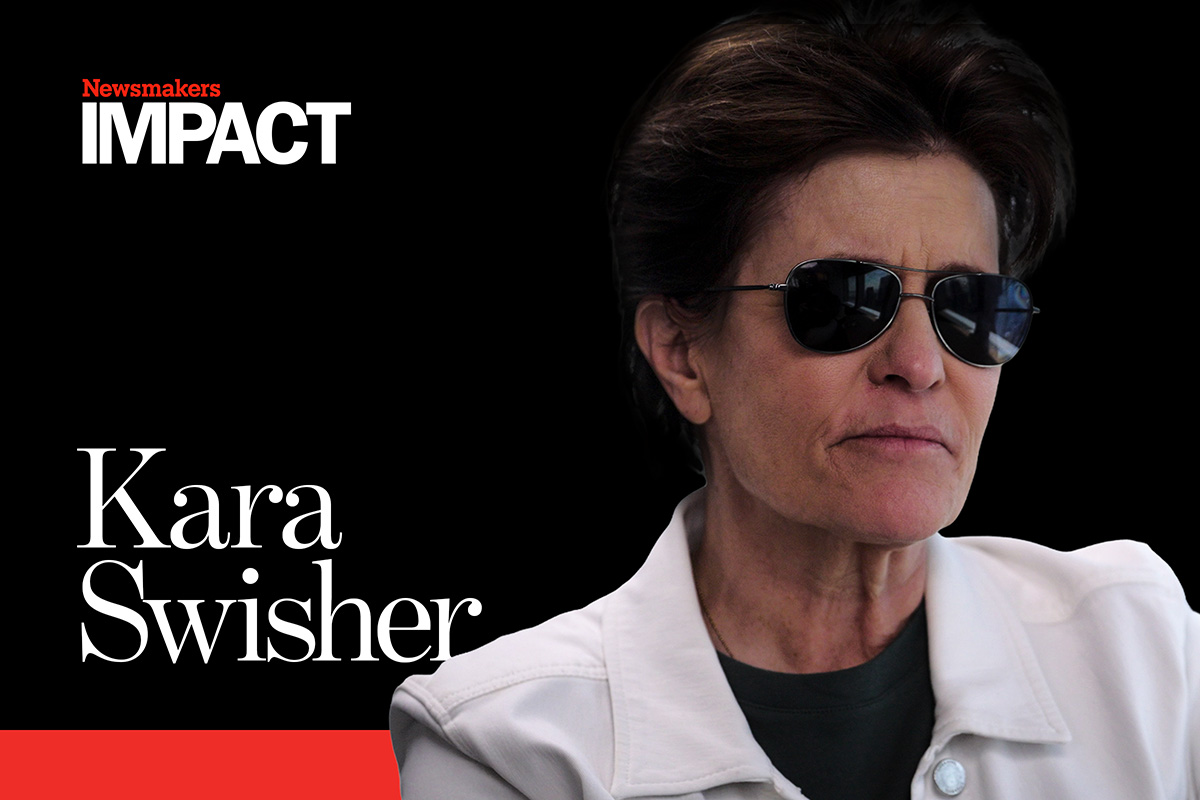
The Brooklyn Bridge was right there, framed in the window from our office atop One World Trade Center, and Kara Swisher couldn’t stop talking about it.
“The guy who built it died,” she told me as our producer mic’ed her up. “He got sepsis. His foot got caught on the dock. His son got the bends. And their bridge is still here.” She paused. “That’s kind of a metaphor.”
This is what it’s like talking to Kara Swisher—the tech journalist, podcaster, author, and now CNN docuseries host—about longevity. Our subject at hand was ostensibly about living longer, but with Swisher, everything circles back to the same obsession: the gap between what humanity is capable of and what a small, self-aggrandizing, frequently broken group of very rich men are actually doing with that sort of ingenuity and resources.
Her new six-part CNN series, Kara Swisher Wants to Live Forever, is a tour through the Longevity Industrial Complex—a growing field that includes everything from the hyperbaric chambers that annoy her (“If you have the bends, sure. Otherwise, no.”) to the GLP-1 medications that actually excite her, to a school lunch in South Korea that left her genuinely stunned. Kids eating miso and fermented vegetables and whole apples, supervised by a real nutritionist. “I don’t know how I could get my kids to eat that,” she admitted, as I nodded along in shared parental frustration.
The CNN series, she said, has three pillars: documenting the explosion of health misinformation amplified by social media; the genuine, astonishing medical breakthroughs happening right now in areas like mRNA technology and AI-assisted drug discovery; and the existential question underneath all of it—for what? She called it the “meat sack” problem—a concept she traces back to a radio play Elon Musk once introduced her to, about aliens baffled by the humans communicating through their mouths, their throats, their meat tubes. Why are these people so obsessed with preserving the container when the question of what to put in it goes completely unasked?
Musk is a through-line in Swisher’s worldview—a case study in the distance between what a person builds and what they become. She covered his early days. She was a believer. Solar. Electric cars. Space. “Everyone else was doing dating services,” she told Newsweek. “He was trying to save the planet.” She gives him his due as a force of will, a visionary in the mold of Steve Jobs who couldn’t code but could bend reality.
But something changed—or maybe, she thinks, something was always there. His grandfather was a well-documented racist and anti-Semite, she noted, but she doesn’t blame Musk for that. She did, however, point out a pattern in his apparent thinking: ideas that flirt with white supremacy, a fixation on birth rates filtered through a very specific demographic anxiety. “Instead of figuring out what to do, he’s like: ‘We’re running out of white people,'” Swisher said. “That’s how it goes through his brain.”
She compared him to Henry Ford—a transformational industrialist with genuinely poisonous beliefs, who used his platform to spread them. The difference, Swisher said, is scale. “Ford had influence. But Musk is a trillionaire. The kind of impact he can have is vast.”
There is a Steve Jobs thread running through all of this as well. Swisher conducted the last public interview with the Apple founder before he died, alongside Walt Mossberg. She watched him in the room—visibly sick, yet somehow the most vibrant person present. Someone asked Jobs about his famous 2005 Stanford commencement speech, the one about death as inspiration. What would he say differently? “I ten times it,” he replied. Swisher loved that. But the same ethos has been captured, distorted, turned into body-maxing and biohacking and the pharmaceutical pursuit of immortality as a form of self-promotion. “It has nothing to do with the rest of it,” she argued. “It’s just them.”
At the end of our conversation, as any good fellow interviewer would, she turned the tables on me. She asks everyone a particular question, she explained—because death acceptance, making peace with the inevitable, actually correlates with happiness. The death-deniers, she said, are the angry ones. The ones who want to live forever tend to make everyone else miserable.
“How do you want to die?”
The question caught me off guard. As it happens, I had just received some worrisome health news the previous day. There were two cancerous tumors on my kidney, which were found by accident. I was now about to go through what so many others have: a battle with cancer, that great equalizer that doesn’t care about your plans, your career, your life. Needless to say, mortality happened to be on my mind. Then I felt the tears coming.
After seriously thinking about this question for perhaps the first time in my life, I gave her my answer: with my daughter. Preferably while holding her hand.
She sat with that for a second. Then she told me about Reid Jobs—Steve’s son—and a project he’s running on AI and liver cancer. She told me about her sister-in-law’s colon cancer diagnosis and what they can do now that they couldn’t five years ago. She was not being kind, exactly. She was being Swisher: redirecting grief toward evidence, mortality toward possibility. Pointing, again, to that bridge out our window. Still standing after all these years. Still here.
Watch Swisher’s interview with Newsweek, for our Newsmakers Impact series, above.
Read the full article here


