



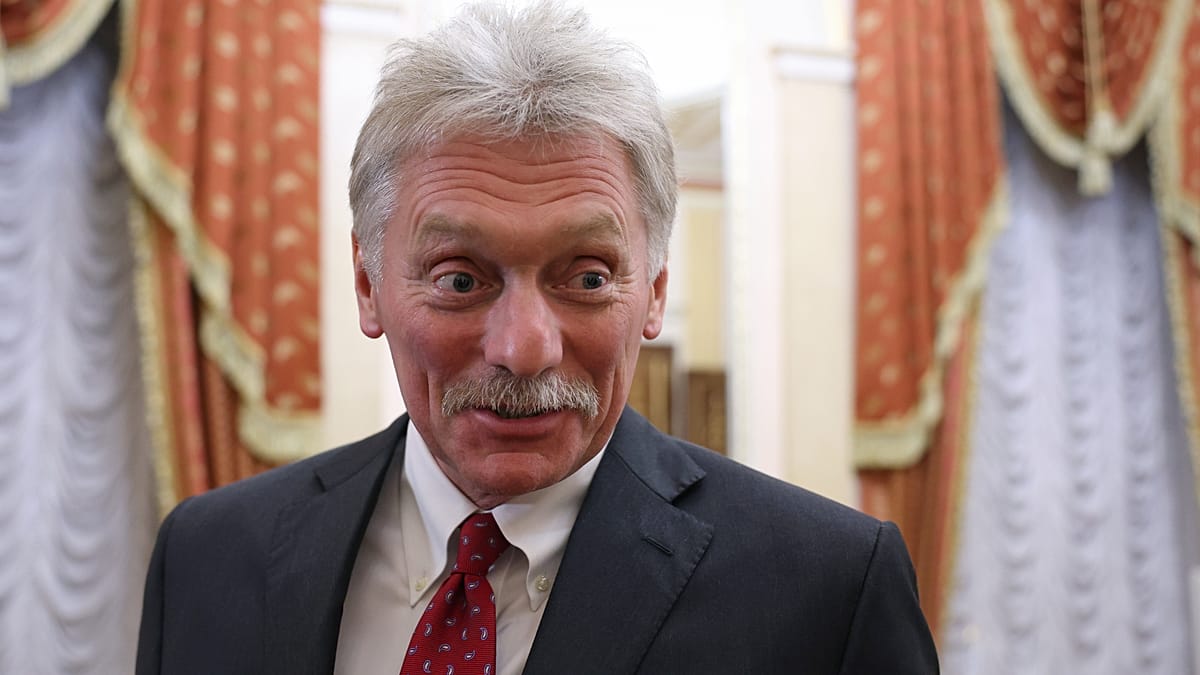
Kremlin spokesperson Dmitry Peskov said on Monday that Russia posed “no threat” to France or any other European country, local media reported. His comments came after the far-right National Rally party’s Marine Le Pen and Jordan Bardella issued a warning to Moscow on the weekend.
“We will never tolerate a foreign power, specifically Russia, attempting to dictate our country’s policies through intimidation, threats, destabilisation, or psychological pressure, either directly or indirectly,” the pair said in a joint statement.
In response, Peskov told reporters that Russia was “not threatening France or any other country in Europe,” adding that “President Putin has stated this on numerous occasions. We have no disputes with any European states that could give rise to any serious disagreements.”
He added that “Russia poses no threat. Russia does not threaten anyone, nor does it blackmail anyone.”
It comes as the pro-Putin United Russia party won a record supermajority in the State Duma, the lower house of Russia’s parliament, authorities announced on Monday. Voting wrapped up on Sunday after a tightly controlled election that excluded parties critical of the Kremlin and the war in Ukraine.
Macron’s crisis meeting
Earlier this week, Russian authorities moved to seize the businesses and assets of companies including Nestlé and France’s Auchan.
The French Ministry of Foreign Affairs reacted by condemning what it called the companies’ “unjustified placement under temporary administration of Russian subsidiaries.”
Meanwhile, Le Pen and Bardella’s statement, which denounced the move as an “act hostile to the interests of France and Europe,” followed a crisis meeting convened by French President Emmanuel Macron with party leaders from across the political spectrum on Friday, including Bardella.
During the meeting, Macron briefed attendees on several issues, including potential security threats posed by Russia.
He later told reporters that Moscow’s expanding shadow operations across Europe represented a growing threat, adding that he had ordered measures to protect France’s critical infrastructure from Russian “hybrid attacks.”
In their statement, Le Pen and Bardella pointed to the recent drone attack at Leipzig/Halle Airport in Germany, which German authorities have blamed on Russia.
“France is also affected by these actions, which specifically target our economic interests and companies in our defence industry,” they said, while warning that Moscow could escalate tensions with countries supporting Ukraine, citing intelligence reports.
Their condemnation of Russia is at odds with the National Rally’s past leniency towards the Eastern European nation, however.
In 2011, Le Pen said she admired Russian President Vladimir Putin “to a certain extent,” while arguing that France should work on building closer ties with Moscow.
She also “disagreed” with the idea that Moscow’s annexation of Crimea in 2014 was illegal, citing a referendum held under Russian occupation.
The National Front — which subsequently became the National Rally party in 2018 — also contracted a controversial €9.4 million loan from a Russian bank in 2014 after French banks refused to finance their operations. The money was used to fund its 2015 departmental and regional elections campaign.
In September 2023, the party declared it had repaid the loan in full.
Funding for Ukraine
Despite the strong criticism of Moscow and “foreign pressure” in their statement, Le Pen and Bardella stressed that questions around financial support for Ukraine remained “legitimate.”
In a recent interview with Bloomberg, Bardella sought to appease the controversy sparked by comments from Louis Aliot, the National Rally party’s vice-president and mayor of Perpignan.
Speaking to BFM-TV in early September, Aliot said he would “turn off the tap” when asked about aid to Ukraine.
“The health system, the education system, the whole economy, everything has been cut to the bone, and yet we still find money to fund more weapons (…) I’m willing to accept that, but who pays for all this? You also have to know how to stop a war,” he said.
Bardella responded by arguing that the plan was not to abandon Ukraine but that unconditional financial and military aid were not viable solutions.
French authorities react to Russian election
The United Russia party retained its majority in Russia’s parliament, election officials said Monday, after three days of voting that saw Putin tighten his grip on power.
Preliminary results indicated that United Russia would get 355 out of 450 seats in the State Duma, the Central Election Commission said, which would be a record high for the party if confirmed.
France’s Ministry of Foreign Affairs has issued a statement acknowledging “the expected outcome” of the elections but said it regretted “that the conditions for a free, pluralistic, and democratic election” had not been met.
The ministry also declared that it was “disappointed” that Russia did not invite the observation mission of the OSCE’s Representative Office for Human Rights and Democracy (OHR) to monitor the voting process.
Read the full article here


