



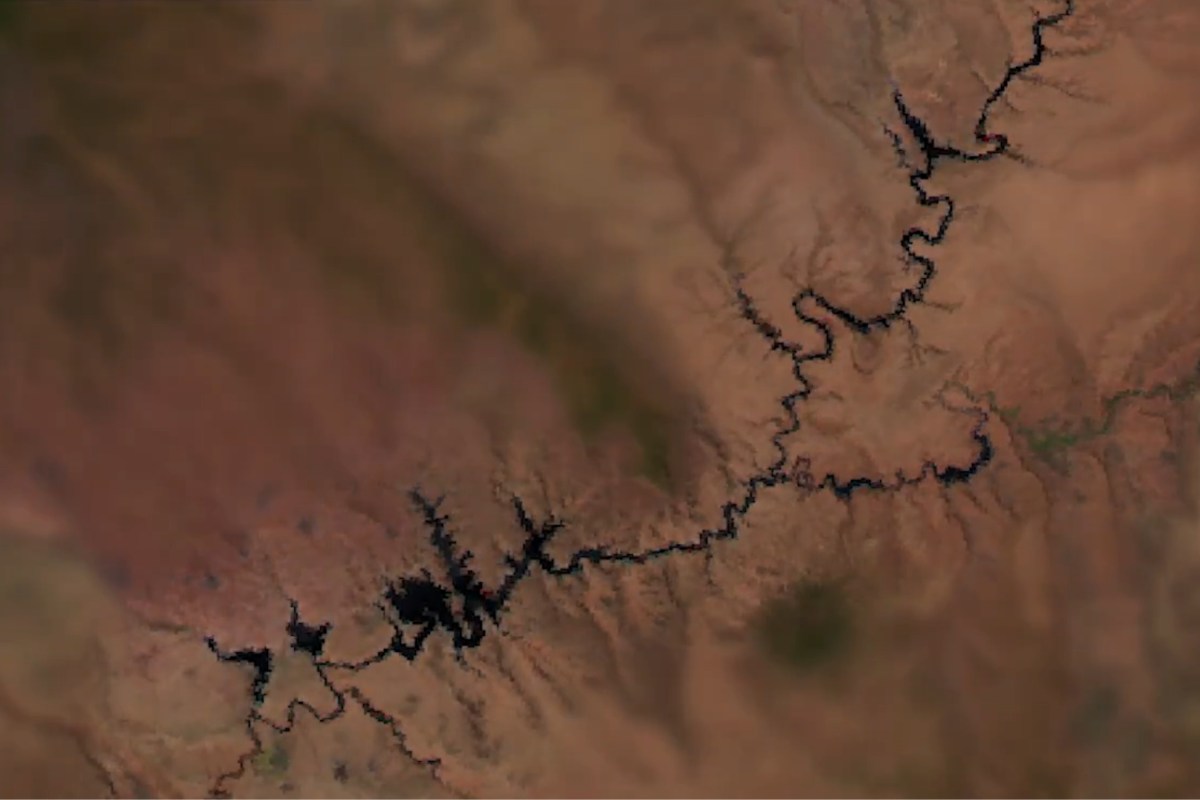
A newly released time-lapse of Lake Powell highlights more than a decade of falling water levels, as federal forecasts warn the reservoir could see record-low inflows this year.
The time-lapse’s release came shortly after federal forecasters said the reservoir is projected to receive only 13 percent of its typical April-to-July runoff this year, the lowest on record since the reservoir’s creation in 1963.
Lake Powell, the second-largest reservoir in the U.S., lies along the Colorado River, which has been grappling with long-term drought. The system also includes Lake Mead, the country’s largest reservoir. The river irrigates more than 5 million acres of farmland and supplies water to 40 million people across the West.
What To Know
The time-lapse footage shows the lake’s shorelines gradually receding, using imagery captured by NOAA’s JPSS satellites between 2012 and 2026.
“This year’s spring and summer runoff into the lake is projected to be the lowest ever recorded, according to NOAA’s Colorado Basin River Forecast Center,” NOAA said.
Federal water managers had already cautioned that sinking reservoir levels could imperil hydropower production at Glen Canyon Dam, whose turbines are fed by water from the lake.
Officials announced plans to prop up the lake’s levels last month by releasing water from the upstream Flaming Gorge Reservoir while also reducing downstream releases to Lake Mead—a move intended to prevent Lake Powell from dropping to critical thresholds, though experts and officials have warned of potential impacts to power, local economies, and recreational activities.
The move followed what the U.S. Bureau of Reclamation called “the combination of the lowest snowpack on record and record-breaking March heat,” which it said had only served to worsen drought conditions across the basin.
The Colorado River serves seven basin states—Wyoming, Utah, Colorado and New Mexico in the Upper Basin; Arizona, California and Nevada in the Lower Basin—as well as Mexico. These states have been working to negotiate new water-sharing agreements to replace those due to expire this year.
The Lower Basin states recently proposed a plan to federal officials that would substantially enhance water conservation as a stopgap while talks continue.
Arizona, California and Nevada put forward a plan under which the three states would jointly cut their water use by as much as 1 million acre-feet a year through 2028. This would come on top of 1.5 million acre-feet in reductions that had already been proposed among the three states and Mexico, Newsweek previously reported.
The proposal includes immediate reductions of roughly 700,000 acre-feet annually, to be shared between the states. It also allows for the possibility of an additional 300,000 acre-feet of voluntary cuts, to be supported by federal drought funding provided through the 2022 Inflation Reduction Act.
What Happens Next
As of Sunday, Lake Powell was 23 percent full, with storage levels 39 percent of average for the date, according to USBR data.
Read the full article here


