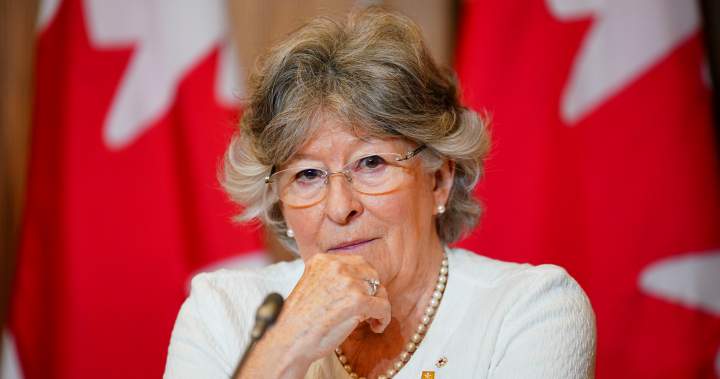
Former Supreme Court justice Louise Arbour will be Canada’s next governor general, replacing Mary Simon in the role, Prime Minister Mark Carney said Tuesday.
Simon, who made history in 2021 by becoming the first Indigenous person to be named as the representative for Canada’s head of state, will see her five-year term end this July.
Arbour, who was born in Montreal, served as a Supreme Court justice from 1999 to 2004. Prior to serving in Canada’s highest court, she was appointed to the Supreme Court of Ontario in 1987 and the Court of Appeal for Ontario in 1990.
In 1995, she led a public inquiry into the conditions of prisons for women in Ontario.
“Her work matters in and of itself. It also tells us something about what Louise Arbour will bring to Rideau Hall – the conviction that institutions are the load-bearing walls of a civil society, and that they remain trustworthy only as long as someone is willing to hold them accountable,” Carney said.
As UN High Commissioner for Human Rights, Arbour “gave voice to those whose dignity was denied in places where the powerful preferred silence,” he said.
“She did not flinch and she never confused being heard with being safe,” he added.


Get daily National news
Get daily Canada news delivered to your inbox so you’ll never miss the day’s top stories.
Arbour also served the United Nations’ chief prosecutor for the International Criminal Tribunal for the former Yugoslavia and Rwanda, prosecuting crimes against humanity and genocide.
Carney praised Arbour’s record spearheading “the first international criminal tribunals since Nuremberg.”
“She inherited two institutions that many believed could not succeed. She made them succeed. Under her leadership, the tribunals secured the first conviction for genocide since the adoption of the Genocide Convention in 1948,” Carney said.
Arbour led the public inquiry into sexual misconduct in Canada’s military in 2021 and submitted her report in 2022.
In a 2014 interview to the Globe and Mail, she said the “biggest hurdle” in her career was moving from Quebec to Ontario, since her entire formal education had been in French.
After she resigned from the Supreme Court in 2004, Arbour became the United Nations High Commissioner for Human Rights.
In 2017, UN Secretary-General António Guterres appointed her to be the UN Special Representative for International Migration.
Arbour, 79, is one of Canada’s most decorated jurists. In 2007, former governor general Michaëlle Jean named her as a companion to the Order of Canada “for her contributions to the Canadian justice system and for her dedication to the advancement of human rights throughout the world.”
Governor General Mary Simon faced questions during her term over her lack of ability to speak French, with Canada’s past governors general typically expected to be bilingual in the country’s two official languages. She is bilingual in English and Inuktituk.
Carney’s appointment of Arbour again puts a bilingual speaker of both English and French into the role.
Read the full article here