



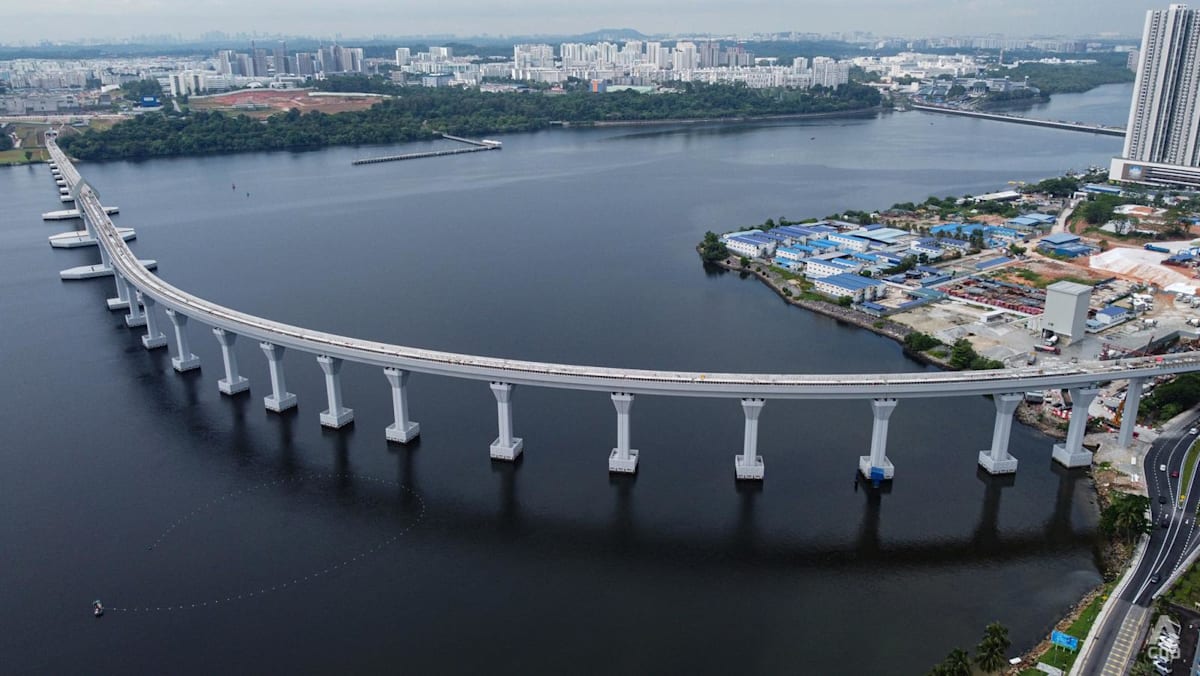
SINGAPORE: Malaysian border laws will apply in a part of the Woodlands North station of the upcoming Johor Bahru-Singapore Rapid Transit System (RTS) Link, under a proposed law tabled in parliament on Tuesday (Apr 7).
The area would be designated as a Malaysian customs, immigration and quarantine (CIQ) zone, where Malaysian officers will be empowered to perform tasks like checking travel documents, screening travellers and refusing entry or the import of goods bound for Malaysia, said the Ministry of Home Affairs (MHA) in a press release.
However, Singapore’s laws will continue to apply in the designated area, with the Malaysian officers’ powers only applying within the scope of their official duties.
Under the Cross-Border Railways (Border Control Co-Location) Bill introduced by Second Minister for Home Affairs Edwin Tong in parliament, Malaysian officers will also have certain protections and immunities when performing their duties here, said MHA.
For instance, they will be deemed as public servants and offences committed against them will be dealt with under Singapore’s laws similarly to those committed against Singapore’s public servants.
“There are safeguards on the exercise of these powers. For example, Malaysian preclearance officers are not allowed to make an arrest in Singapore. If they detain any person or item, they must transfer custody to a Singapore preclearance officer as soon as is practicable,” said MHA.
Malaysian preclearance officers operating here will need to be approved by Singapore’s Minister for Home Affairs, who may refuse or withdraw such recognition without giving any reason, added MHA.
RECIPROCAL BASIS
When up and running, the RTS Link will move up to 10,000 commuters per hour in each direction, with each journey between the Woodlands North and Bukit Chagar stations taking about five minutes.
The RTS Link is expected to start operations by the end of 2026.
Co-locating both countries’ CIQ facilities at each of the stations lets travellers clear immigration only once – at the point of embarkation – hence making the process more efficient and seamless, said MHA.
The powers and protections given to officers will be on a reciprocal basis, with Singapore officers also enjoying the same conditions at Bukit Chagar station in Malaysia, said MHA.
If passed, the new law will allow Singapore preclearance officers to be deployed to Malaysia, with similar powers, rights and immunities under Singapore law to when they are performing the same roles here.
“The Bill also modifies certain Singapore border control laws to adapt them for co-located border control arrangements in Malaysia, enabling Singapore preclearance officers deployed in Malaysia to continue to keep our borders safe,” said MHA.
Both sides will continue to supervise security and safety operations and manage incidents within their own territory. Incidents occurring within Malaysia’s designated zone at Woodlands North station will be handled by Singapore, while Malaysia will manage incidents that occur in Bukit Chagar station, said MHA.
Malaysia has already enacted such legislation on its end, with its Johor Bahru-Singapore Rapid Transit System (RTS) Link Bill 2026 passed early last month.
SECURITY AND SAFETY OPERATIONS
Under the proposed law, Singapore and Malaysia will hold concurrent criminal jurisdiction for incidents that take place on trains in transit and on the railway tracks.
“In general, the country in whose territory the train journey is completed has the primary right to exercise jurisdiction,” said MHA.
However, the other country may request the other to waive that right in cases where there is greater public interest for it to investigate and prosecute, said the ministry.
Such an approach ensures clarity of jurisdiction when the exact location of an offence is unclear, and is similar to other major cross-border railways, such as the Channel Fixed Link between the United Kingdom and France, said MHA.
The Bill also lets Singapore incident responders, such as from the Singapore Police Force and Singapore Civil Defence Force, attend to emergencies on or near trains and the tracks in Malaysia’s half of the line, and vice versa, said MHA.
“Singapore and Malaysia authorities have also worked closely on a comprehensive set of Standard Operating Procedures for incident management. Taken together, these laws and SOPs will enable effective response to cross-border incidents and help keep travellers safe,” the ministry said.
The proposed law also ensures that all information and data collected or generated by Singapore officers in the line of duty in Malaysia, will be treated as if they were collected in Singapore and governed by Singapore’s laws.
Amendments will also be made to related laws, such as the Immigration Act, the Civil Defence Act and the Police Force Act.
Read the full article here


