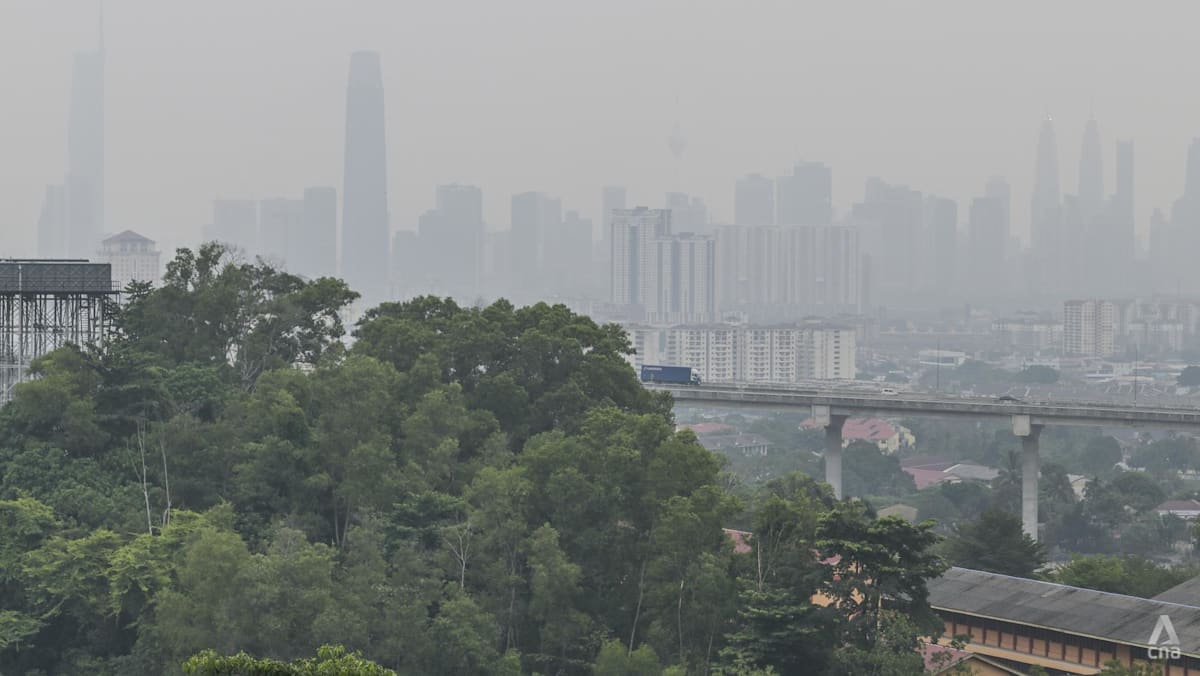
The deteriorating situation has prompted Malaysian leaders to call for a review of parts of the ASEAN Agreement on Transboundary Haze Pollution (AATHP), which entered into force in 2003.
The agreement is built around the bloc’s longstanding principles of consensus, sovereignty and non-interference. It has no ASEAN-level fines or sanctions for non-compliance, while disputes are to be settled through consultation or negotiation.
But more than two decades after the pact took effect, experts said that strengthening it will be an uphill task.
James Chin, professor of Asian Studies at the University of Tasmania, told CNA that significant changes to the pact may garner support, but would require major players such as Indonesia to “play ball”.
“Malaysia is pushing for (legislation change), and this is likely supported by Singapore – but the bottom line is (whether) Indonesia wants to do it,” said Chin, who is also a senior research associate at the Tun Tan Cheng Lock Institute of Social Studies in Malaysia.
“If things continue like it is presently, nothing much will change because ASEAN is dependent on consensus,” he added.
Breaking the cycle will therefore require not just changes on paper but stronger political will and accountability, experts said, including stronger cross-border cooperation, evidence-sharing and domestic enforcement.
Transboundary haze has repeatedly plagued Southeast Asia over the decades, with particularly severe episodes in 1997-98, 2013 and 2015, as well as significant outbreaks in 2019 and this year. Some of the worst episodes have coincided with El Nino-driven dry conditions that exacerbate forest and peatland fires.
The consequences have been far-reaching: millions exposed to unhealthy air, schools shut, businesses and travel disrupted, and billions of dollars in economic losses.
Besides Malaysia, the Philippines is also experiencing worsening air quality, including in Metro Manila. Last month, Singapore’s National Environment Agency warned that an escalation in hotspot activity in Indonesia could lead to “occasional periods of haze affecting Singapore”.
In Sarawak, governor Wan Junaidi Tuanku Jaafar was quoted by Malaysian media as saying there was a possibility that the Air Pollutant Index in parts of the state could hit 800, forcing schools and some businesses to close.
An API level of above 500 could trigger a state of emergency, halting non-essential government and commercial operations.
Wan Junaidi reportedly said the AATHP remained relevant, but stronger mechanisms, new technologies and faster decision-making were needed to make regional cooperation more effective.
Deputy Natural Resources and Environmental Sustainability Minister Syed Ibrahim Syed Noh was also quoted as saying that mechanisms under the AATHP must evolve to meet changing challenges, with enforcement among the issues that should be discussed alongside ways to prevent, detect and respond to haze.
“This is not about pointing fingers. Haze does not recognise national borders and neither should our commitment to finding solutions,” he reportedly told local news outlet the New Straits Times.
On Tuesday (Sep 1), Indonesian ambassador to Malaysia Raden Mohammad Iman Hascarya Kusumo said that Jakarta supports further strengthening the AATHP.
“Indonesia remains committed to the AATHP and considers it an important framework for regional cooperation,” he was quoted as saying by the New Straits Times.
“Indonesia believes regional mechanisms should continue to be strengthened in terms of implementation, particularly in early warning and monitoring, real-time information and data sharing, coordination of firefighting operations, weather modification and capacity-building among ASEAN member states.”
ASEAN’s Second Haze-Free Roadmap 2023-2030 sets out a vision of a transboundary haze-free region by the end of the decade.
The roadmap, which spells out that haze-free doesn’t mean zero fires or zero haze, seeks to prevent and control large-scale land, forest, peatland and agricultural fires that result in significant transboundary haze.
At the heart of the problem, analysts said, is a longstanding dilemma between ASEAN’s principles of consensus and non-interference and measures that could hold member states more directly accountable.
“The goal of a haze-free ASEAN in 2030 is not realistic and is a bad look for ASEAN as they have spent a lot time and effort to make progress on this issue but they (have little to show for their efforts),” said Chin.
Read the full article here