



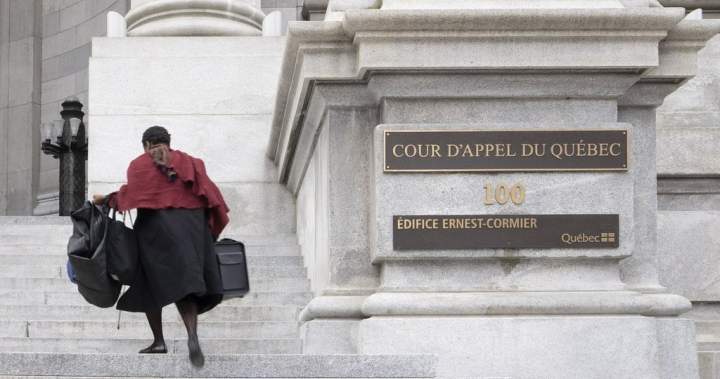
Quebec’s highest court has ruled the minimum one-year sentence for distribution of child sexual abuse material is unconstitutional.
In a decision Monday, a Court of Appeal panel ruled on the case of a man who pleaded guilty in 2018 to one count each of possessing, accessing and distributing the material.
The panel found that the original sentence of 12 months imprisonment would constitute cruel and unusual punishment given the defendant’s intellectual disability and mental health conditions.
It noted that many experts as well as the Supreme Court of Canada have established that imprisonment has particularly negative effects on people with intellectual deficiencies, which the defendant experienced during the time he was incarcerated.
“Imprisoning this offender disregards the principle of individualization and reveals a level of severity that will prevent his social reintegration,” Justice Mark Schrager wrote in the decision.
The court reduced the defendant’s sentence to six months served in the community, as well as probation and a long list of conditions, in addition to the time already served in detention.
The panel noted that the Supreme Court of Canada already struck down mandatory one-year minimum jail sentences for accessing or possessing child sexual abuse material last year.


Get breaking National news
Get breaking Canada news delivered to your inbox as it happens so you won’t miss a trending story.
That court concluded that mandatory minimum sentences can be constitutionally vulnerable because they leave a court no choice but to impose a grossly disproportionate sentence on certain offenders.
In the case being studied by the Quebec judges, the defendant admitted in 2018 to having possessed more than 600 images and 150 videos showing sexual acts involving children between the ages of three and 13. He also admitted to having sent 73 files to another person via Skype.
The original judge hearing the case described the material as “particularly repugnant,” but chose a sentence on the low end of the severity scale because of the defendant’s circumstances, which include a mental age of between 8 and 11 years, and the fact his caregiver was temporarily sidelined by a health problem that limited supervision at the time of the offence.
At the time, the defendant was also given six months for possessing and another six months for accessing the material, to be served concurrently. The Court of Appeal reduced those two sentences to three months each, served in the community.
Like the Supreme Court before it, the Quebec Court of Appeal weighed not only the defendant’s situation in order to determine if the mandatory sentences violate the Charter, but also less severe hypothetical scenarios. In one of those scenarios, the court considered a hypothetical case involving a person with the same limited mental capacities as the defendant but who distributed 10 images of teenagers posing alone.
The judges concluded that, while a sentence of a year or more is very often justified, “there are reasonably foreseeable situations in which such a sentence would be excessively severe.”
The hypothetical situation as well as that of the defendant “highlight the cruelty of such a sentence for certain vulnerable offenders whose actions fall at the lower end of the scale of seriousness.”
Parliament adopted legislation last month aimed at ensuring mandatory minimum sentences remain enforceable. That law allows a judge to order a shorter sentence in cases where applying the mandatory minimum would be “grossly disproportionate punishment for the offender.”
Schrager wrote in the Quebec decision that he doesn’t believe the new federal law would change the outcome of the defendant’s appeal, due to his mental impairment.
“In any event, it will come into force on July 19, 2026, and is therefore inapplicable,” the judge wrote.
Read the full article here


