



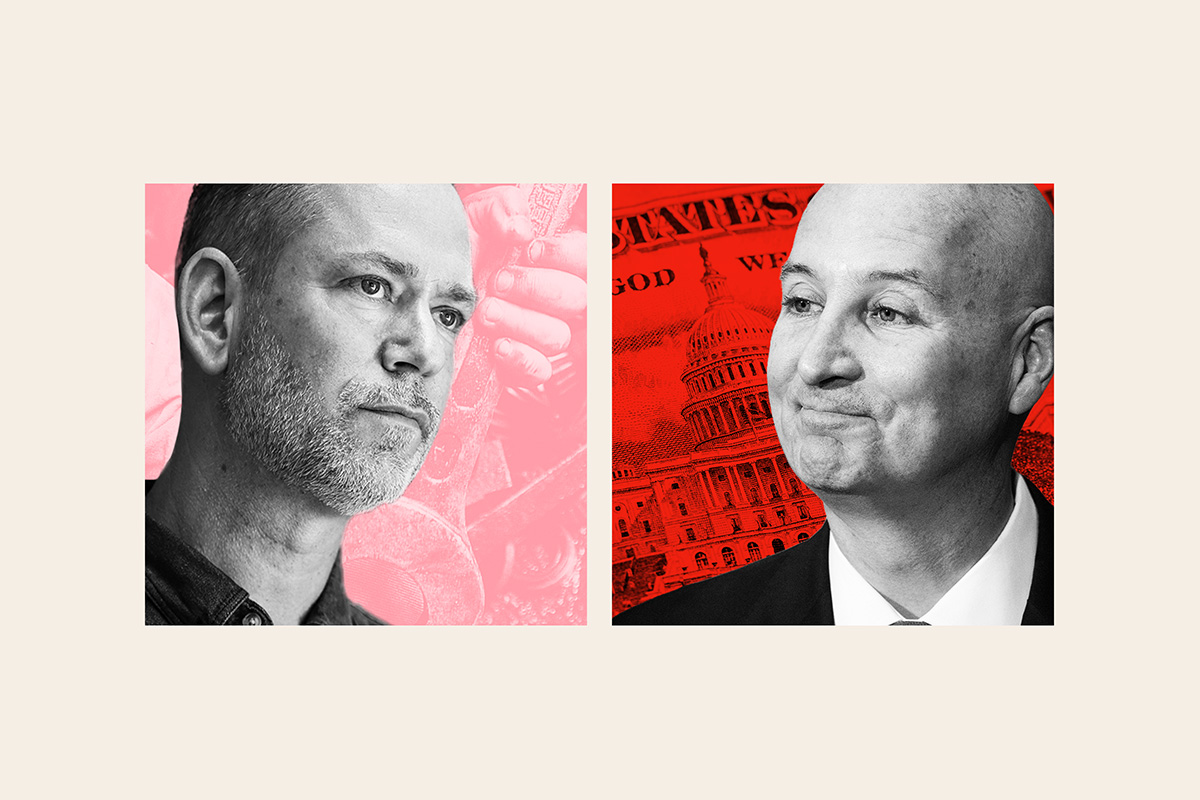
Dan Osborn’s believes his “best years” have been working in a factory, saying with pride that he knows firsthand what it’s like to hit a punch clock daily and await a regular paycheck to know “how much comes in” and “how much goes out.” The Nebraska independent and U.S. Navy veteran believes that working-class relatability will be a winning message in 2026, especially as he faces off with one of the wealthiest men in Congress.
Incumbent Republican Senator Pete Ricketts, the eldest son of billionaire TD Ameritrade founder Joe Ricketts, has a personal net worth estimated to be north of $180 million. His father’s net worth, according to Bloomberg, hovers around $8.6 billion
“Pete Ricketts is the son of a billionaire who really ran our state like a mob boss as a two-term governor, and spending millions of dollars in the state against his opponents,” Osborn, a former labor union leader and industrial mechanic, told Newsweek as he discussed how his campaign message is all about “paycheck populism” and relating with everyday Nebraskans.
The GOP senator’s campaign has tried to tie Osborn and his campaign to New York City’s “socialist” Mayor Zohran Mamdani while also casting doubt on his independent status, pointing to Democratic Party support and saying he would caucus with Democrats in the Senate. Osborn, for his part, has said repeatedly he will not caucus with either party.
Ricketts in September directly accused Osborn of having “allegiance” to Democrats, with plans to undermine President Donald Trump’s agenda. “That’s why it’s so important that we beat fake Dan Osborn and send a real conservative to Washington,” the Republican said at a campaign stop.
For his part, Osborn says he can get behind some Trump policies, giving him credit for securing the border. He also sees common ground with the president on anti-trust policy, preventing private equity buying up single-family homes and the recent move to reclassify cannabis from Schedule 1 to Schedule 3. “My opponent is fighting that initiative tooth and nail,” Osborn said.
Ricketts joined 21 other GOP senators in a December letter urging Trump not to reschedule marijuana. While the reclassification doesn’t legalize cannabis nationwide, it will make banking and taxes simpler for marijuana businesses. It will also ease restrictions on research, and recognize the drug has medical uses along with lower potential for abuse.
At the same time, Osborn says he sees the political dynamics between Republicans and Democrats in Washington, D.C. as “dysfunctional,” criticizing both parties for being beholden to the wealthy and corporations. He’s also critical of Trump’s tariff polices, the president’s One Big Beautiful Bill (OBBB) and the Iran War—connecting all of these issues back to the concerns of everyday Americans.
With the OBBB, Osborn said the signature Trump legislative achievement “gives the lion’s share of tax cuts to the uber-wealthy.” On tariffs, he said they are raising costs for everyone, particularly Nebraska’s farmers, describing it as “a tax on the people.” And on the Iran War, the Senate hopeful said his first questions were, “How is this going to help my daughter afford a house? How is this gonna help people put groceries on American tables? How is going to feed the hungry and give the basic necessities to people? How’s this going to increase people’s paychecks? And the answer is it’s not.”
Dan Osborn’s Chances of Beating Pete Ricketts
Ricketts would present a formidable challenge to any opponent, especially considering Nebraska’s strong Republican lean. The former two-term governor easily won with over 57 percent of the vote in 2014, getting reelected four years later with 59 percent. Most recently, Ricketts easily won a special election to finish out former Senator Ben Sasse’s term, defeating his opponent by more than 25 points. Trump also carried the state by double-digit margins in 2016, 2020 and again in 2024, and the last time the Midwestern state elected a non-Republican statewide was 20 years ago, when former Democratic Senator Ben Nelson was reelected in 2006.
Nonetheless, Osborn believes there is a path for a working class independent. In 2024, he ran against Senator Deb Fischer, and although he ultimately lost, he showed significant crossover appeal. While former Vice President Kamala Harris lost in Nebraska to Trump by more than 20 points, Osborn finished less than 7 points behind Fischer.
“You would see my sign next to Trump signs, and then you’d go a block over, and you’d see my signs next to Harris signs,” he told Newsweek. “So what my campaign was able to do is bring people together around policy and around issues, not over party or a president.”
Another thing that’s different this time, according to Osborn, is the dynamic between him and his opponent. “Deb Fischer painted herself out to be a rancher,” he said, while emphasizing Ricketts’ wealth. Additionally, similar to 2024, the Democratic Party has chosen not to officially back a candidate in the race, seeing Osborn as more likely to win and as someone they can work with better than a Republican.
A Ricketts spokesperson dismissed the challenge, however, saying the incumbent Republican “has consistently worked for and voted to secure the border and cut taxes for Nebraska workers, families and seniors.” He described Osborn as “bought and paid for by his liberal, out-of-state, coastal donors.”
There are, however, some signs showing the race could be competitive. A poll by Democratic pollster Lake Research Partners carried out in December had Osborn at 47 percent in Nebraska compared to Ricketts’ 48 percent. That poll also showed Ricketts’ favorability underwater by 9 points, while Osborn’s favorability was positive 7 points. Another February survey by Impact Research, which was sponsored by Osborn’s campaign, showed the Republican up by just 1 point as well.
Pointing to his higher name recognition and the infrastructure his campaign built in his previous Senate race, Osborn said, “We’re starting from definitely a stronger place than I was at the beginning of 2024.”
The campaign comes amid a wave of anger directed at wealthy elites, after years of populist messaging from Democrats and Republicans alike. A January Economist/YouGov poll found that majorities of Americans think wealth inequality is a “very big problem” and that the amount of taxes billionaires pay is “too low.” It also showed 80 percent of Americans, including two-thirds of Republicans, say the rich have too much political power.
Osborn spoke with Newsweek last Monday at our Manhattan office about his goal to represent the working class in the Senate, his “paycheck populism” message and how an iconic actor once got him fired from a job. The interview transcript has been edited for brevity and clarity.
Dan Osborn Interview Transcript
Newsweek: This is your second Senate run after falling short in 2024. Why do you think this time will be different?
Dan Osborn: We ended up doing over 200 public events in Nebraska in 2024. And we went around the state building an organization around a message and building name recognition. So, we’re starting from definitely a stronger place than I was at the beginning of 2024. And my opponent’s different. Pete Ricketts is the son of a billionaire who really ran our state like a mob boss as a two-term governor, and spending millions of dollars in the state against his opponents. [GOP Senator] Deb Fischer painted herself out to be a rancher [in 2024], so a little bit different of a candidate. I think people are understanding my message more. We’re going to continue to get out there and do a lot of the same things that we were doing in 2024, and some things differently to across the finish line.
You’re an independent. As an independent, how do you view the leadership right now from Republicans and from Democrats on the national level?
Dysfunctional. What I see from the outside looking in is—I see a Congress that takes money from special interests, lobbyists and corporations. We don’t take money from corporate PACs. We’ve had $951,000 raised by individual donors compared to my opponent who’s raised $67,000 from individual donors. He takes his money from corporations, so that’s who he takes his orders from. I want to take my orders from the people of Nebraska, the way the framers of the Constitution intended this to be, a government by and for the people, it really is that simple for me.
A lot of your critics in 2024, and I think this cycle as well, they would say you’re actually just a Democrat in disguise, and also raise questions about who you’re going to caucus with when you get to the Senate. How do you respond to that as an independent?
Wait, I have critics? You wouldn’t know it if you went into the comments section on Facebook.
As far as what the Republicans are doing and the Trump administration, I could get behind, without a border we don’t have a country. I do believe that what he’s doing on the border specifically is the right thing to do. I would also work with the president on common sense issues. He talks about breaking up the meatpacking monopolies. He talks about getting private equity out of buying single-family homes, things like that, makes sense to me.
But what I can’t get behind is the Big, Beautiful Bill that gives the lion’s share of tax cuts to the uber-wealthy. Things like that. To me, it’s all about the working class. It’s about giving working people a seat at the table, because the fact is less than 2 percent of elected officials in both the House and Senate come from the working class or wage-earning class. So if you don’t have a seat at the table, you’re on the menu. And I think that’s where I differ. I’m not afraid to agree with Republicans. I’m not afraid to disagree with Republicans or Democrats, for that matter. That’s fundamentally where I’m different than both of them.
You just mentioned the wealthy and you talked about how Ricketts is the son of a billionaire. That was also a big part of your opening message in your video announcement, going after billionaires and corporations. Can you talk about why you think that message specifically resonates with people in your state?
It goes to your paycheck. The way I see my world and the way I’ve lived my world, and understand my world is I get a paycheck every week, right? I’m a mechanic. I know how much comes in, I know much goes out. And that’s how I’m able to relate with people. And I understand bad policy affects paychecks. Housing is unaffordable. This is the main reason I’m doing this this year is because I have a daughter who said, “I don’t think I’m ever going to be able to afford a house.” The average first-time homebuyer is 40 years old.
If we don’t have a seat at the table, we’re on the menu. And we see this transfer of money from the bulk of Americans to the top half, 1 percent. That’s what I’m fighting for. I’m fighting to give people a voice who are voiceless right now in our federal government. And we see that with bad tariff policy, raising the cost of building materials, making the affordability of homes further and further away. We have a whole generation of young people that are losing hope. That’s what I’m fighting for, the everyday person who’s just trying to get through life.
We’ve seen a lot of politicians on both sides of the aisle talk about going after the elite or raising concerns about Big Tech and corporations. Polling consistently shows people want higher taxes on the wealthy. At the same time, we elected Trump in 2024. In Nebraska, he won by 60 percent and he’s a billionaire. How do you think that fits into what you’re seeing in your community? When we’re putting billionaires in charge.
We definitely are, and for me, I know they’re not coming to save them. My background, a punch clock, for 20 years, the best years of my life are inside a factory in Omaha. That same company turned around and tried to take from its workers, and that’s really kind of what opened my eyes to the fact of corporations and monopolies. And really starting to understand that world and how much the control they have over elections specifically through Citizens United. That is, I think, one of the most important if not the most important issue of our time—campaign finance reform and getting the money out of politics.
It is becoming harder and harder for guys like me to run for office because it is so expensive right? It’s so expensive to run. It shouldn’t cost $100 million to run for U.S. Senate in Texas, Montana, Florida, Ohio and $14 million in Nebraska. That’s disgusting. That money is because of Citizens United, right? Corporations are not people, money is not free speech, and you shouldn’t be able to donate an unlimited amount of money to a campaign. A campaign’s independent expenditure, that shouldn’t even exist. That’s too much power and influence for individuals to have over our elections.
You mentioned the One Big, Beautiful Bill and how you don’t support the tax cuts for the wealthy. Do you believe we should have tax increases for billionaires? People talk about a wealth tax, higher corporate taxes—what specifically are you thinking should be done at the national level?
If paying your fair share is an increase, then I suppose yeah. But what it is for me is every April 14th, usually 11.30 p.m., I’m sitting at my computer with my wife after we’ve had about two or three fights, doing our taxes, and I pay my fair share, right? I think that’s really what it’s all about. If our government took away the loopholes for the billionaires and the corporations to funnel their profits overseas, not repatriate them back to the United States, that’s un-American in itself, and therefore they don’t pay their fair share of taxes? Well that’s—it’s common sense to me.
You’ve mentioned your union background and there’s been this sort of uptick in people being interested in unions in recent years, but at the same time we’re seeing the numbers decline. Where do you think that disconnect is happening when people are so concerned about the gap between wealthy and poor, and yet we’ve seen unionization decrease?
It’s two parts. It’s a tremendous amount of money. Probably billions of dollars has gone into corporations and anti-union rhetoric, anti-union meetings in workplaces threatening to shut down entire plants or job sites if anybody even utters the word union.You gotta ask yourself, why would somebody spend that amount of money on that type of messaging? It’s because they know it’s going to cut into their bottom line. Ultimately, what being in a union is, it’s not always about wages and benefits, which that’s certainly part of it. We all want to be able to afford to live our lives, but it’s also about mostly having a voice in the workplace. Ninety-nine percent of what I did when I was president [of the union] was work rules and making sure people were protected from toxic managers and issues like that.
The second part of that is in the federal government we’re seeing a rollback with the national labor relations board. I would love to see a PRO Act [Protecting the Right to Organize Act] passed. That would—you basically have some teeth for workers to be able to unionize in the workplace. But I don’t think everybody needs to be in a union and that doesn’t make any sense. But I think unionizing is as American as apple pie and baseball. It’s about having a voice in your workplace, because if you’re standing alone, you’re not going to be effective. If you are standing with everybody, you will.
Earlier you talked about the tariffs and how they’re making things less affordable for people in Nebraska. At the same time, some union leaders have spoken favorably of tariffs. How do you think about that position from other union leaders related to what you said earlier?
I think it’s different. I think you’re probably referencing [President of the United Automobile Workers] Shawn Fain and the auto industry. So, you have sweeping tariffs, which the current administration is doing, which is ineffective, and it’s damaging to the economy. We’re seeing it with soybean farmers that have silos full of rotting beans. These people, they just want a market to be able to sell their product plain and simple. I was raised in a conservative household, and the things my father taught to me were if you work hard in this country and you do the right things, then you get ahead. I think sweeping tariffs, especially in the agriculture industry and in my industry, the HVAC, it’s a tax on the people.
I know this for a fact, right? Because a domestic water heater is $600 more than it was pre-tariffs. So that goes right into being able to afford life, and especially going back to housing. If a water heater is $600 more, how much more is a two-by-four? It’s sweeping tariffs over Canada and Mexico.
So what the UAW was referencing is there are targeted tariffs. I believe it was FDR that had a pretty extensive tariff policy, and then he started to dial it back, but he left some of it. The auto industry is one of them. But that’s why the majority of full-size trucks on the road are still Ford, Chevy and [Dodge] Ram. Because targeted tariffs can work, but it takes time. You know keeping stuff built here is certainly the idea behind it but sweeping tariffs don’t implement that.
I know you’ve been critical of the Iran War. I was reading how there’s this concern now about fertilizer, which specifically in Nebraska, some farmers are concerned about that. Have you been hearing this from people in your state, and what are your thoughts about how the war will impact affordability?
Well, fuel prices. Farmers’ machinery runs off fuel. Fuel is going to be a big part of it. I was just talking to a row crop farmer who has soybeans last year, and how the tariffs are affecting him are negative. Then he also sees the administration bail out Argentina soybean farmers with the $20 billion bailout. Our farmers are getting 12 billion dollars and I asked, “How is that going to affect you? Are you going to be able to get through? This bailout is it going to keep you above water?” And he said, “no.” He said, “What that’s going to do is it’s going help me buy my seed and chemicals and fuel for next year, but it does nothing for me this year.” A lot of our farmers are just out.
Now, with the increasing prices of fertilizer and fuel, that bailout’s going to even fall more short. We’re going to see more bankruptcies. We are going to see further consolidation of our agriculture industries. That’s a huge problem, because 2 percent of our population feed the rest of us. The people who live on that land are the ones who drink the water, are the ones that have skin in the game when it comes to a product that we can consume. The consolidation with corporate farmers, they don’t have that interest in mind. They just want to turn a profit, and they want to do it quickly. They want to appease stockholders. This is gonna turn into a crisis pretty quickly.
I know you’ve raised some other concerns about the Iran War. Can you just talk about how you’re viewing this situation as it’s rapidly developing?
When I first saw it happening, my first question was, “How is this going to help my daughter afford a house? How is this gonna help people put groceries on American tables? How is going to feed the hungry and give the basic necessities to people? How’s this going to increase people’s paychecks?” And the answer is it’s not. I understand everything that has happened in Iran. I understand the Ayatollah was not a good guy, that a lot of people lost their lives under his regime.
My question is why now? We had a chance in 2018. I believe we should have stayed in the nuclear deal and been able to make sure they were only enriching uranium for power sources and power needs, but we got out of that. Now we’re seeing American servicemen die. I signed on the dotted line [to serve in the Navy] because I love this country and I believed that—and I do believe—that our leaders should make the right decisions for our country. I’m just not seeing it. With this war, I’m not seeing why we are in it. It’s unclear to me.
About 60 percent of Nebraskan voters backed Trump in 2024. We’re seeing nationally his approval ratings are underwater since the election. You’re talking about tariffs, cost-of-living, all of these things. When you’re out talking to voters in your state, do you still feel like Trump is popular or how are people talking about the president now?
I think Trump’s favorability in Nebraska, according to the latest polling data, is about a 54 percent favorability rating. When I’m driving around my state, well, when we were driving around in 2024, you would see my sign next to Trump signs, and then you’d go a block over, and you’d see my signs next to Harris signs. What my campaign was able to do is bring people together around policy and around issues, not over party or a president, right?
What I’m seeing with Trump now is I am seeing some buyer’s remorse, and I’m seeing questions raised. The latest question somebody asked me was, and I don’t know the exact number, but there was this girls school in Iran that recently got bombed and a lot of evidence is pointing towards it was our bomb that that landed on that school, that killed 165 girls, something like that. We have seen nothing. No apology, no, look, we’re going to investigate this. The American people, the American values we believe in life and not condoning what happened will hold people accountable. We’re not seeing that. So that’s something people are really starting to question. They ask, and I agree. Why hasn’t Pete Hegseth or Donald Trump said anything about that bombing? You know things like that shouldn’t happen.
You touched on this earlier, but when it comes to getting elected as a senator for Nebraska, what are some of the areas where you think that you could work with the Trump administration to advance the interests of your state?
I think it’s going after the big four meat packers in the state. Tyson just recently got sued and paid out an $82 million lawsuit for price fixing. They’ve carved up the country and the beef packing industry for themselves. They operate with each other. They’re doing the same thing. Tyson just shut up beef manufacturing. They do 5 percent of all beef production in the country, and 3,300 people just lost their job in a town of 11,000. They’re in direct violation of the Packers and Stockyards Act—it’s laws on the books—by closing that plant and not reselling it to a competitor.
I would love to work with the Trump administration on anti-trust laws, against private equity buying up single-family homes. Another thing that he did recently that I agree with is rescheduling cannabis. You know there’s a lot of people in Nebraska—we just passed a statewide initiative legalizing medical cannabis. My opponent is fighting that initiative tooth and nail. But certainly, issues like that is where I could find myself in alignment.
And what about with Democrats? The things that you see as their priorities, where do you think you would work the best with them?
I would think especially fighting this Big, Beautiful Bill. Again, it’s giving the lion’s share of tax cuts to billionaires and working class families like mine are always getting sold out short. I want to show people in both parties how to win an election without taking corporate money and doing corporate bidding. Thank you very much. That’s really what i’m interested in, is certainly changing the landscape of American politics. It’s gonna start right in the middle of the country in the heartland. You know we’re small but mighty. I think we could show the country how to move forward.
I was reading in Politico this morning there’s this new trend of candidates in conservative states running as independents and cited you as the sort of template. They listed Montana, Idaho and South Dakota. I’m curious if you’ve had any communications with people running as independents and if you’ve been following any of those races?
I’ve been following it. And I’m honored if they take the model of what we created in 2024 with our overperformance compared to the top of the ticket. We ran the closest Senate race of anybody running against a Republican in 2024. I think we outperformed the top at the ticket by 14. And we did that—I call it paycheck populism. I get a paycheck every week. I know how much comes in, I know how much goes out. Just relating to people, with bad policy or good policy on how that affects their lives. So for me, if these guys, or these men and women, can get elected off this model and give working class people a seat at the table, that’s what I’m all about.
One thing I like to ask is, what is something that you think would surprise people about you that they wouldn’t expect?
I’m a pretty open book for the most part…As far as me personally, I once got fired from a job that Charlton Heston got me fired from. I was a busboy and he came into the hotel where I was working, and I knew who he was because my dad watched all his movies. He played Moses [in The Ten Commandments (1956)].
So I said, “Hey, you’re Charlton, Heston, right?” And he had his face in a book and he said, “yes,” and he put his face back in the book. But I wanted to press a little bit more. I said, “Do you mind me asking why you’re in Omaha?” And he said, “a seminar.”
I got a little irritated. I was like, man, he should be happy that a 17-year-old kid knows who he is, right? So I was getting ready to pour his water, and I said, “Hey Chuck, do want your water parted or just normal?” And he goes, “normal.” And he puts his nose back in the book.
And I’m putting dishes away into the dishwasher. I just bused another table. And my manager taps me on the shoulder, and he says, “Hey, Dan, that was some of the funniest stuff I’ve ever heard, but I still got to fire you, because Charlton wants you fired.”
Read the full article here


