



As a 14-year-old student was getting ready to compete at an interschool swimming carnival for his Jewish school, he saw a student from another private school perform a Nazi salute.
The Mount Scopus Memorial College student, whose great-grandfather lost most of his family in the Holocaust, ended the race in shock.
After it was over, the student, using the pseudonym Eli to shield his identity, reported the offender to the head of the Eastern Independent Schools Melbourne sporting association, which organises independent interschool sports.
Once the shock subsided, he became very distressed and left the sports event early.
“It didn’t feel great,” he said. “I did come out crying.”
Eli said the sporting association acted quickly when he reported the abuse. But Eli’s principal, Dan Sztrajt, said it wasn’t the first conversation he’d had with the school’s leaders about these kinds of incidents.
“I informed them that what the student had done is actually considered a crime in Victoria,” said Sztrajt, whose school is Victoria’s biggest Jewish education institution.
“That was information we felt was pertinent to share with the student and share with the student’s family … to let them know that actually the student has broken the law,” he said.
Sztrajt said it was not uncommon for his students to be subjected to vicious antisemitism – and that things had become worse since the war in Gaza began in 2023.
At a year 9 soccer game, a team shouted, “let’s go kill those Jews”, at another game a student was yelling out “JGA” – “Jewish gassing association”. About two weeks ago, he says a year 11 student playing senior school girls football was called a “fat Jew”. The opposing student denied the slur, and without a corroborating witness, the matter couldn’t be taken further.
“[Jewish students] have as much right to play and be a part of what’s going on as anyone else, but at the same time I want them to be safe, and you know some of the incidents we’ve had, student safety has been a significant factor,” Sztrajt said.
Sztrajt said he dealt with about one antisemitic incident at interschool sports – played against other private and local schools – every five to six weeks. In general, including online harassment, it’s about three times a week.
The words “Jew die” were painted on the school fence in 2024; a group of boys from Gladstone Park Secondary College allegedly called 10-year-old children “dirty Jews” on a Melbourne Museum excursion in July last year; and in March this year, students from regional NSW’s Crookwell High School made an antisemitic remark to a year 6 Mount Scopus student at Questacon in Canberra.
“I think our students are genuinely frightened,” Sztrajt said. “Our primary school students have had a number of incidents, and I think they generally get quite frightened by it.
“It’s insane that so much of my day has nothing to do with education because of [security-related conversations]”.
The Victorian Antisemitism Report 2025 found there’d been a huge increase from the eight incidents of hate against Jewish students in 2022 to 79 reported in 2025.
After the Bondi massacre in December, which left 15 people dead and 41 wounded at a Hanukkah celebration, Sztrajt has been working with Independent Schools Victoria and the associated sporting bodies to tackle antisemitism against his students.
Independent Schools Victoria chief executive Rachel Holthouse said the organisation was hosting its second roundtable with schools and non-Jewish school members on Friday, June 19, at the Jewish Museum of Australia to discuss how to tackle antisemitism in their schools.
“It’s complex, and it probably needs a multifaceted approach,” she said.
“There’s a real role for the curriculum to have this embedded into it, and that’s something ISV is looking at, and it’s less about antisemitism itself, and more about acceptance, inclusivity, recognising difference, not being aggressive towards it,” she said.
She said young people needed to learn the distinction between appropriate debate and abusive attack.
The forum will also explore how schools can support teachers, sports coaches and educators who see racism or antisemitism happen, and how to respond and prevent it.
“What we’re seeing here play out with the Jewish community fundamentally could be played out within any other community. Allowing one cultural group to be attacked means that you open yourself up for any cultural group to be attacked,” Holthouse said.
Sztrajt wants a more holistic and proactive approach to tackling these issues.
He believes school sports coaches, especially when they aren’t teachers, need “significantly more training” on how to manage and respond to an antisemitic or racist attack, unsportsmanlike behaviour or inappropriate slurs at a sports match.
He said there were too many inconsistent responses, and a clear procedure could support them. “I think at the moment, it’s sort of, ‘oh well, I didn’t really hear it, and I don’t want to get too involved, and I’m not really sure’,” he said.
“Sometimes our coaches have actually needed to step in and say, ‘no, you need to pull that student off the field’,” he said. “This is unacceptable behaviour. That student shouldn’t be allowed to compete.”
But students also need strong zero-tolerance ground rules and expectations, with serious consequences for breaching them.
“I think every school needs to take that on and say ‘there is no room for racism in sport, there is no room for this, it is totally unacceptable’,” he said.
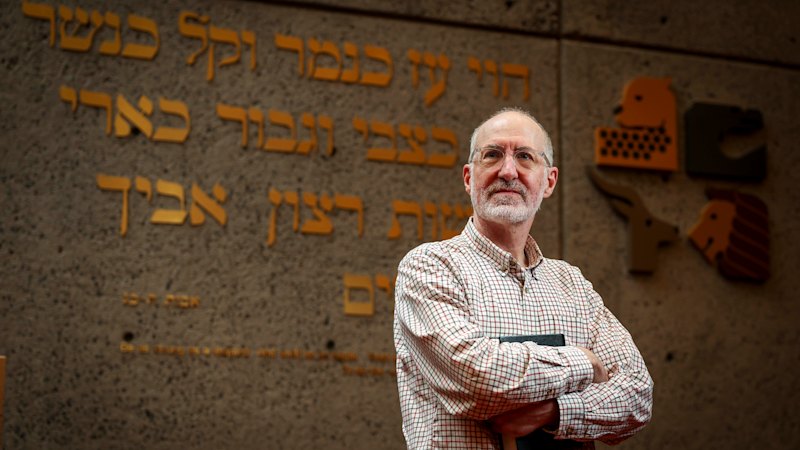
Mount Scopus runs a free outreach program in which non-Jewish students or schools visit their campus, and Jewish year 11 students deliver about an hour-long program about Judaism and the Jewish community to foster understanding and acceptance of a community that accounts for less than half a percentage point of the population, guided by Rabbi Shamir Caplan.
“It started because student leaders noticed their peers didn’t have any exposure or knowledge about the Jewish community,” said Caplan.
Since the outreach work began about 25 years ago, about 30 different schools have been involved and between 6500 and 7000 students have taken part over the past 10 years.
Jewish school members of Eastern Independent Schools Melbourne (EISM), in a statement supported by the body’s president, Brad Fry, said: “Every school’s leadership and every organising body, including the EISM, has dealt with incidents of antisemitism and racism supportively, proactively and assertively”.
Jewish Community Council of Victoria chief executive Naomi Levin said there was “significant work” being done to upskill teachers and school staff to better address antisemitism, being led by the National Education Taskforce as well as curriculum-aligned resources.
Caplan said xenophobia was an issue everyone needed to address.
“We should be trying to improve the tone in Australia in general,” he said.
“Whether it’s for Muslims, Aboriginal people and anyone who is a minority. We are a canary in the coal mine; we are an easy target, so lessons need to be learned for our and everyone’s benefit.”
Start the day with a summary of the day’s most important and interesting stories, analysis and insights. Sign up for our Morning Edition newsletter.


From our partners
Read the full article here


