



While President Donald Trump is in China for a few days, he and President Xi Jinping will have plenty to discuss. There’s trade, of course, and tariffs, and America’s military incursion into Iran and the closure of the Straight of Hormuz and the problems it has caused the Red Dragon. Oh, to be a fly on the wall.
China’s not our adversary. But it’s not just a competitor either. It’s more like a “frenemy” that’s useful to the U.S. and its interests in some ways and an impediment in others. Yes, there’s a lot for the leaders of the world’s two superpowers to discuss that’s of geopolitical and global economic importance, but Trump should not confine himself to those issues. Other things need to be raised with Xi if America is to uphold its well-deserved reputation as a champion of human freedom and democracy.
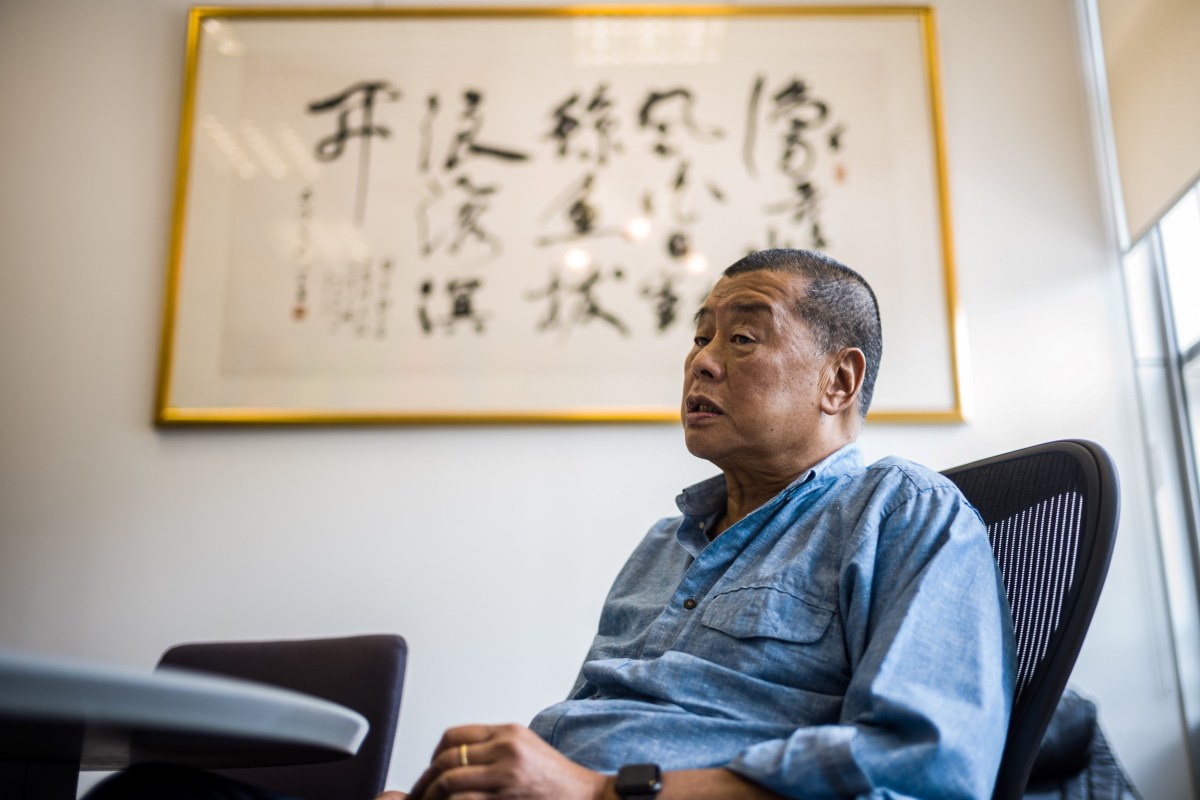
One of those discussions needs to be about Jimmy Lai.
He’s not a household name, even though he should be. He’s a defender of freedom and the rule of law and, like Nelson Mandela, of resistance to tyranny. Since 2020, he’s been held in solitary confinement in a Chinese prison, charged and then found guilty of essentially nothing more than the practice of journalism.
At 78 years of age, his 20-year sentence amounts to life in prison, unless someone like President Trump begins to pressure China to release him. As a powerful voice in opposition to Beijing’s tightened grip on Hong Kong, he is a threat and, under the sweeping national security law imposed after the takeover, that was enough.
If you haven’t heard his story, it’s because few of his editorial colleagues in the West have bothered to make him the champion of a free press he deserves to be. That is odd, given the reaction they show to any democratic leader whose actions they view as a threat to the traditions of the free press.
A refugee from the Maoist takeover of the mainland, Lai and his family arrived in Hong Kong with nothing. From there, he built a media empire that became synonymous with free expression and political dissent. His Apple Daily newspaper spoke plainly, criticized power, and gave voice to those who believed that the promises China had made before returning control of Hong Kong to Beijing would be kept.
Now, with Lai in jail and his assets being seized, he has little recourse. He cannot help himself. We, his fellow journalists, must rally the world to his cause. Which brings us to President Trump, who’s made a career, and a presidency, by projecting strength.
Trump is always willing to challenge allies and adversaries, discard old assumptions, and insist that American interests come first. Strength is not only measured in tariffs imposed or deals struck, but whether the United States is willing to stand up, plainly and without apology, for the principles it claims to embody.
If Trump goes to Beijing and does not raise Lai’s case directly with Xi, it will not go unnoticed. Not in Beijing, where silence is often interpreted as acquiescence. Not in Hong Kong, where those who still believe in freedom are watching closely. And not among America’s allies, who look to Washington not just for power, but moral clarity.
There is a tendency in some corners of the foreign policy establishment to treat human rights as a secondary concern—something to be nodded at in prepared statements but quietly set aside when the “real” negotiations begin. That is a mistake. When the United States signals its values are negotiable, it should not be surprised when adversaries act accordingly.
The argument that raising Lai’s case would somehow jeopardize cooperation with China does not survive scrutiny. High-level meetings are all about exercising leverage. Each side comes to the table with priorities, and both understand that progress in one area influences outcomes in another. To suggest that the president of the United States cannot raise the case of a peaceful dissident for fear of offending his counterpart is to misunderstand the nature of diplomacy—or to accept a diminished role for the United States.
More to the point, and whether it admits it or not, Beijing cares about its international image. Lai’s continued imprisonment complicates China’s efforts to present itself as a responsible global power. A direct appeal from the American president, particularly one made publicly or with clear intent, would not be meaningless. It would put the issue squarely where it belongs—at the center of the bilateral relationship.
There is also a broader context that cannot be ignored. The erosion of freedoms in Hong Kong is not an abstract concern. It represents the unraveling of the “one country, two systems” framework that Beijing once promised to uphold. If that promise can be discarded so easily, it raises questions about the reliability of China’s commitments elsewhere. That is not just a moral issue; it is a strategic one.
Trump, to his credit, has never been shy about speaking his mind. He has shown a willingness to break with convention and to challenge the assumptions that have guided U.S.-China policy for decades. This is an opportunity to do so in a way that aligns American power with American principle.
Securing Lai’s release will not be easy. It may not even be achievable, but that is not the point. The president must look Xi in the eye and say that the continued imprisonment of a peaceful dissident is unacceptable, and that it matters to the United States.
In the end, trips like this are about more than communiqués and photo opportunities. They are about signaling—what the United States stands for, what it is willing to defend, and what it is prepared to overlook. If Jimmy Lai’s name is absent from that conversation, the signal will be unmistakable. And not in a way that serves American interests.
President Trump should certainly go to Beijing prepared to discuss trade and security, but he should also go with a clear understanding that leadership carries obligations. Among them is the responsibility to speak on behalf of those who cannot speak freely themselves.
Jimmy Lai is one of those people. The president should act like it.
Peter Roff is a Newsweek contributing editor, experienced journalist and commentator who has contributed to various media outlets. He is a former UPI and U.S. News columnist who is now affiliated with several public policy organizations and can be followed on social media @TheRoffDraft and can be reached via RoffColumns@Gmail.com.
The views expressed in this article are the writer’s own.
Read the full article here


