



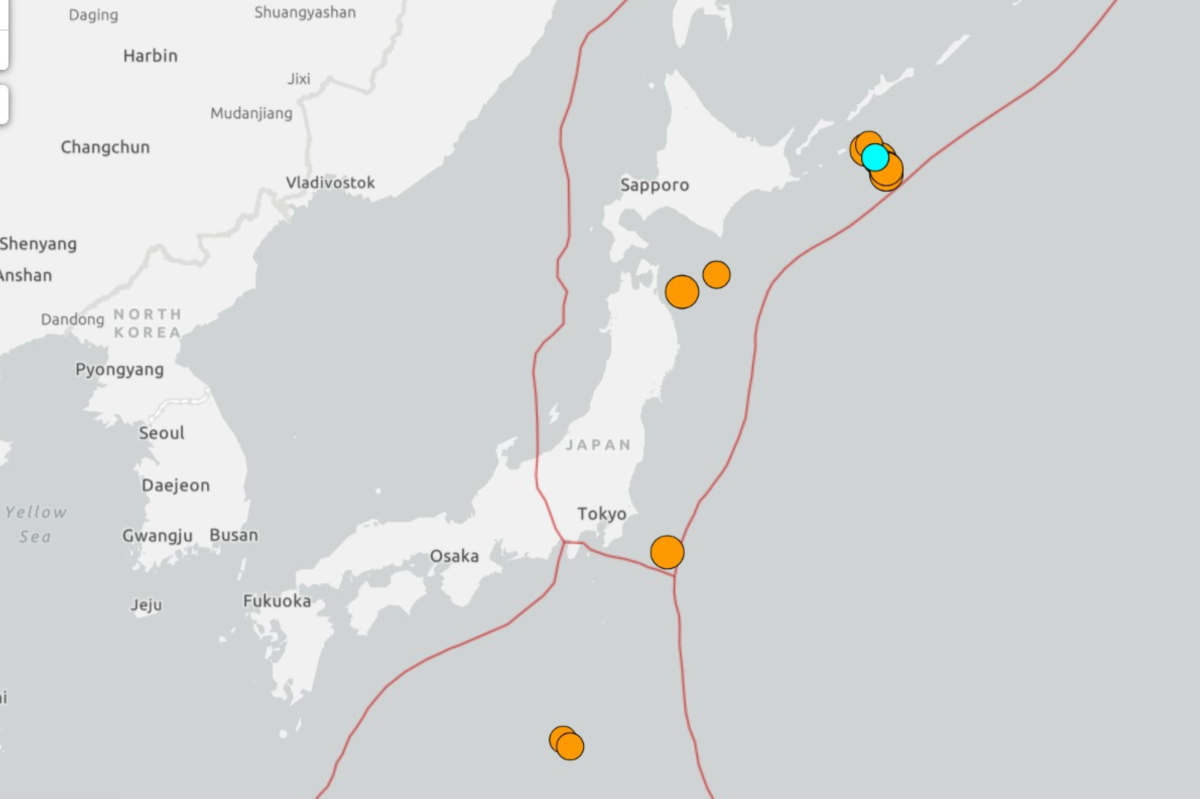
Multiple earthquakes struck southern Japan on Sunday, rattling a region already known for its persistent seismic activity.
No reports of major injuries or structural damage have emerged, and authorities have not issued a tsunami warning, according to the United States Geological Survey (USGS) and official Japanese agencies.
Just a few miles north of Nemuru, Japan, an additional eight earthquakes occurred in Russian territory, the USGS map shows.
The Context
Japan sits above multiple tectonic plates, making it one of the most seismically active regions in the world.
The southern archipelagos—especially areas near the Tokara Islands—regularly record thousands of earthquakes yearly, mostly minor, but sometimes powerful enough to cause significant disruption.
An increase in earthquake frequency or magnitude raises the risk of larger, more destructive events and can prompt temporary advisories from Japanese authorities.
Recent increases in seismic activity have led scientists and officials to warn of the possibility, albeit low, of a major “megaquake” affecting the region within the year, highlighting the ongoing importance of disaster readiness for millions living nearby.
What To Know
The earthquakes recorded on Sunday occurred over a span of several hours and hundreds of miles. Two quakes, reaching strengths of 4.1 and 4.4 in magnitude, struck near the Izu Islands within a six-hour period.
Further north, about 78 miles east of Ohara, a stronger earthquake that registered at a 5.1 magnitude struck around 2 a.m. local time. A 5.4 magnitude earthquake struck off the coast of Hachinoe late Saturday, with another one nearby measuring at a 4.3 magnitude on Sunday.
Eight other earthquakes struck further north off Shikotan, Russia, ranging in strengths from 4.7 to 5.2 magnitude.
Despite the number of earthquakes, there have been no reports of significant injuries, damage, or tsunami generation so far. Historic trends in the region suggest that earthquakes under magnitude 5 are unlikely to cause broad destruction, especially in rural island settings.
The Tokara Islands and southern Japanese archipelago have seen persistent activity for months. From June to July of this year, more than 2,000 earthquakes were recorded in the area.
Japan’s government had previously issued an unusual warning following a magnitude 7.6 earthquake on the northern coast earlier in this month, increasing the public alert for a possible “megaquake,” defined as any event above magnitude 8.
What People Are Saying
Alan Yong, USGS US-Japan Coordinator for Earthquake Studies, told Newsweek in September 17: “The archipelago of Japan is a very seismically active region. Earthquakes of magnitude 4 are common there. The M4.9 earthquakes on September 17th were located near the Ryukyu and Nankai Trenches, an area where much larger quakes can occur, such as rarer magnitude 8 quakes in 1910, 1920, 1944, and 1946.”
The International Federation of Red Cross said on its website in July: “The seismic activity has been very active around the area since the end of June and a magnitude 5.5 (in the Japanese intensity scale level 6 lower) earthquake struck near the Tokara Islands in Kagoshima Prefecture at 4:13 p.m. on 3 July 2025. So far there has been no report of casualties. About 700 people live on the 12 Tokara islands, and some of the residents have been evacuating voluntarily to the mainland.”
Fumiaki Tomita, professor at Tohoku University, told The New York Times on December 11: “The government issued the advisory because there is a ‘more likely than normal’ chance for a magnitude 8 to strike in the next week.”
What Happens Next
Authorities in Japan and international monitoring agencies will continue to observe seismic activity closely in the region.
Read the full article here


