



Published on •Updated
World leaders are gathering for the first day of the Munich Security Conference, one of the year’s most important geopolitical events, where they will focus on the future of the endangered transatlantic alliance and efforts to bring Russia’s war in Ukraine to an end.
In his opening statement, conference chairman Wolfgang Ischinger reflected on the instability of the rules-based international order – and invited delegates to applaud the participation of a large delegation from the United States, led by Secretary of State Marco Rubio, who will address the conference on Saturday.
“The transatlantic partnership needs a stronger Europe,” he said, “but Europe will stand only if European nations stand together more closely than in the past.”
He also said the conference needs to organise a “transatlantic reset – if that’s possible this weekend.”
German Chancellor Friedrich Merz described the conference as a “seismograph” for relations between Europe and the US, and the state of the world order as a whole – and said the conference’s official theme, “under destruction”, is an apt description of that order.
Last year, US Vice President J.D. Vance took Munich by storm with a speech that shocked Europeans after he suggested the real enemy for the continent’s future comes from within, not Russia, through mass migration and political correctness.
Also appearing today is President Volodymyr Zelenskyy, who is expected to press for progress on peace talks days after he said Moscow was stalling efforts to bring a halt to the conflict while continuing to attack civilian energy facilities in the depths of winter.
Our Euronews reporters are on the ground in Munich to bring you the latest updates.
Follow our live blog below:


${title}
${body}
Merz: Germany is building its military might
Merz goes on to talk about Germany’s army, the Bundeswehr, and making it “the strongest conventional army in Europe”.
He points to Germany’s permanent Bundeswehr combat brigade in Lithuania as evidence of this. The brigade will boast 4,800 soldiers by 2027 and mark Germany’s first permanent foreign deployment since World War II.
Era of ‘big power politics’ has arrived, Merz says
Merz says the world has entered a new era of “big power politics”, with major implications for his own country.
Germany’s foreign and security policy, he says, is anchored in a European perspective, one he calls “more precious than ever.”
Its policy in the past he admits, “lacked the means to solve the problem.” He insists Europe is “closing this gap now”, saying that Europe will be better prepared to face challenges ahead.
He says the most important thing is to “turn the switch in the mind now”.
“Our freedom in an era of big powers is no longer a given.”
Top US Democrats to speak this afternoon
Two of US President Donald Trump’s highest-profile domestic critics are on this afternoon’s agenda in Munich.
First up at 16:30 is California Governor Gavin Newsom, whom Trump has repeatedly clashed with over topics from wildfire aid to immigration enforcement.
And at 17:30, New York Congresswoman Alexandria Ocasio-Cortez – universally known as AOC – will join a panel, “Vox Populi? Responding to the Rise of Populism”, also featuring EPP President Manfred Weber and Czech President Petr Pavel.
Both Newsom and Ocasio-Cortez are frequently mentioned as potential presidential candidates for the 2028 election. The latter only passed the minimum 35-year age threshold for a US president in late 2024.
Merz: ‘Vacation from world history’ is over
Merz is setting the tone for the upcoming days with his warning of a growing threat to the world order.
“With the beginning of the Russian invasion of Ukraine, we have entered a new phase of world that make us hold our breath and change our world more comprehensively than we would have thought many years before,” he says. “We need to talk, this is more urgent than ever.”
“This order is flawed, the order in its heyday, no longer exists. Europe had just returned from a vacation from world history. Together we’ve entered an era that once again is marked by power and power politics.”
He points to Russia’s invasion of Ukraine again, before name-checking China as a force changing the world order. “China systematically uses dependencies of others and redefines the world in its favour.”
“The United States’ leadership has been challenged, and possibly lost.”
Merz offers stark diagnosis
Now speaking is German Chancellor Friedrich Merz, who says the conference’s official theme, “under destruction”, is an apt description of the world order.
He says that if there was a “unipolar moment” after the Cold War defined by US hegemony, it is long over – and that instead, the world faces competition between “spheres of influence”, with major powers in a “zero-sum game”.
Söder: NATO is an alliance of values
Bavarian President Markus Söder has now called on the audience to understand the true value of NATO.
“It would have been unthinkable” to consider the relationship between the US and Europe, given the certainty of that relationship over the last decades. “Could we live without it? I can say I cannot imagine a world without this transatlantic bond.”
“The Warsaw Pact was just a military alliance, but NATO is an alliance of values as well…they are important for the future, and we strive to defend these values of freedom, democracy and human rights around the globe.”
He also insists that Germany’s military contribution to the war in Afghanistan deserves due recognition from the US, pushing back on recent remarks from Donald Trump suggesting Europe played no part in it.
Ischinger: Europe will stand ‘only if European nations stand together’
The conference’s chair Wolfgang Ischinger has delivered a message on European unity, after welcoming multiple delegations to the conference.
Europe will stand if “European nations stand together, stand together more closely than in the past” he says.
“This is a time to be serious. This is not a time to mince our words. We need to be honest about our differences, but we should seek to help organise a constructive transatlantic reset, if that is possible this weekend.”
He then proceeds to give the audience some questions.
He asks Europeans: “What concrete steps are you proposing or are you prepared to take beyond delivering speeches to help create a European Union that is going to be a more respected international actor and more capable of defending our freedom, our values, and our borders?
For the US, “Does the Trump administration truly believe it needs allies and partners and, if so, is Washington prepared to treat allies as partners?”
And for China, “If China wishes to further develop and enhance her relationship with Europe, to what extent is China actually going to be willing to invest in getting Russia to end its aggression and withdraw from Ukraine?”
The Trump question
Ischinger offers up a bold question for Rubio and his delegation to answer this weekend:
“Does the Trump administration truly believe that it needs allies and partners? And if so – this is what we hope – is Washington truly prepared to treat allies as partners?”
“A stronger Europe” is vital – Ischinger
Warmly welcoming a large US delegation, Ischinger issues a warning to Europe:
“The transatlantic partnership needs a stronger Europe,” he says, “but Europe will stand only if European nations stand together more closely than in the past.”
‘Wrecking-ball politics’
The audience has just been shown a video montage of world leaders featuring the phrase “wrecking-ball politics”, used by the conference’s organisers in a report this week to describe the state of the world.
Also included was a question: “Can destruction be creative?”
And with that, Conference Chairman Wolfgang Ischinger takes the stage.
“What happened in Davos a couple of weeks ago does not have to stay in Davos,” he says – before donning a pair of Macron-esque aviators, to laughter and applause.
Formal opening session to begin
The Munich Security Conference’s opening session is shortly to begin with an address from chair Wolfgang Ischinger and Bavarian leader Markus Söder.
Pistorius shows Zelenskyy round drone facility
German Defence Minister Boris Pistorius and Ukrainian President Volodymyr Zelenskyy have paid a visit to drone producing company Quantum Frontline Industries, based near Munich.
European-made drones are proving a key part of Ukraine’s defence against Russia. The ground advantage in Ukraine is often determined by the two sides’ drone abilities, both for battlefield surveillance and targeted strikes on troops and equipment.
Russia has relied heavily on Shahed drones purchased from Iran.


Copyright: AP Photo
Flashback: Vance in Munich, 2025
When he visited the Munich Security Conference as the United States’ freshly inaugurated vice president last year, J.D. Vance delivered a speech that left many in the room and around the world open-mouthed with its condemnation of European democracies.
Railing against supposed crackdowns on free speech and tolerance of mass migration, Vance warned of “a retreat of Europe from some of its most fundamental values, values shared with the United States of America”.
The speech set the stage for a year of aggressive US diplomacy towards Europe, including a National Security Strategy released last December that warned of the continent’s “civilisational decline”.
At the 2025 Munich conference, Vance met with the co-leader of the far-right party Alternative for Germany, which several in the Trump administration have gone on to support.
Here is how then-German Chancellor Olaf Scholz reacted at the time:


Scholz: Germany won’t accept people who ‘intervene in our democracy’
German Chancellor Olaf Scholz has said his country won’t accept people who “intervene in our democracy”, a day after US Vice President JD Vance criticised Euro…
Spotted in Munich
We have some pictures coming in on the wires of leaders arriving for today’s talks. It’s cold and overcast in Munich today — stay tuned for more.

European Union foreign policy chief Kaja Kallas.

Germany’s Chancellor Friedrich Merz.

US Secretary of State Marco Rubio meets China’s Foreign Minister Wang Yi.

Denmark’s Foreign Minister Lars Lokke Rasmussen smokes a pipe.
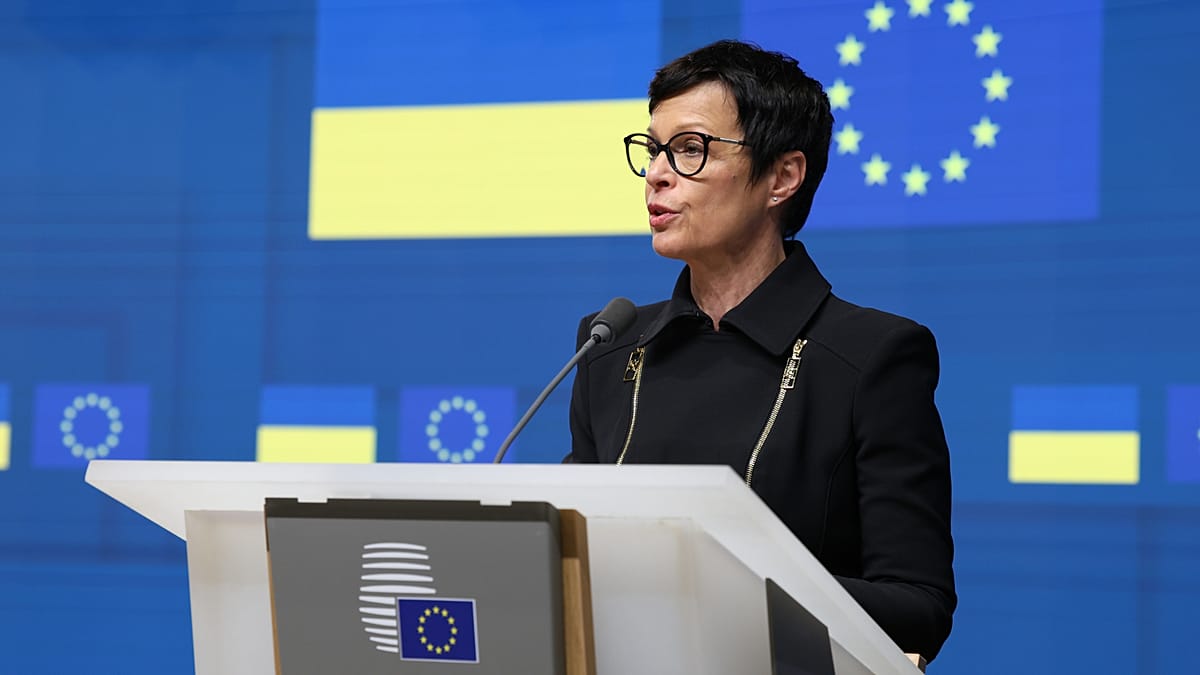
Ukraine joining the EU forces rethink of Brussels’ enlargement rules
Ukraine’s push to join the European Union in 2027 is forcing Brussels to reconsider how enlargement works.
EU officials have said that Kyiv’s stated 2027 goal is impossible under current, merit-based enlargement rules, which require full alignment with EU laws and democratic standards. At the same time, diplomats say rejecting the deadline, which is tied to a US-brokered peace deal, would be politically challenging.
How is Brussels rethinking its enlargement rules? Mared Gwyn has more.
Kyiv’s call for 2027 EU accesion forces re-think of enlargement rules
EU officials and diplomats say several “new models” for integrating candidate countries are being considered in response to Zelenskyy’s demand for a date on Uk…
Europe needs ‘a strategic and mental shift’ – Sweden’s Kristersson
Swedish Prime Minister Ulf Kristersson, who is scheduled to take part in a panel this afternoon on deterring and countering hybrid warfare, has written lengthy X post sharing his thoughts on how Europe should change to face the “great geopolitical shifts” taking place.
Europe, he wrote on X, needs to operate a “strategic and mental shift, to make sure we can do more on our own, and with other partners”. He said that the relationship with the US “has suffered a blow” but that “this does not at all mean we should abandon the transatlantic relation” (sic).
His remedy to all that?
- Europe must become more competitive by “tearing down barriers and cutting red tape on the single market” – but “‘Buy Europe’ protectionism is not the answer”
- Europe must take more responsibility for its own security through rebalancing the NATO military alliance
- Europe must continue its support for Ukraine and keep its pressure on Russia, Kristersson said, noting that although the bloc has done “more than many expected”, its “words have sometimes been stronger than our budgetary allocations”
He adds that while the EU has a broad toolbox it can draw on, one of its strengths remains its size and its deep attachment to a rules-based international order, which brings “much-needed stability and predictability to global trade”.
“We have the tools to shape our own future, promote security and stability in our neighbourhood and to project our own geopolitical interests. We can achieve this as long as we stand united and act on the main security challenges facing Europe.”
Read the full post below.
Some thoughts on the current state of affairs, from the road to Munich Security Conference. https://t.co/yGBLZiuEjn
— Ulf Kristersson (@SwedishPM) February 13, 2026
Von der Leyen talks up SAFE and €90 billion Ukraine loan
European Commission President von der Leyen has celebrated the EU’s €150 billion Security Action for Europe (SAFE) scheme at a side event organised by Germany’s ruling CDU party.
“SAFE has €100 billion allocated for joint projects to close the gaps and also to strengthen (the EU’s) own defence capability,” she said.
“A second element is important here, namely that these €100 billion, which are made available, very clearly define that 65 per cent, two-thirds of the products must come from Ukraine or Europe, and can no longer be purchased from abroad.”
She also mentioned the bloc’s collective €90 billion loan for Ukraine, which was agreed by EU countries in early February.
“This loan must only be repaid by Ukraine if Russia pays reparations. Two-thirds of this loan, i.e. €60 billion, is available for defence expenditures.”
Rutte describes “mindset shift” as leaders trickle in
NATO Secretary General Mark Rutte kicked off today’s conference by speaking of a “mindset shift” amongst European leaders.
“We had years, decades, of complaints by the US about the fact that in Europe we were not spending enough on defence. That is what we are correcting at the moment, and this makes NATO so much stronger,” he told reporters at a press conference with European Commission President Ursula von der Leyen.
“The shift in mindset is that yesterday in the room, what we felt, all of us, there was a clear coming together of vision and of unity.”
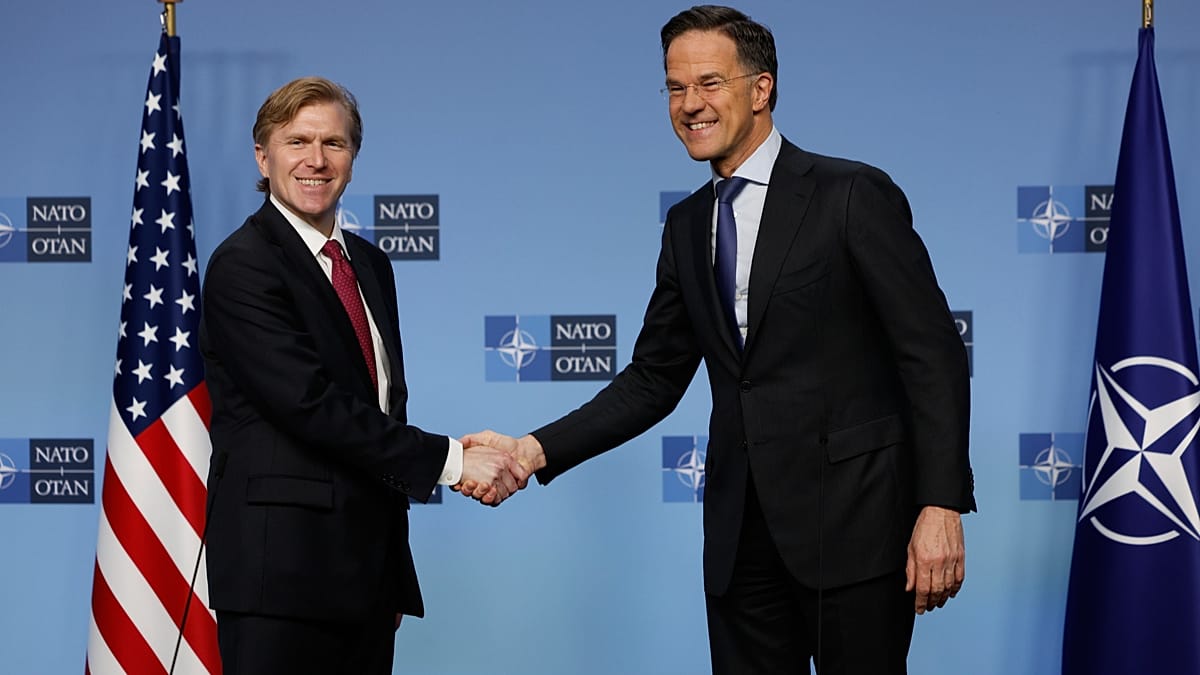
A NATO 3.0?
Transatlantic relations are a key theme at this year’s conference after a tumultuous year of White House policies that’s shaken the western alliance to its core.
At a meeting on Thursday, US and European defence ministers seemed to be in agreement that the NATO military alliance needs to become more “European” to survive, but their rationales for this shift might differ.
Our reporter Alice Tidey has more below.
‘NATO 3.0’: US & Europe appear to agree rebalancing of power is needed
Washington wants to focus more on other theatres, while Europeans are wary of the mercurial nature of the current US administration. #EuropeNews
What we know about Zelenskyy’s agenda
Ukrainian President Volodymyr Zelenskyy’s speech to the Munich Security Conference is scheduled for 12pm tomorrow.
According to my colleague Sasha Vakulina, he will today attend a Berlin format meeting with leaders of European countries, the EU, NATO, and US Secretary of State Marco Rubio, as well as holding a series of bilateral meetings with Germany’s Friedrich Merz, Denmark’s Mette Frederiksen, Finland’s Alexander Stubb, the Netherlands’ Dick Schoof, and exiled Iranian dissident Reza Pahlavi.
He will also visit the first joint Ukrainian-German drone production enterprise, Quantum Frontline Industries.
“We need more of our joint production, more of our resilience, more coordination and effectiveness of our shared security architecture in Europe,” Zelenskyy wrote on X.
“The most significant thing we can achieve together is ending the war with a dignified peace and creating reliable security guarantees for Ukraine and for all of Europe – so that no one in Europe is afraid of being left without protection.”
Today in Munich, Germany. An important day, and there will be new steps toward our shared security – that of Ukraine and Europe. On the agenda is the first joint Ukrainian-German drone production enterprise, as well as bilateral and multilateral meetings with partners.
We need… pic.twitter.com/nFLqSCSV0P
— Volodymyr Zelenskyy / Володимир Зеленський (@ZelenskyyUa) February 13, 2026
Arrivals
World leaders are starting to trickle into Munich’s iconic Bayerischer Hof hotel.
Among others, our reporters on the ground have spotted German Chancellor Friedrich Merz and Danish Prime Minister Mette Frederiksen; earlier, Germany’s Foreign Minister Johann Wadephul and Ukrainian Foreign Minister Andrii Sybiha were seen cutting a ribbon to open the “Ukraine House” — a new venue designed to showcase the conference’s commitment to supporting Ukraine.
Here are the key events we’ll monitor for you today
The three-day conference officially kicks off at 13.30 CET, but it will still be an action-packed day with some heavy-hitting speakers.
Here are the events we’ll bring you (all times CET):
- 13.30: Opening with welcome remarks by MSC chairman Ischinger, Bavaria State Premier Soeder, Chancellor Friedrich Merz
- 14.30: Session on multilateralism with EU’s Kaja Kallas, Saudi Arabia’s foreign minister, and the US ambassador to UN
- 15.30: Session on Geoeconomics with the WTO chief Okonjo-Iweala, Finnish President Alexander Stubb, Germany’ finance minister
- 15.30: Arctic Security with Norwegian Prime Minister Jonas Gahr Støre, Greenlandic Foreign Minister Vivian Motzfeldt
- 17.30: Session on hybrid warfare with the German Federal Intelligence Service president, Swedish Prime Minister Ulf Kristersson, Moldova President Maia Sandu, NATO Admiral Guiseppe Cavo Dragone
- 18.45: Session on Iran with Prince Reza Pahlavi, and European Parliament President Roberta Metsola
- 19.00: France in Europe and the world with President Macron
Good morning
Welcome to Euronews’ live coverage of the Munich Security Conference, bringing you the latest updates from three days of debate between the world’s top international security figures.
Today’s conference opens with a speech by German Chancellor Friedrich Merz, one of multiple European heads of state or government who will attend.
Among the other guests are Ukrainian President Volodymyr Zelenskyy and US Secretary of State Marco Rubio, who is bringing with him a large US delegation one year after Vice President J.D. Vance shocked European leaders with a lecture on the state of democracy in Europe.
All eyes this year will be on how Washington will show up after a year of White House policies that have strained the transatlantic relationship. Stay tuned for more.
Read the full article here


