



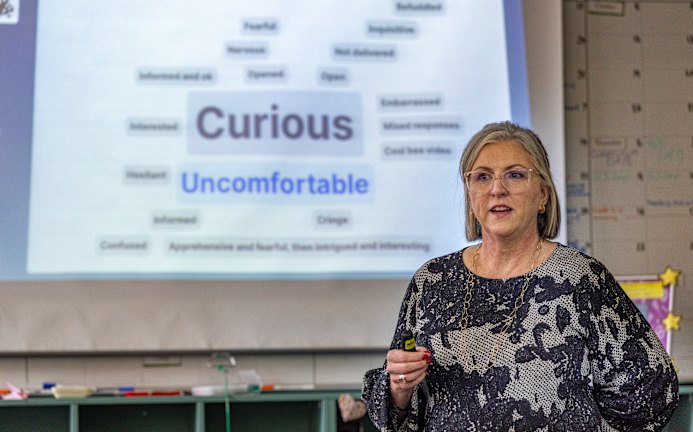
At a school in Melbourne’s inner north, Vanessa Hamilton asks 13 primary school teachers where their students are learning about sex.
From a large table in the staff room, they call out answers: social media, television, YouTube, spicy novels, older siblings.
For Hamilton, a former sexual health nurse turned sexuality educator, these answers are unsurprising.
“You’d hope they’d say parents or school, but not necessarily,” she says. “That’s not what I’m seeing.”
Having run the same professional development session at the same school previously, Hamilton says most teachers believe that once they have the right tools, delivering sex education lessons is less daunting than they had imagined and can be empowering.
Despite the introduction of national guidelines in 2015 and national mandates in 2023, La Trobe University’s Third National Study of Australian Teachers of Relationships and Sexuality Education shows that two-thirds of teachers still don’t feel equipped to deliver classes on the subject, while students say they want more practical guidance.
The survey, published on Monday, also found two-thirds of teachers (68.1 per cent) still have no formal training in providing sexual education to their students, while 60 per cent say they fear saying the wrong thing or facing negative reactions from parents.
In recent years, the scope of topics has broadened from puberty, contraception, HIV and sexually transmitted infection prevention, and protective behaviours to also include discussions on consent, respectful relationships and digital literacy, including online safety, sexting and the influence of pornography.
However, La Trobe researcher Lily Moor said young people were still reporting education often lacked the nuance or practical guidance they needed. With recent research showing condom use among sexually active Australian teenagers was at its lowest recorded level since 1992, Moor said ensuring teachers felt confident to tackle these issues was critical.
Lead researcher Professor Jennifer Power agreed, saying increasing misogynistic, homophobic and transphobic content online had heightened the scrutiny of lessons for students and parents, leaving some educators feeling uncertain about their role.
“These broader moral and political dynamics shape teachers’ comfort and confidence in delivering RSE [relationship and sexuality education], as they navigate concerns sometimes raised by parents or others in the community,” Power said.
Hamilton said in her experience, most parents were supportive, but one vocal parent could be enough to derail a program.
“I’ve had one or two cancellations due to just one parent agitating, and leadership weren’t able to stand up to those parents,” she said. “Some of these people who object can be very threatening.”
La Trobe’s survey also found about one in four educators had no training on how to respond to disclosures of sexual violence or harassment from students, and felt least comfortable discussing topics of sexual pleasure, pornography and abortion.
“If we’re putting all of this investment into keeping young people safe, we really need to make sure that schools are engaging in a way that is relevant for young people,” Moor said.
“Even if it’s not necessarily … these sort of explicit things about sex that young people are really yearning for, we still need to be making sure that we’re adequately engaging with young people about sexual safety, sexual health, sexual wellbeing, or else it does end up falling by the wayside.”
Having spent decades in the sexual education sector, Hamilton said withholding age-appropriate information from students was “unethical” and potentially neglectful.
“The evidence is so crystal clear, and our rates of abuse and gender-based sexual violence are so high, and education absolutely can help prevent that,” she said.
Among younger children, she said not providing information about topics such as menstruation until they were 12, which some parents chose to do, was “neglectful” because some children got their periods when they were as young as eight.
In Victoria, the state Department of Education has allocated $129 million to the Respectful Relationships initiative and employs 42 dedicated staff to provide professional learning and support to educators delivering the program, a government spokesperson said.
The age-appropriate teaching and learning resources had been developed by experts and were provided to teachers to freely use in class, and covered a range of topics, the spokesperson said.
“Teaching consent and pornography awareness matters more than ever, given the new risks posed by AI misuse,” the spokesperson said.
Of the 482 primary and secondary school teachers surveyed across government, Catholic and independent schools, 93.4 per cent said that when they were given enough time and adequate resources for professional development in the topic, they felt more prepared to deliver it.
The survey came with 13 recommendations, including making training compulsory and developing a national outcomes framework to ensure consistent, evidence-based delivery across schools.
It also recommended frameworks and policies to ensure the programs were being implemented properly.
Sexual Health Victoria’s head of education services, Sam Read, agreed the approach to sexuality and relationships education was fragmented and lacked national governance.
She said a whole-of-school or whole-of-community approach was vital.
“Age and stage-appropriate conversations need to happen really early on. If they have the device in their hand, or the capacity to have their device, education needs to happen beforehand,” Read said.
Hamilton agreed, saying there needed to be more oversight to ensure schools were teaching the mandated content, and delivering it effectively.
“I can tell you there are plenty of schools where this education is not happening,” Hamilton said.


From our partners
Read the full article here


