



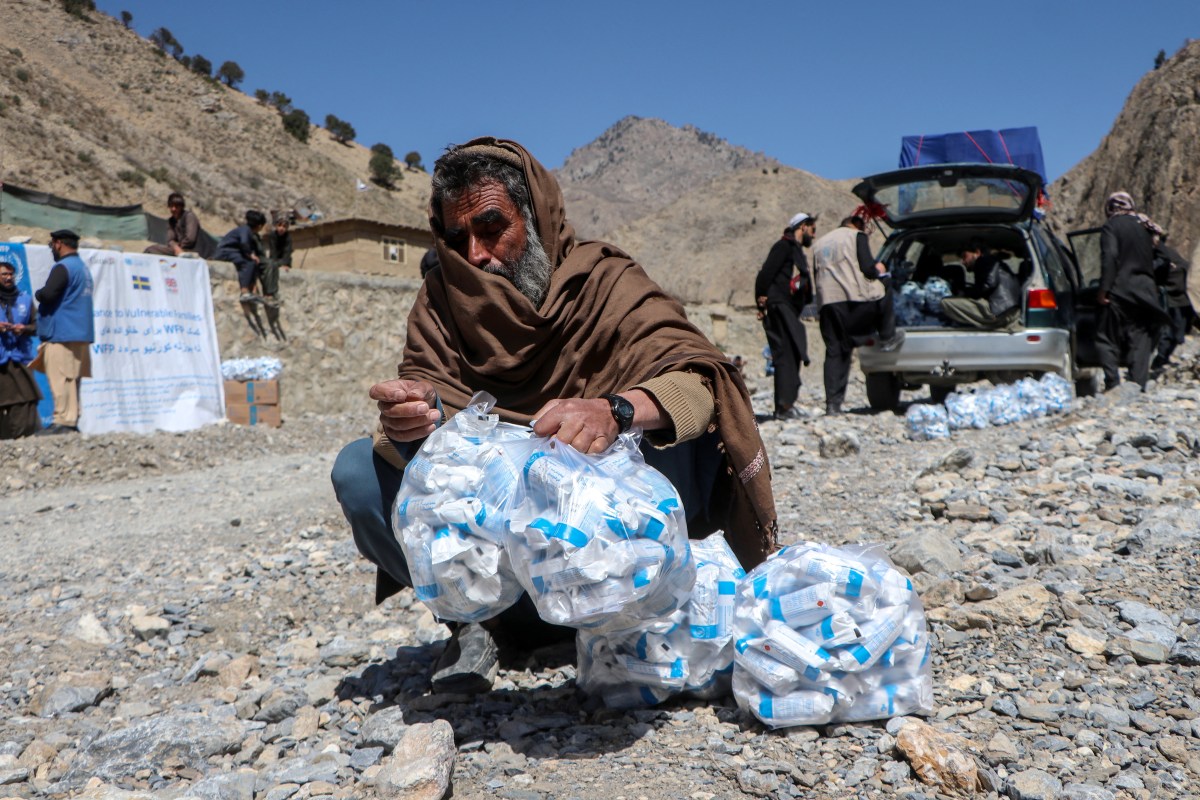
“This is our monthly ration,” a father told me, flanked by his family as he held up a three-quarters-full bucket of sorghum.
I still carry vivid memories of this visit to Kenya’s Kakuma refugee camp—especially the camp hospital’s malnourished children’s ward—and of watching life-saving products like ready-to-use therapeutic food (RUTF), agricultural commodities, and market-based assistance reach families displaced by violence in the Horn of Africa. More recently, I visited a World Food Programme distribution facility near Gaza just weeks after a ceasefire framework was signed, where the scale, complexity, and urgency of the mission were undeniable. In these travels, I have also witnessed women and girls, who often eat least and last, being affected disproportionately.
Experiences like these have shaped my understanding of what is at stake: not simply the delivery of food, but the preservation of life.
Today, hunger is rising, with almost 320 million people facing acute food insecurity. Conflict, weather, and economic instability are placing unprecedented strain on the world.
At the same time, the world produces enough food to feed every person on the planet. With knowledge at our fingertips, our expectations for transparency and effectiveness are growing. This is the challenge before us: not one of production, but of delivery, coordination, and collective will.
The United Nations World Food Programme (WFP) stands at the center of that effort. It is the only organization with the humanitarian imperative, operational reach, logistical capability, deep partnerships, and global trust required to deliver assistance in the most complex and dangerous environments. Its work represents the very best of multilateral cooperation— where nations come together to serve those most in need.
Across donor nations, taxpayers rightly expect that their contributions are used efficiently, transparently, and with measurable impact. Across recipient communities, families depend on systems that are responsive, reliable, and capable of reaching them, no matter how remote or insecure their circumstances.
These expectations are not in tension; they are aligned. A more effective, accountable system is one that ultimately serves more people, more quickly.
But meeting this moment will require immediate, strong, and decisive leadership now—the staff, the donors, the recipients, and the very cause itself deserve it.
In my work across government, global finance, and multinational healthcare, I have focused on improving institutional delivery of results at scale, streamlining operations, strengthening accountability, and ensuring that assistance reaches those who need it most. As Under Secretary at the U.S. Department of Agriculture, I rallied a team of employees across the United States and in 100 countries around the globe to streamline America’s Food for Peace, Food for Progress, and McGovern-Dole Food for Education and Child Nutrition programs to more urgently deliver humanitarian aid and build long-term resilience. In my first six months on the job, I led our team to deploy $864 million to 40 countries. For me, the goal was simple: more effective, more transparent, and better outcomes for the people who rely on us most.
No country can meet this challenge alone, nor should they. America First, in fact, has never meant America alone. Since its founding, with critical leadership from fellow South Dakotan Senator George McGovern, WFP’s fight against hunger has been a shared responsibility—one that depends on cooperation, coordination, and sustained commitment across the international system.
As the United Nations considers the next executive director of the World Food Programme, I believe this is a moment to choose leadership that is both principled and practical. Leadership that can unite member states. Leadership that can strengthen trust and deliver results at scale. And leadership that can inspire the current global staff and the next generation of humanitarians.
WFP deserves leadership that will meet this moment with urgency, credibility, and resolve, and I would be honored and humbled to serve humanity in this noble task.
No person anywhere in the world should go to bed hungry. That is not simply an aspiration; I will make sure that together we can make it a reality.
Luke J. Lindberg is an executive director candidate for the United Nations World Food Programme.
The views expressed in this article are the writers’ own.
Read the full article here


