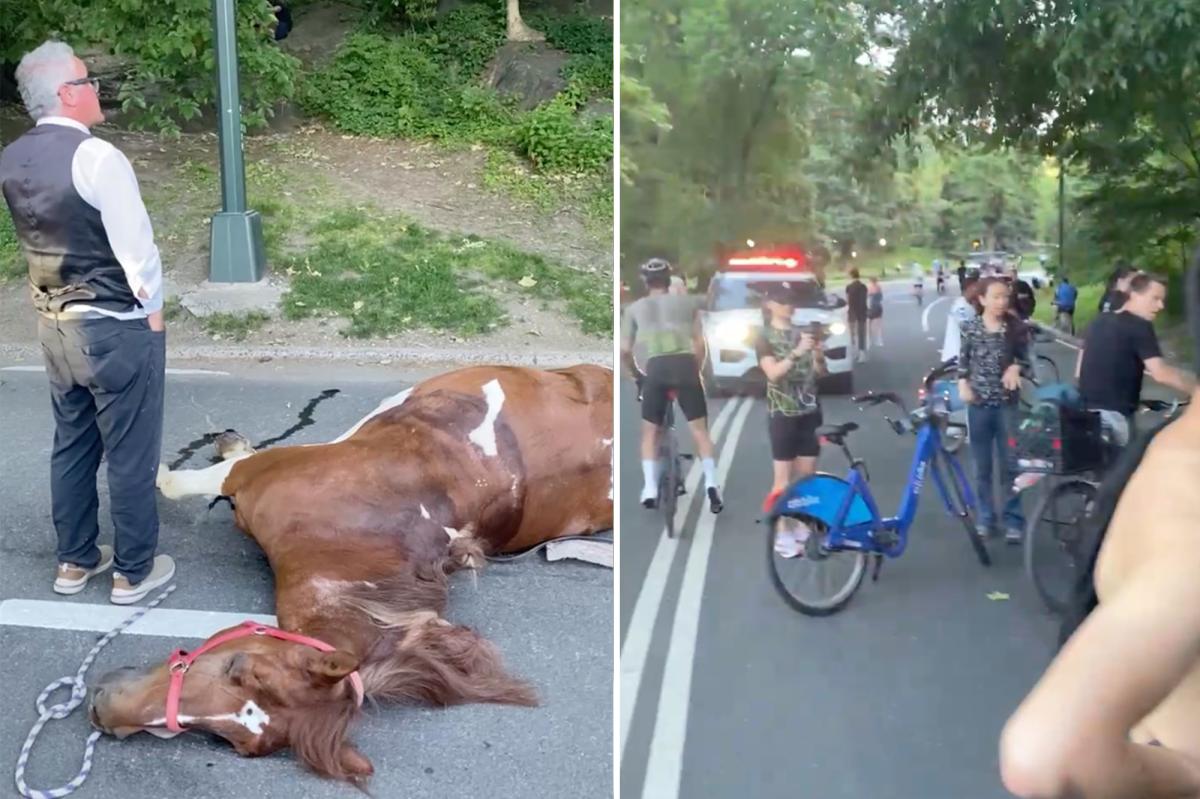
A carriage horse that collapsed and died in Central Park last week was likely poisoned after consuming a toxic plant, a report claims — sparking a vicious blame game between union leaders and park management.
The horse, Deniz, had “abundant” plant needles and components of a Japanese yew in his mouth and stomach, according to the results of a necropsy shared Tuesday by the powerful union repping carriage horses.
Deniz had “enough” Japanese yew — which is non-native to the US and particularly toxic to horses — in his stomach for it “to be lethal,” a pathologist at Cornell University’s College of Veterinary Medicine reportedly found.
Deniz collapsed at Strawberry Fields around 7:30 p.m. on June 9. The horse’s death, described by onlookers as “agonizing,” occurred shortly after the animal began thrashing on the ground.
“That horse, without a doubt, had an agonizing death right in front of everyone. People will never forget seeing that happen,” Edita Birnkrant, the Executive Director of the nonprofit New Yorkers for Clean, Livable, and Safe Streets told The Post.
The Transport Workers Union asserted that Deniz’s death wasn’t the carriage driver’s fault.
Rather, TWU Local 100 Administrative Vice President Alexander Kemp insisted in a Tuesday statement that “poor Deniz died because the people running the Park Conservancy never warned anyone that there were deadly yew plants in the park.”
“This is negligence at the highest level of the Conservancy.”
Deniz’s death has sparked a heated blame game between the TWU and Central Park Conservancy.
The Conservancy accused the TWU of “negligence” since “NYC parks rules plainly forbid horses from eating vegetation anywhere across our 843 acres.”
“The same rule requires carriage drivers and operators to attend to their horses at all times in order to keep them safe and healthy,” the statement continues.
“Perhaps if they had, Deniz would not have suffered as he did, and died,” the Conservancy added, pushing for a horse and carriage ban.
TWU International President John Samuels vehemently rejected those calls, describing the Conservancy’s response as “shameful” and blaming the organization for planting toxic shrubbery in areas heavily used by horses, including Cherry Hill Plaza.
Organizations like PETA have long claimed that horse-drawn carriages should be banned from Central Park, especially during extreme weather.
“This could have been any of the carriage horses, police horses, or recreational riding horses that use the park,” said Christina Hansen, a horse carriage driver and Local 100 shop steward.
“Who knows how many dogs spent a day in the park and later died,” Hansen continued.
“God forbid a child puts yew needles or a branch in his or her mouth. I blame the Central Park Conservancy.”
Read the full article here