



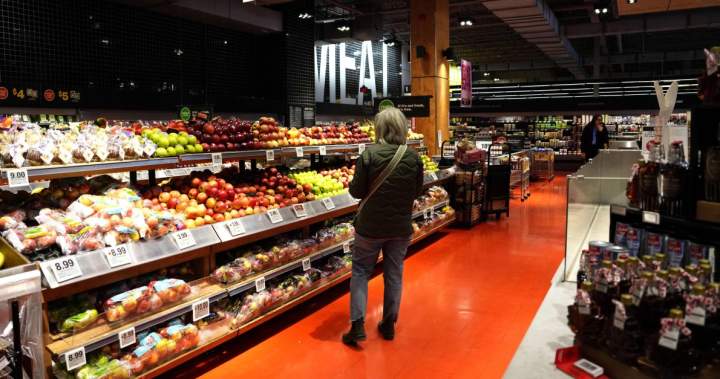
The federal government on Thursday unveiled a $3.2-billion national food security strategy aimed at lowering grocery bills by overhauling how food is grown, processed and sold in Canada.
The multi-year plan, titled “More Choice. More Control. More Canada,” seeks to reduce the country’s dependence on international imports and break the grip of a highly concentrated retail market that officials say has contributed to surging food inflation.
“A country that can’t feed itself or fuel itself or defend itself isn’t truly sovereign. It’s vulnerable to global shocks, it’s vulnerable to supply chain disruptions, vulnerable to tariffs,” Prime Minister Mark Carney said while announcing the strategy in Toronto.
“So to protect our sovereignty and truly take control of our future, we have to take control of our food system.”
A central pillar of the strategy is the creation of a so-called Food-Link Fund, which will see Ottawa provide $1 billion over 10 years to expand the Ontario Food Terminal and build new regional “food hubs” across the country.
Those hubs will then allow independent grocers and local farmers a way to bypass the “Big Five” retail chains that currently control 75 per cent of the Canadian market, according to the plan.
“We are trying to inject some competition, some alternatives,” a government official told reporters during a Thursday morning technical briefing.
“We’re really looking at the structural gaps and the pressures faced by independent grocery stores, different outlets where food can be purchased, restaurants, institutions needing to source food.”
The strategy arrives as Canadians face food prices that have risen 31 per cent since 2020, an issue that has been repeatedly highlighted by opposition Conservatives and putting pressure on the Liberal government to address affordability.
That inflation, the government says in its strategy, is similar to food inflation in other G7 countries and has been caused by domestic and global pressures, including the Russian invasion of Ukraine and the war in the Middle East, which have driven up the cost of fuel and fertilizer.
To address these vulnerabilities, the government is setting a target to increase the domestically produced share of healthy food available to Canadians from 75 per cent to 85 per cent by 2032.


Get breaking National news
Get breaking Canada news delivered to your inbox as it happens so you won’t miss a trending story.
“We are an agricultural superpower,” Carney said. “Yet for most Canadians it doesn’t feel like that at the checkout counter.
“We’re going to grow more at home, process more at home, and feed more Canadians with Canadian food.”
Conservatives and other opposition parties have noted that Canada’s food inflation outpaced the rest of the G7 early this year at 6.2 per cent, despite those countries facing the same global pressures.
Statistics Canada recently said the figure eased to 3.5 per cent in April — the second-highest rate in the G7 behind the United Kingdom.
Ottawa has sought short-term measures to address rising grocery bills, such as the one-time GST rebate top-up that began rolling out to some Canadians last week.
That credit program is set to transition next month into the higher Canada Groceries and Essentials Benefit, which was announced in January along with the development of the food security strategy.
A significant portion of the strategy’s funding — $750 million over seven years — is earmarked for “controlled environment agriculture.”
This includes supporting the expansion of greenhouses and vertical farms to grow produce year-round that Canada currently imports, such as strawberries, lettuce and various vegetables.
Currently, Canadians rely on imports for 88 per cent of fresh fruit and 72 per cent of vegetables consumed.
The plan also targets what officials described as a long-standing gap in Canada’s agri-food sector: the tendency to export raw materials only to import them back as processed goods.
For example, Canada exported $724 million worth of fresh tomatoes in 2025 while importing $511 million in processed tomato products.
To reverse this trend, the government will provide $1 billion through Farm Credit Canada for capital-intensive processing projects.
“We need more Canada,” the strategy document states. “More food that is grown here. More food that is processed here. More food on store shelves from here.”
In the retail sector, the government is strengthening the Competition Bureau with an additional $12.9 million in annual ongoing funding to better investigate anti-competitive practices like “property controls,” where major grocers use lease agreements to prevent competitors from opening nearby.
The government also aims to help small-scale livestock producers by creating temporary exemptions for inter-provincial trade of fresh meat. This will allow meat processed in provincial abattoirs to be sold across borders in regions facing slaughter capacity shortages, which is expected to lower transportation costs and increase local supply.
Government officials said Thursday they do not anticipate new federal-provincial agreements will be required to facilitate this trade.
The strategy includes several measures to support farmers directly, including:
- Increasing the Lifetime Capital Gains Exemption to $1.25 million to help with farm successions;
- Doubling guaranteed loan limits and extending terms to help young farmers enter the sector; and
- Maintaining interest-free limits on the Advance Payment Program at $250,000 for the 2026 program year.
Regulatory changes are also coming to speed up the approval of seeds, fertilizers and veterinary biologics.
The government plans to amend the Canadian Food Inspection Agency Act and the Pest Control Products Act to force regulators to consider food security and costs when making decisions, provided health and safety are not compromised.
This includes a controversial provision allowing for the temporary use of certain pesticides under specific conditions if they are deemed necessary for national food or economic security.
Read the full article here


