



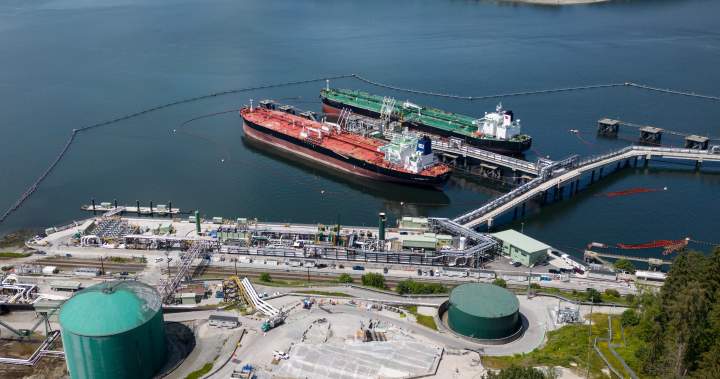
The federal government will protect and “fully” maintain a ban on oil tankers off the coast of northern British Columbia, Prime Minister Mark Carney and B.C. Premier David Eby said at a Thursday press conference.
The North Coast Tanker Ban, which went into effect in 2019, prohibits tankers from carrying more than 12,500 metric tonnes of crude oil in areas along the northern coast of British Columbia.
The future of the ban came into question after the federal government and Alberta signed a memorandum of understanding in November to lay the foundation of a new oil pipeline.


Get daily National news
Get daily Canada news delivered to your inbox so you’ll never miss the day’s top stories.
The “Canada-B.C. agreement will maintain the federal North Coast tanker ban in accordance with a proposed route of a new trans-provincial pipeline under the bilateral agreement with Canada and Alberta,” Carney said.
“We have secured a commitment to keep the northern tanker ban firmly in place, protecting British Columbia’s pristine northern coast and the $2 billion plus economy that relies on it,” Eby said.
The flagship proposal in the MOU is a bitumen pipeline from Alberta to Canada’s West Coast that would carry an additional 300,000 to 400,000 barrels per day destined for Asian markets.
Under Thursday’s agreement, B.C. will also receive new funding for “critical infrastructure, resource projects, clean energy.”
This will include $3 billion on the Fraser River Tunnel Project, “as well as commitments to the Red Chris mine expansion and the North Coast Transmission Line.”
“We will catalyze through these initiatives over $200 billion in new investment. While advancing our trade agenda across Asia,” Carney said, adding that B.C. was the “lynchpin” in Canada’s strategy to diversify its trade relationships.
The federal government will work with private sector proponents, communities and First Nations to accelerate the permitting, financing and the construction of major LNG projects in B.C., Carney said.
Read the full article here


