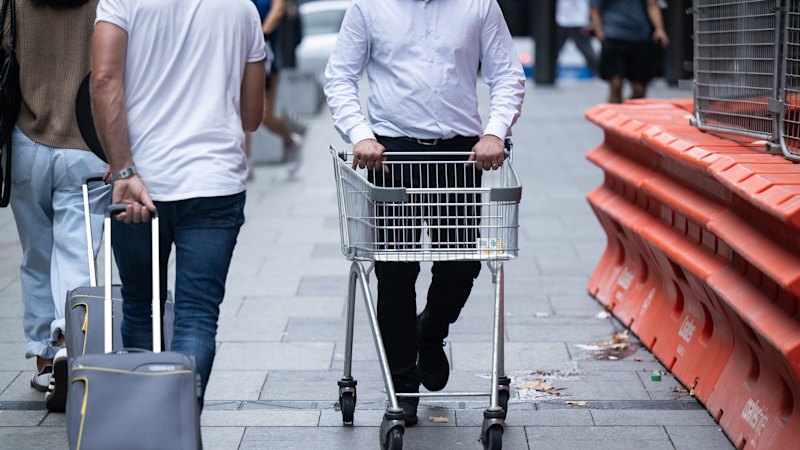
An abandoned trolley on a suburban footpath used to be a minor nuisance.
Today, it is the centre of a jurisdictional war testing the limits of local government power across Western Australia.
As thousands of carts spill out of shopping precincts each year, three major Perth councils have launched separate crackdowns – ranging from three-hour collection windows to state-level lobbying – to decide who ultimately holds the bill.
In 2024, the City of Swan implemented their updated shopping trolley local law after a trial run of a trolley collection system resulted in an average of 77 trolleys being collected every week.
“Abandoned shopping trolleys can reduce the visual appeal of public places, obstruct roads and footpaths, and even end up in local waterways. Like many local governments across WA, they are a frequent source of frustration for the Swan community,” the city’s website reads.
“The City has decided to act on this issue. Ultimately, it is hoped this approach will lead to retailers taking more responsibility for their property and being more proactive about keeping their shopping trolleys at the shops.”
Under its law, the city can impound abandoned shopping trolleys, while also charging a fee to retailers for their collection and disposal if they are not collected.
“Simply put, it allows the City to remove abandoned shopping trolleys from public places, while minimising the cost of that service to ratepayers.”
Retailers can be stung with a $100 fine for breaching the law and an additional $20 for each day or part of a day during which the offence has continued.
A repeat shopping trolley ditcher was also slapped with a $5000 fine in February after on three occasions, they were found pushing shopping trolleys loaded with various materials and abandoning both the items and trolleys on a verge.
The person was charged with several offences including littering and the abandonment of shopping trolleys in South Guildford.
After failing to appear in court, the individual was handed the fine as well as being ordered to cover the City’s legal costs of $1646.30, and clean-up costs of $2617.96, bringing the total amount imposed by the Court to $9264.26.
Swan’s local law was passed through official channels without any issues, but the City of Stirling’s recently amended law is not having the same luck.
In March, the city’s Shopping Trolley Local Law was passed by the local council but ran into a hurdle when in June, before it could be enforced, the state’s Joint Standing Committee on Delegated Legislation made a motion to disallow it.
Stirling Mayor Mark Irwin said there were 343 abandoned shopping trolleys reported within the city of in the 2026 calendar year, 57 per cent by residents and 43 per cent identified by the community safety team.
A total of 127 trolleys have been referred to retailers for recovery with no enforcement action taken as a result of the disallowance motion.
Their new law would have seen retailers required to collect their abandoned shopping trolleys within three hours of them being reported or run the risk of receiving a fine.
“We did seek some particular reform around having powers on private property, the three-hour time limit in getting shopping centres to actually pick up their shopping trolleys, and the significant uplift in the fines that they would receive if they weren’t contained,” Irwin told 9News Perth.
“Under the proposed local law [a fine could be] up to about $2,000. In reality, that will be disallowed, and that won’t be the case.”
Currently, retailers are only at risk of a $200 fine.
Irwin said he believes the Joint Standing Committee wants to disallow the law because there were elements that were “probably a bit contentious”.
“We received feedback already from the delegated powers to look at that and to take some undertakings. We’ve declined to do that,” he said.
“We believe it weakens the local law we are proposing. We’d rather seek other legislative powers to be able to contain them.”
Stirling IGA owner Richard Maio said he understood why the city wanted to ramp up its enforcement around abandoned trolleys, but it would hit smaller businesses the hardest.
“At the end of the day, they’re pushing the responsibility on us owners,” Maio said.
“That’s fine in that they’ve got a three-hour collection that you’ve got to go pick them up in the park or wherever they are, but to put three hours on us is very hard.”
He said they bought 40 to 50 new trolleys each year because they got stolen, which costs $200 per trolley, so the possibility of a $2000 fine for not picking one up when the business could be running short-staffed would be difficult to swallow.
Meanwhile, the City of Canning has leaned on the Western Australian Local Government Association to advocate the state government for legislative reforms around abandoned shopping trolleys.
Canning amended its shopping trolley local law in 2025 to ensure that whether inside or outside a shopping precinct, trolleys are the responsibility of the retailers they belong to.
Retailers have 12 to 24 hours of being notified to retrieve an abandoned trolley, depending on the location and failing to collect them could cost their owner $250, with court-imposed penalties reaching up to $5000 and $500 per day for continuing breaches
In June, the city put forward a motion at the WALGA South East Metropolitan Zone Meeting to request the organisation to escalate their advocacy for state government legislative reform.
The reforms would give councils greater capacity to regulate and manage the problem of abandoned shopping trolleys by requiring retailers to install and maintain approved containment systems such as wheel-lock technology and introduce modified penalties.
The resolution was considered by WALGA State Council at a meeting in July, where it agreed to refer it to the relevant portfolio for consideration and action.
Irwin, who is also the WALGA president, said once shopping trolleys were removed from retail premises the expectation typically shifts to local governments to manage them.
“WALGA’s position remains that the state government consults with the sector and prioritises legislative changes requiring retailers to contain shopping trolleys within shopping centre property boundaries,” he said.
“This should include enforcement measures and modified penalty mechanisms that create a realistic economic imperative for retailers to comply with containment requirements.”
A state government spokesperson said Local Government Minister Hannah Beazley was aware of the concerns raised in relation to abandoned shopping trolleys in local streets and will “request the Department of Local Government, Industry Regulation and Safety look into the matter.”
The motion to disallow the City of Stirling’s law is expected to be dealt with by parliament in October.
From our partners
Read the full article here