



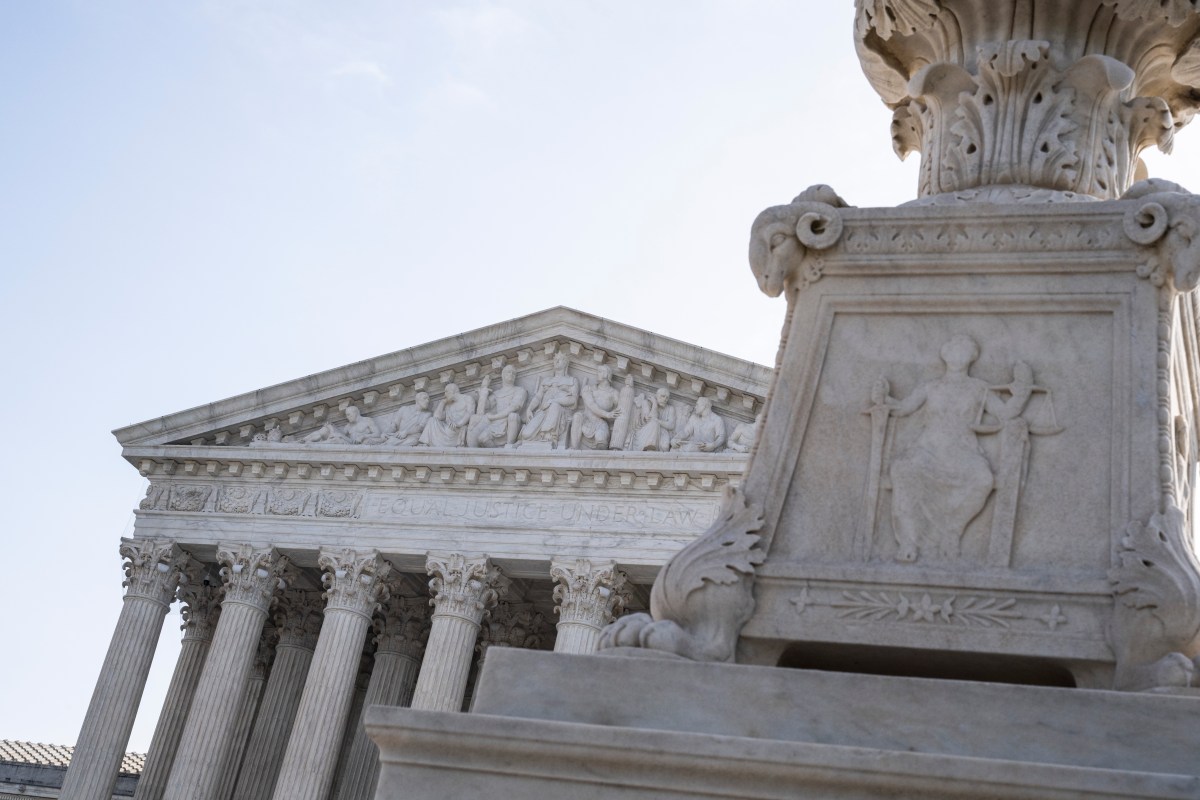
In the 78th Federalist Papers, Alexander Hamilton describes the judiciary as the “least dangerous” branch of government, holding neither the power of the purse nor the sword.
Our highest court heard only a handful of cases in its earliest years. Part-time Supreme Court justices borrowed office space in the U.S Capitol. Some nominees even declined the position due to a lack of prestige.
Today, Supreme Court justices are paid over $300,000, have personal chambers, security and office staff. Appointed for life, several current justices could remain on the bench for as many as nine presidential terms.
They also now shape nearly every aspect of American life, annually handing down rulings on as many as 80 cases for some of the most consequential issues facing our country.
Americans have seen the current court toss out decades of sound legal precedence on issues of critical importance, including reproductive freedom, affirmative action and voting rights—and almost always along ideological lines.
These decisions are being handed down as the American people watch justices engage in ethically questionable conduct. Justice Clarence Thomas accepted—and failed to disclose—luxury trips for years. Justice Samuel Alito took gifts from a hedge fund billionaire who later had cases before the court. Justice Neil Gorsuch just promoted his new book, for which he received a $250,000 advance, on Fox News. Justice Ketanji Brown Jackson has also been on the road promoting her book, for which she has been paid over $2 million.
All six of the court’s conservative justices recently hobnobbed at the White House state dinner for King Charles III, hosted by the very administration whose policies often come before them.
Unsurprisingly, the court now faces a complete crisis of confidence and legitimacy—less than half of Americans say they “trust” the court, and its 42 percent overall approval rating is near record lows, according to a recent Marquette analysis. The public is also demanding reforms.
One such reform supported by as many as 75 percent of Americans is term limits. According to poll after poll, Democrats, Independents and Republicans alike agree: this public institution in our democracy cannot continue operating with no check and no accountability.
Perhaps that is why no other major democracy in the world grants life tenure to constitutional court judges in this way.
We see the consequences of Supreme Court lifetime appointments all the time: divisive confirmation battles; presidents selecting younger nominees to cement generational influence; retirements strategically timed for political advantage; and a court increasingly disconnected from the public it serves.
That is not what the Framers envisioned, and precisely why I have introduced the ROBE (Reform of Bench Eligibility) Act, a constitutional amendment to establish 18-year term limits for Supreme Court justices.
Americans understand that regular, predictable turnover would lower the stakes of any single appointment, reduce incentives for political gamesmanship and ensure that every president appoints justices under a more consistent and fairer framework.
Some of my colleagues seek to impose term limits through a statutory fix. This is an important step of which I am also supportive.
But ordinary legislation is inherently temporary. One Congress can pass a law and another can repeal it. Moreover, a statutory change of terms would almost certainly trigger legal challenges that could ultimately land before the Supreme Court itself, where no one would be surprised if the justices overturned their own term limits.
A constitutional amendment avoids that trap by establishing a permanent and indisputable standard.
Constitutional amendments require broad consensus. That’s not a weakness—it’s the point. Reforms of this magnitude should, ideally, be thoughtful and systemic, reflecting the type of sustained public support and bipartisan agreement that we see on issues like this.
An 18-year term limit would not solve every problem overnight. But it would help rebuild public trust in a court that Americans increasingly believe has drifted too far from the democratic principles it was created to protect.
That is why this reform matters. And that is why I believe it is best done as a constitutional amendment. Let’s get it done—together.
Johnny Olszewski is a Democratic representative for Maryland’s 2nd Congressional District.
The views expressed in this article are the writer’s own.
Read the full article here


