



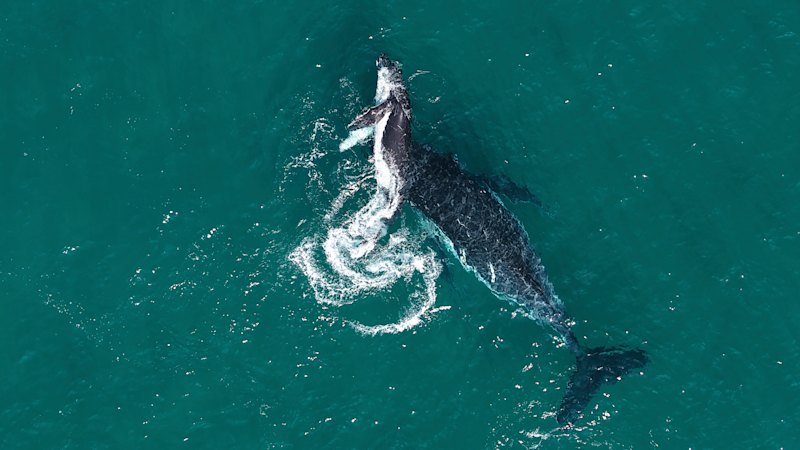
The sea was calm and the sky half-strewn with clouds on a winter’s morning at Palm Beach Reef, off the Gold Coast, when Andrew Mulville arrived by boat to check on two whales milling in the shallow water.
Members of the public had become worried that one of the humpbacks was injured or entangled, and reported their concerns to Sea World. Mulville, a whale rescue boat captain with the organisation, happened to be fishing nearby.
The whales weren’t hurt, he found, but were behaving strangely. An amniotic sack – part of a placenta – floated to the surface. Mulville dipped his GoPro underwater, and captured what researchers believe is the first detailed documentation of possible grief in a humpback whale over a stillborn calf.
Watched by a companion, the young female repeatedly dove to the bottom, lying next to the calf’s body on the sea floor. She nudged it gently with her head and touched it with her fin.
“There were what appears to be attempts at eye contact, just observing it to see whether, maybe, there was any sign of life,” said Griffith University whale scientist Dr Olaf Meynecke. “There was clearly vocalisation happening, calling between the escort and her.
“She was going and literally lying on the bottom … she was definitely spending time with the deceased calf.”
A new paper by Meynecke and Mulville about the incident, which occurred in July last year, argues the whale probably understood her calf had died, as there was no attempt to lift it to the surface to breathe.
Based on sightings from the public, Meynecke believes the whales may have remained near the calf for almost three days.
“We think it was a younger female; she wasn’t that big,” he said. “It might have been her first.”
The observation adds unique insight into rare “post-mortem attentive responses” in socially complex mammals – also called grief behaviours – which involve mothers carrying, nudging, circling and guarding their dead offspring.
The behaviours have been documented mostly in toothed whales, notably the orca known as Tahlequah, who carried the body of a calf for 17 days in 2018 and was observed doing the same with another dead calf last year.
There have been few observations of these behaviours in baleen whales such as humpbacks.
Whether these intelligent and social creatures truly mourn, or experience something we would understand as grief, is up for debate.
“Of course, from a science perspective, we can’t prove it’s grief,” Meynecke said. “It’d be so much easier if you could just ask them.”
The paper notes the behaviours could be explained by confusion, or misfired caregiving instinct.
But after years of observing humpbacks respond to other whales entangled in nets, and even protect other species from predators, Meynecke believes they must experience an “emotional state that is not necessarily comparable to ours … but there is something there that is quite strong”.
“I don’t even want to think about how horrible or traumatic it might have been for the whales that survived whaling because clearly, they would have had emotional responses,” he said.
Brain studies have discovered “spindle neurons”, which underpin social awareness and empathy, in humpbacks alongside other species that guard and touch their dead, including elephants and chimps.
“Marine mammals are closely related to us from an evolutionary perspective. If they have evolved similar responses that we have, it might explain some of our quite deeply embedded emotional connections.”
Associate Professor Rebecca Dunlop, an expert in whale behaviour from the University of Queensland who wasn’t involved in the study, said “descriptive case studies reporting the potential for animal emotions run the risk of anthropomorphising” animal behaviour.
“However, the study does present a balanced argument of how the observed behaviour could be interpreted and notes that the terms ‘grief’, ‘emotion’, ‘distress’ must be used with caution since we cannot definitively assign these terms to the observed behaviour,” she said.
“The issue is around comparing human definitions of ‘emotion’ to non-humans, since emotion is a human conscious experience, where a human subject self-reports their experienced feelings. Clearly, this is not possible for animals.”
While this study meditated on the possible deep emotional lives of whales, another paper released on Wednesday showed their close cousins can be thugs.
Scientists from the University of the Sunshine Coast have documented a bottlenose dolphin called Bubbles repeatedly harassing and chasing fish until they regurgitated their food, so Bubbles could eat it.
It’s the first detailed description of “kleptoparasitism” in a whale or dolphin – and provides another warning about viewing wild animals through a simplistic human lens.
“This perception of dolphins as the ‘good guys of the sea’ has more to do with anthropomorphism – our tendency to assign human characteristics to them – and perhaps that’s because dolphins appear to be smiling,” research co-author Dr Asia Haines said.
“Dolphins are predators and actively hunt their prey, whether it has been stolen from another species or not.”
The Examine newsletter explains and analyses science with a rigorous focus on the evidence. Sign up to get it each week.


From our partners
Read the full article here


