



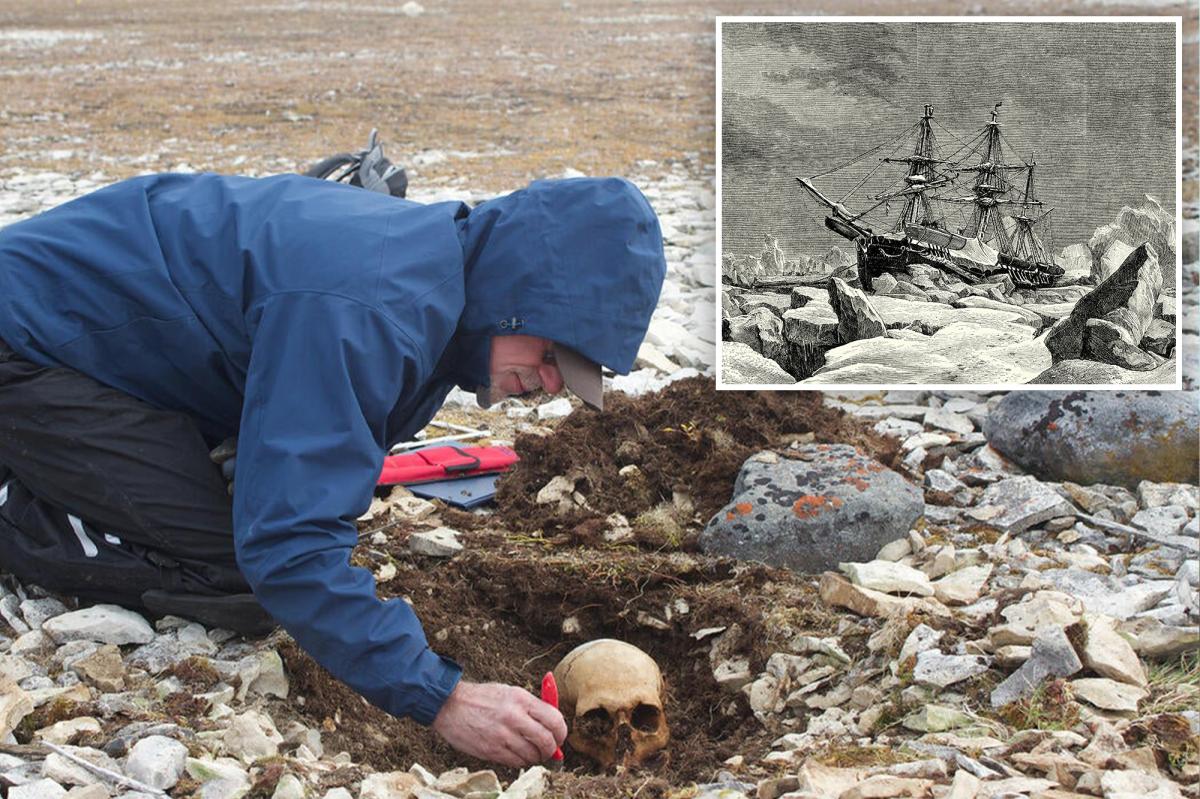
Around 180 years after Sir John Franklin’s doomed expedition to find the Northwest Passage ended in disaster, researchers have identified four additional crew members through DNA analysis.
The new research, shedding light on one of history’s most infamous Arctic tragedies, was led by researchers at the University of Waterloo in Ontario, Canada.
The identified remains include William Orren, Able Seaman; David Young, Boy 1st Class; John Bridgens, Subordinate Officers’ Steward; and Harry Peglar, Captain of the Foretop on HMS Terror.
Franklin, a British explorer, brought 129 officers and crew members aboard HMS Erebus and HMS Terror in 1845 in an attempt to chart the Northwest Passage.
The vessels became trapped in ice near King William Island in Nunavut in September 1846 — and Franklin died in 1847.
In April 1848, the surviving crew abandoned the vessels and tried escaping on foot and by dragging boats across the Arctic terrain, but no one survived.
“All 105 died trying to escape,” the University of Waterloo said in a May 6 statement. Its study was published in the Journal of Archaeological Science: Reports in May.
“Remains of expedition members have been found on King William Island and the Adelaide Peninsula since the mid-19th century,” the researchers said.
University of Waterloo anthropologists did DNA analysis of skeletal remains recovered from Franklin expedition sites, finding that the samples matched DNA donated by living descendants.
Study co-author Stephen Fratpietro of Lakehead University compared DNA from the remains with living descendants and found exact genetic matches in all four cases.
These new discoveries bring the total number of identified sailors of the Franklin expedition to six, as researchers previously identified John Gregory in 2021 and Captain James Fitzjames in 2024.
The journey to find the Northwest Passage was “dangerous for many reasons,” study co-author Douglas Stenton told Fox News Digital.
“The main threats came from the harsh Arctic environment: extreme winter cold, a short sailing season that could force the crew to overwinter, ice capable of crushing a ship, strain on the men’s physical and mental health, and the constant risk of death from illness or injury working under these conditions,” he said.
Stenton said the DNA analysis process yielded several surprises — including the identification of Captain James Fitzjames in 2024, whose remains showed evidence of cannibalism.
“Captain Fitzjames is not the only member of the expedition whose body suffered that fate, but he is the only one who has been identified,” he said.
Researchers were also amazed to find that five of the six identified sailors were discovered near two boats less than 1.25 miles apart along Erebus Bay, he said.
Researchers said Peglar’s identification was surprising because the body was dressed as a steward, leading some experts to believe the remains belonged to another man.
Stenton believes Peglar was dressed as a steward “because he had been demoted to that position due to misconduct.”
Stenton added, “A petty officer is an experienced sailor with important responsibilities. … Because of the clothing, many researchers assumed that Peglar had died and that the body was not his, but [rather] that of a friend who was a steward and who was carrying Peglar’s papers home to his family.”
However, he said, “167 years after the discovery of the body, our research has conclusively disproven that theory.”
Extracting usable DNA from the remains was challenging because genetic material naturally deteriorates over time, even in Arctic conditions, Stenton said.
To improve their chances, scientists primarily analyzed teeth. The hard enamel can better preserve DNA after years of exposure to weather and the elements.
Stenton added that the Northwest Passage was so sought-after because it was viewed as a potential trade route between the Atlantic and Pacific oceans, offering faster access to markets in Asia.
The Franklin expedition was also “the largest and arguably best-equipped Arctic expedition of its time,” he said, meaning that its success promised major prestige and pride for Britain.
Next steps include working with genealogists and descendants to identify more crew members, as well as potentially collecting additional archaeological DNA samples in the future.
Stenton said DNA research is helping scientists develop “a better understanding of the catastrophic loss of life,” while also providing some closure for families.
“Just as importantly, the research both depends on and invites the participation of descendants of the men who never returned home, which feels especially fitting,” he said.
Read the full article here


