



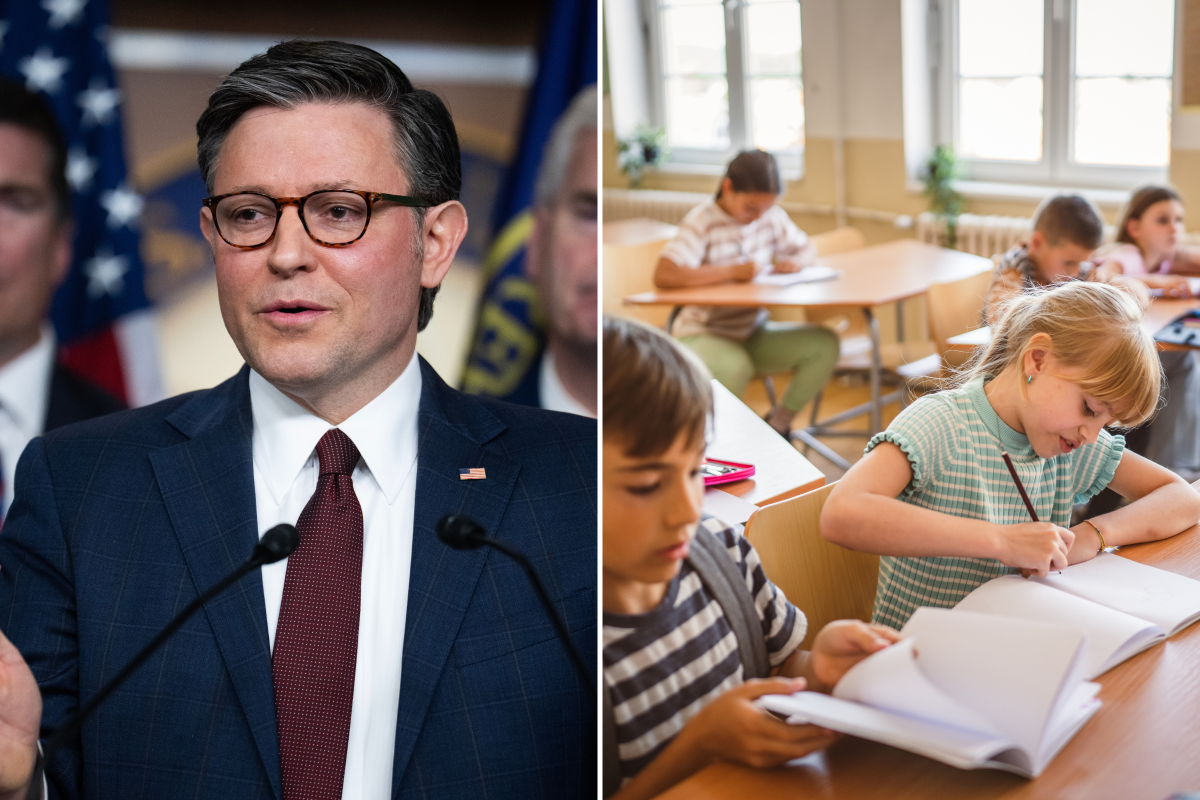
Democratic‑backed candidates flipped school board seats from conservatives in a number of red‑leaning states on Tuesday, offering what analysts say could be an early warning sign for Republicans heading into the November midterms.
Voters in Missouri, Wisconsin and Oklahoma went to the polls April 7 for local school district elections, with several high‑profile conservative‑aligned slates suffering defeats. In Missouri’s Francis Howell School District, three Democratic‑backed candidates swept school board races, removing the board’s last conservative member following a campaign centered on book bans and LGBTQ‑inclusive policies. In Tulsa, Oklahoma, a conservative incumbent lost to a Democratic‑backed challenger following controversy over anti‑immigrant and anti‑LGBTQ remarks. Similar dynamics played out in suburban Wisconsin districts, including parts of Waukesha County, long considered a Republican stronghold, according to election tracker Bolts.
These elections provide a “clear signal that the American public wants to see real, material quality of life improvements,” Jonathan Collins, co‑director of the Politics and Education Program at Columbia University, told Newsweek. “Nothing better represents America’s aspirations for tomorrow than schools.”
While school board races are formally nonpartisan, they have increasingly functioned as proxies for national political battles, with party‑aligned groups, unions and ideological organizations openly backing competing slates. That dynamic has made the contests a testing ground for broader political messaging—including whether education‑focused culture‑war issues mobilize or alienate voters in red‑leaning communities.
The emerging pattern has prompted analysts to ask whether voters are growing fatigued with education‑related culture wars, and whether those fights are beginning to cost GOP‑aligned candidates support even in red‑leaning communities.
There are several possible explanations for the recent results. Jon Valant, director of the Brown Center on Education Policy at the Brookings Institution, told Newsweek that the elections are “happening in a favorable political climate for Democrats,” which school board candidates may be benefiting from.
“As Democrats are more motivated to vote,” Valant said, there is “a lot of pushback against forces and candidates that are aligned with the Trump administration,” adding that education is “no exception.”
Valant also pointed to exhaustion with education-related culture wars, saying he thought there is now “a lot of fatigue when it comes to the culture-war issues and politics that we’ve seen in education over the last several years.”
Collins added that the outcomes may serve as “a proverbial warning that platforms built around ‘anti‑DEI’ and anti‑immigrant sentiments have a shelf life.”
Jeffrey Henig, a professor of political science and education at Columbia University, said the elections served as “omens or predictors” that may prove useful in the midterms.
Historically, Henig said, school board elections have been “largely disconnected from national and partisan politics” because the issues were “largely localized.” That has changed in recent decades as national politicians and interest groups have become increasingly involved.
“Republican strategists came to see education messaging as a way to appeal to mothers who had been turned off by Donald Trump’s style and to recapture so called ‘purple’ districts in which electoral outcomes often switch between Democrats and Republicans,” he said.
More recently, Henig said, “backlash against book bans and against efforts to ‘whitewash’ the teaching of American history has shown that local school board politics can also play to the advantage of more Democratically aligned voters.”
Even so, experts cautioned against reading too much into the results. Valant noted that school board contests tend to have very low turnout, and that most candidates’ party affiliations are not listed on ballots, making them imperfect predictors of broader electoral outcomes.
It also can be hard for voters to get “good, clear information about the candidates,” he added.
Henig echoed that warning, saying “lots can change between now and November,” and that general elections are typically driven by factors beyond education policy alone.
From a Republican perspective, however, the results are still worth watching. Brittany Martinez, a GOP strategist and executive director of the grassroots conservative group Principles First, told Newsweek that the races offer an early signal, even if an imperfect one.
“This is especially true if Democrats are consolidating support in places where they’ve struggled, which can point to broader shifts in tone and messaging heading into the midterms,” she said.
Liberal and progressive electoral success have not been limited to school board races. In Wisconsin on Tuesday, a liberal candidate flipped a seat on the state Supreme Court, replacing a conservative justice, while a Democrat also won the mayoral race in Waukesha, a traditionally Republican‑leaning suburb.
The results are far from determinative. But as education becomes increasingly nationalized—and increasingly polarized—the setbacks in Tuesday’s school board races may serve as an early warning to Republicans that the politics of backlash are no longer producing the returns they once did.
In a polarized era, the center is dismissed as bland. At Newsweek, ours is different: The Courageous Center—it’s not “both sides,” it’s sharp, challenging and alive with ideas. We follow facts, not factions. If that sounds like the kind of journalism you want to see thrive, we need you.
When you become a Newsweek Member, you support a mission to keep the center strong and vibrant. Members enjoy: Ad-free browsing, exclusive content and editor conversations. Help keep the center courageous. Join today.
Read the full article here


