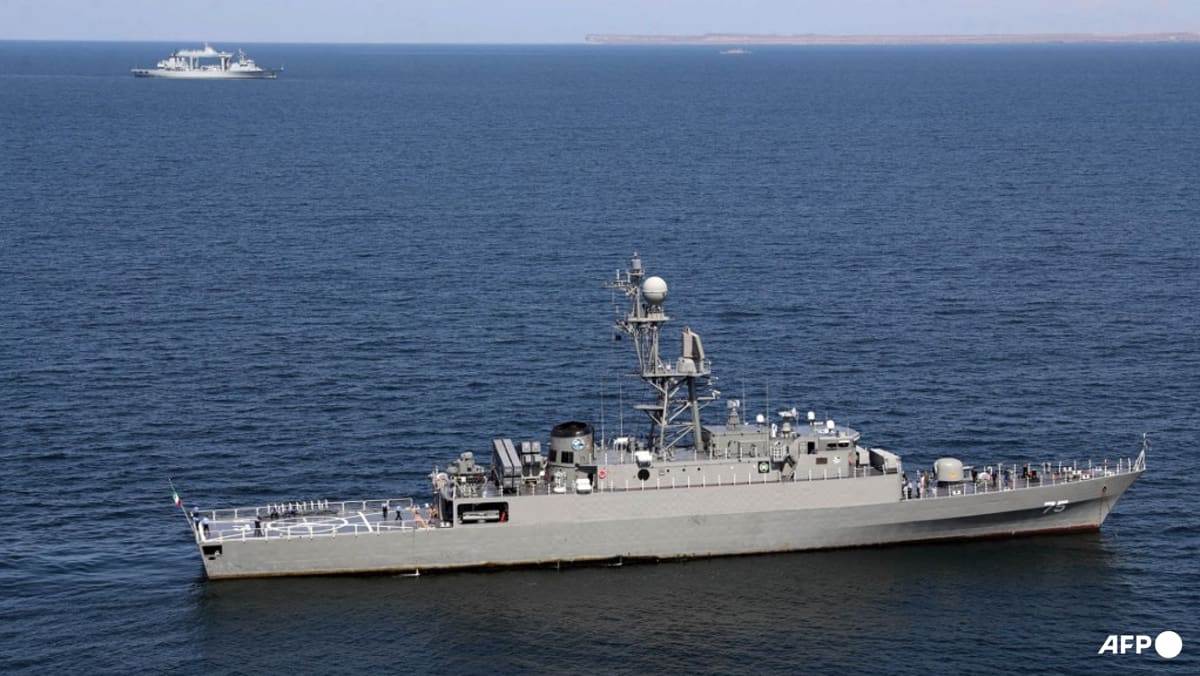
While Rahman noted that Iranian warship visits to the region were “irregular”, he said ASEAN should be concerned about the number of dark fleet tankers operating off Malaysia’s Johor state that transfer crude oil believed to originate from Iran.
“Dark fleet tankers carrying sanctioned oil could be targeted by any actor who is keen to cripple Iran’s source of income,” he said.
“If these tankers are hit, we could see environmental disasters such as oil spills, affecting the maritime resources, but also the coastal communities in Malaysia, Singapore and perhaps Indonesia.”
RSIS’ Koh said Iran generally has no credible naval power projection that could be sustained beyond the Gulf region, save for the occasional naval cruisers conducting port calls to select Southeast Asian nations such as Indonesia.
But he warned that Iran’s Islamic Revolutionary Guard Corps Navy could still muster large, converted merchant ships that might operate in distant areas well outside the immediate Middle East combat zone.
“If Washington has concrete proof that the said vessel is in fact carrying out military-related operations other than commercial or private activities, it could still constitute a lawful target,” Koh added.
What can ASEAN do?
One step ASEAN could take is to proactively issue a statement affirming it does not tolerate hostile military actions in the territorial waters or EEZs of its member states, said Rahman from Verve Research.
“Such a declaration would send a clear signal to external powers not to bring their conflicts into Southeast Asia,” he said.
Mathiew Rajoo, partner at maritime and commercial law firm DennisMathiew, argued that strikes in ASEAN states’ EEZs could be considered a grey area, highlighting that all ships have a “right of innocent passage” in an EEZ.
If a ship is suspected to be engaging in illicit activities in the EEZ, like conducting transfers while trying to mask its cargo’s origin, only the coastal state in charge of the EEZ should respond to this, he said.
If the US tries to justify a strike against a merchant ship or tanker in an EEZ by using the reason of armed conflict, Rajoo believes Washington and the coastal state will have “issues” to resolve.
“They (the coastal state) can say, ‘Why did you attack a ship that was passing through my EEZ?’ It makes (the coastal state) look weak. You’re not even defending your EEZ,” he told CNA.
Read the full article here