



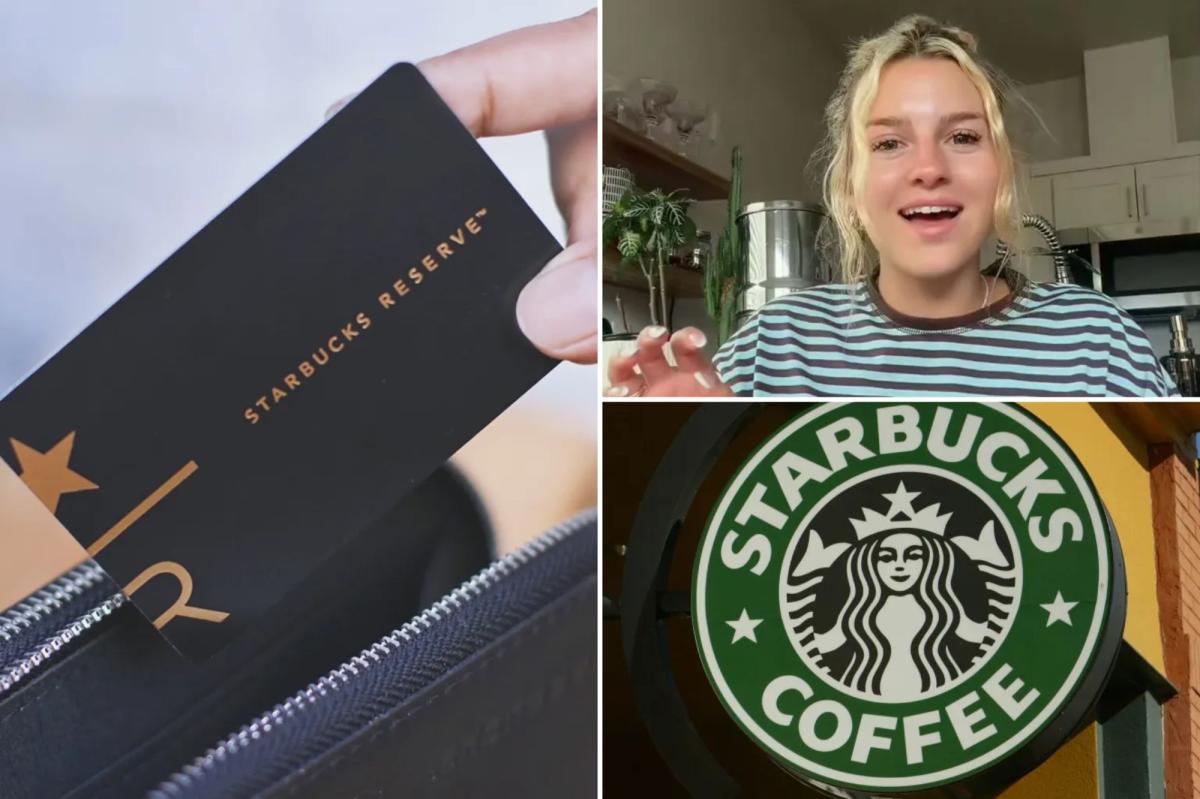
Bottoms up and dollars out if you want to reap the rewards of the new Starbucks Reserve card.
The internet is divided on whether the rewards associated with the coffee purveyors’ new personalized metal card, reserved for top-tier, big-spending Reserve members, are worth the cost of carrying it.
Is the brew worth the beans, so to speak?
The debate was ignited by a TikTok video shared by Madison Dahl that shows her opening a Starbucks mailer.
“Tell me you have a Starbucks addiction without telling me you have a Starbucks addiction,” the aesthetician said as she unsealed the package and revealed the matte-black metal card, dropping it to emphasize its heft.
“You’re joking, it has my name on it,” she said.
While Dahl was visibly hype to receive the card, @WallStreetApes reposted her clip alongside their criticism of the rewards program, which they argue amounts to an “insane scam.”
The account, which prides itself on delivering “Unfiltered Breaking News,” and counts Elon Musk and Joe Rogan as followers, alleges that the complimentary personalized gift card, which is exclusively offered to members who reach the top Reserve tier in the rewards program, requires customers to earn 2,500 Stars in a rolling 12-month period.
“You must spend an estimated $1,470 every 12 months to have this card, because every year it needs to be earned,” they said in their post.
They added that the biggest benefit of the card is that it allows members to earn 1.7 stars per dollar spent; however, they said that prior to this program, everyone earned 2 Stars for every $1 spent without having to opt in to the tiered program
“There was no status, there was no spending fifteen hundred dollars a year. Everyone just got two stars per dollar. But now you have to spend 1,500 bucks, and you get 1.7 stars per dollar. This is corporate greed, and it is ridiculous.”
As a point of reference, an average Starbucks drink clocks in at a controversial $9, a price point the company’s “out of touch” CEO says reflects the “premium experience” the chain offers customers.
In rough math, to achieve Reserve status, a customer would need to order a coffee drink from Starbucks every other day.
X commenters weighed in on the Reserve card, with some defending the loyalty program.
“Thanks for reminding me to claim my card,” said one.
Another capitalist vigilante went for the jugular of the X account itself, calling it a “whiner” that has “convinced itself that it is some warrior for economic justice.”
“Is a company prohibited from restructuring a rewards program that is corporately inhibitive? No one is forced to participate in this program, and it costs nothing additional to earn points,” they added.
“What’s the scam that they scaled back their rewards plan? Do only the huge fanatics get the top rewards? That’s how things should work,” argued another.
Others fell firmly on the side of @WallStreetApes and their condemnation of the program as an example of “corporate greed.”
“Starbucks turned inflation into a collectible,” one commenter wrote. “Elegant scamwork.”
“Basically a $1470 loyalty tax to prove you overpay for coffee,” said another.
“Starbucks: Give us more money, and in return we’ll not only give you diabetes, but you’ll get a cool new card that’s made out of metal,” surmised a third.
“These are the same people saying they can’t afford their student loan payments,” heckled a fourth.
Starbucks’ current caffeine caste system was introduced earlier this year and has three tiers: “Green”, “Gold,” and “Reserve,” with each tier giving loyalty users a different point or star value for every dollar spent.
Each dollar spent gets Green members one star, Gold members 1.2 stars, and Reserve members 1.7 stars.
The Reserve tier also includes opportunities for paid “global coffee experiences” in Tokyo, Milan, or Costa Rica.
In addition, Reserve members get at least six extra Double Star Days each year, Stars that never expire, and a 30-day window to claim birthday goodies.
Last year, the coffee chain announced the launch of its “Back to Starbucks” initiative, a company-wide strategy aimed at enhancing the customer experience through operational efficiency, modernized food and beverage offerings, and improved store design.
Starbucks has already poured roughly $500 million into ramping up staffing and store operations, putting more workers on the floor during peak hours and introducing new in-store “coach” roles to keep service running smoothly.
In April, Starbucks announced plans to dangle bonuses of up to $1,200 to get baristas moving faster and smiling more as the coffee giant battles sluggish sales.
The payouts will begin this fall, with employees earning bonuses at stores that hit “certain sales, operational and customer service targets,” the Seattle-based coffee company said.
Read the full article here


