



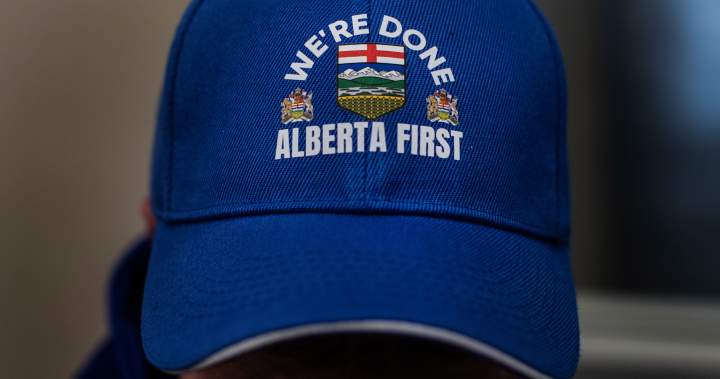
Three months remain until a petition’s deadline on Alberta separation, but a recent poll shows support for the province leaving Canada appears not to have budged much.
New polling conducted last week by the Angus Reid Institute of 979 Albertans found just 29 per cent would vote to separate from Canada. Of that group, only eight per cent — 80 people — said they would definitely vote to leave, while 21 per cent leaned that way.
Meanwhile, 57 per cent said they’d definitely vote to stay, while 81 people, or eight per cent, said they’re leaning towards staying.
The numbers aren’t much of a change from polling conducted by Ipsos as part of its Confederation Stress Test in early January.
Ipsos found that of 500 Albertans, about 29 per cent said they’d vote for their province to begin the separation process. Yet after considering potential downsides, such as standard of living declines or pension losses, just 15 to 16 per cent maintained their support.
Angus Reid also looked at what it called “common arguments” for staying or leaving Canada and asked each group of Albertans if they found them “convincing or not.”
Among those who said they’d definitely vote to stay, 555 people — 93 per cent — agreed that Alberta would struggle as a landlocked country to sell its resources globally. Eighty-eight per cent also said they agree their own financial prospects would be harmed by independence.


Get breaking National news
For news impacting Canada and around the world, sign up for breaking news alerts delivered directly to you when they happen.
Few in that same group agreed with the arguments to leave, though 28 per cent did find the argument that Alberta gives more to Canada than it gets from being a part of it convincing.
About 78 per cent of those who lean towards voting to leave say they believe their financial prospects would improve with Albertan independence. As well, 95 per cent of the 209 Albertans say they agree with the argument that the province would control its own resources.
Less than 20 per cent of that same group agree with the arguments to stay, though 16 per cent — the highest number — did find that the argument that an independent Alberta would be more economically unstable was convincing.
Opponents of Alberta separation have been vocal in recent months, with the Alberta Chambers of Commerce denouncing the prospect as bad for business and claiming it’s driving away investment.
Several First Nations in Alberta have also criticized the movement, with a trio applying for a judicial review last month of the decision by Elections Alberta to approve a petition on the province’s separation.
The petition has received support, though, with a group called Stay Free Alberta touting the crowd that showed up for a meeting on the proposal in Red Deer and other communities in recent weeks.
The group did not provide journalists with the number of people they have gotten to sign the petition in Red Deer, though they said they were confident it would get enough by the legislated deadline.
To be successful, they need to collect about 177,000 signatures by May 2, of which 10 per cent must be eligible voters from the last provincial election. The signatures then must be validated by the province’s chief electoral officer before the petition can be presented to the Alberta government.
If Albertans did vote to leave Canada, Angus Reid asked the 638 people who would vote to stay how they would respond. Seventy-three per cent said they’d move to another province or territory in Canada, while 23 per cent would stay and three per cent would leave the country altogether.
Former deputy Alberta premier Thomas Lukaszuk is trying to prevent people from having to leave, with his Forever Canadian petition aiming to make it official policy for the province to stay in Canada.
The Forever Canadian successfully approved by Elections Alberta after approximately 438,000 signatures were collected.
Angus Reid Institute polled a randomized sample of 979 Canadian adults who live in Alberta using an online survey from Feb. 2 to 6, 2026. For comparison purposes only, a probability sample of this size would carry a margin of error of +/- three percentage points. The survey was self-commissioned and paid for by Angus Reid.
Read the full article here


