



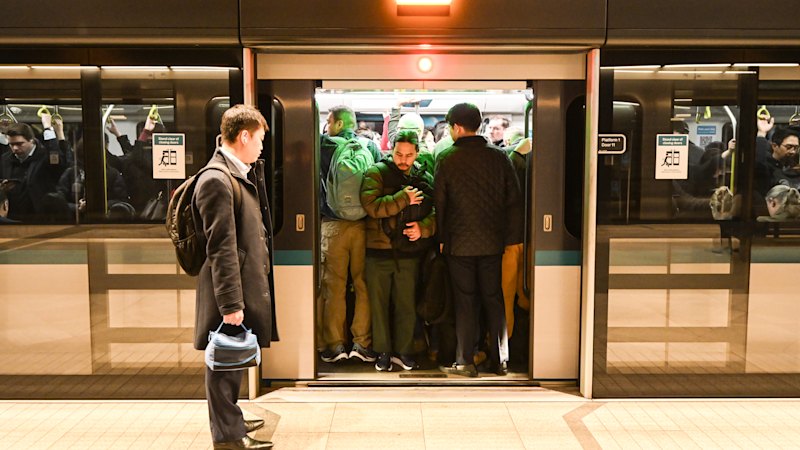
Commuters catching trains on Sydney’s $30 billion M1 metro rail line during the morning peak have surged over the past 12 months: two stations in the central city have easily exceeded forecasts made two years ago and some trains have been too packed for passengers to get on.
On the eve of the two-year anniversary of the opening of the line’s city section, new government figures show a 14 per cent rise in passengers filing through ticket gates at Martin Place metro station during the morning peak in May and June, compared to the same months a year earlier.
Martin Place station’s average patronage of 20,500 passengers on weekday mornings in May was almost a third higher than forecasts released in 2024, shortly before the section between Chatswood and Sydenham opened on August 19 of that year.
Gadigal station, near Town Hall, is also easily beating forecasts. About 10,700 commuters passed through its gates in the morning peak between 6.30 and 10 in May, up 8 per cent on the prior period, and 43 per cent higher than predictions made in 2024.
Victoria Cross station in North Sydney had a rise of more than 10 per cent during morning peaks in May and June, while Central Station’s metro platforms were up about 9 per cent, as commuters switched from heavy rail services to metro trains.
The number of commuters entering and exiting North Sydney station on a typical weekday has halved since the metro’s city-section opened two years ago and patronage for St Leonards station has fallen by a third. Both heavy rail stations are close to metro stations.
The growth in patronage on metro trains comes two months before the M1 line’s final stage between Sydenham and Bankstown is expected to open. Confidential government documents have slated a target date of mid-October, but the start of passenger services will hinge on approval by the national rail regulator.
Crows Nest resident Lucy Wang catches metro trains every weekday to travel to Martin Place for work because they are faster than double-decker services on the T1 North Shore heavy rail line.
Wang said it was always a case of squeezing into packed metro carriages or waiting for the next one if she could not get on during the morning peak. “I usually only wait for one, or squish [into a carriage],” she said. “I do wish it was less packed, but there’s really nothing you can do.”
After driving to Crows Nest to drop her daughter at day care, Norwest resident Ashley Felsman is used to being unable to get on a city-bound metro train during the morning peak. “I’m always having to wait for the next one because I can’t get on,” she said.
Trains run every four minutes in both directions on the M1 line during weekday peaks between about 7am and 10am, and from 3pm to 7pm. They operate every five minutes from 10am to 3pm, and every 10 minutes at other times.
Over the coming years, the two options for boosting passenger capacity on the M1 line are to lengthen trains from six to eight carriages, or to increase the frequency to a service every three minutes, which would require the NSW government to buy more trains.
Sydney Metro customer and planning executive director Samantha Phillips said the agency was keeping a close eye on crowding on city-bound trains departing Crows Nest, which was the “pinch point” on the network in the morning peak.
Phillips said the most likely option, if capacity was boosted, would be to increase train frequency to every three minutes. “Frequency matters. That’s what people really value,” she said.
“I want to make sure I’ve looked at all the different options before I’m saying to government or to the community we need to spend a lot more money on additional fleet. It is a big investment.”
Phillips said increased housing along the rail corridor and commuters’ willingness to give up seats on double-decker trains for a faster journey standing in metro carriages were key drivers of the patronage growth.
“I was always really a bit sceptical around people preferring to give up their seat to choose the metro, but the evidence is speaking for itself. People are choosing those faster journeys,” she said of commuters switching from heavy rail to metro services at stations such as Chatswood and Epping.
University of Technology transport researcher Mathew Hounsell said the metro line’s strong patronage growth demonstrated that modelling had underestimated passenger demand.
“It is the same all over the world – when you build an automated metro that is reliable and fast, people use it,” he said. “Buses are great for moving people around a local area but it’s trains that build a city.”
Hounsell said the government needed to improve feeder bus links to metro stations along the M1 line, especially in Sydney’s northwest. “Getting people to these stations now is the limiting factor in terms of [patronage] growth,” he said.
While Martin Place and Gadigal are easily beating expectations, Waterloo station continues to lag Sydney Metro’s patronage forecasts and Barangaroo’s figures were nearly flat year-on-year.
Phillips said Waterloo and other stations that had had slower patronage growth reflected a lag in proposed development around them.
Start the day with a summary of the day’s most important and interesting stories, analysis and insights. Sign up for our Morning Edition newsletter.


From our partners
Read the full article here


