



Apple’s release of the iPhone Air last fall generated plenty of buzz, even as sales reportedly disappointed. But beyond its appeal as a standalone device, signs suggested the Air was a stepping stone toward something bigger – and foldable.
Measuring a slim 5.6mm thick and weighing just 165 grams, the $999 iPhone Air made a striking impression from the moment I first got my hands on it at Apple Park last September. That sense of amazement continued as I made the phone my daily driver, finding it surprisingly durable while feeling almost imperceptible in my pocket or bag.
Those are attributes that would be particularly well-suited to a foldable phone – a category that has, until recently, carried a reputation for being bulky, fragile and unwieldy. More recent foldables like the Samsung Galaxy Z Fold 8 series, the Honor Magic V6 and the Motorola Razr Fold have demonstrated that sleekness and versatility can coexist. And now, it may be Apple’s turn to do the same.
“The first iPhone Air may eventually be viewed as a transitional step rather than a failed product category,” said Rishi Padhi, research principal at Gartner. “It proved that Apple could still make a thinner iPhone. It identified the minimum features consumers will not readily surrender and established a component and design pathway for a foldable iPhone.”
A foldable iPhone, which has speculatively been dubbed the iPhone Ultra, could make its debut at Apple’s Sept. 9 event in Cupertino, California. A second-generation iPhone Air could follow early next year. The company’s anticipated entry into the foldable phone market could give the entire segment a boost, with IDC forecasting global shipments to grow more than 12% this year, led by Apple’s new offering. A CNET survey found that 75% of US adults aren’t interested in a foldable iPhone, but that could quickly change once they see what Apple has to offer.
A premium trade-off
The iPhone Air supplanted the iPhone Plus, an awkward middle-ground device that offered a larger screen than the baseline model, but little else to distinguish it.
The Air, meanwhile, stood out for more obvious reasons: It was eye-catchingly thin and jaw-droppingly light, making it an enticing centerpiece of Apple’s marketing for its latest iPhone lineup. It gave people who didn’t just want the standard, baseline model or the specced-out Pro a solid middle-ground option that felt fresh and enticing.
“Consumers who want a premium iPhone had traditionally opted for the Pro, but did not always need some of the Pro features,” Padhi said. “The Air, in many ways, was Apple’s goal to address that gap in the market – an iPhone for premium end-user consumption without delving into Pro features.”

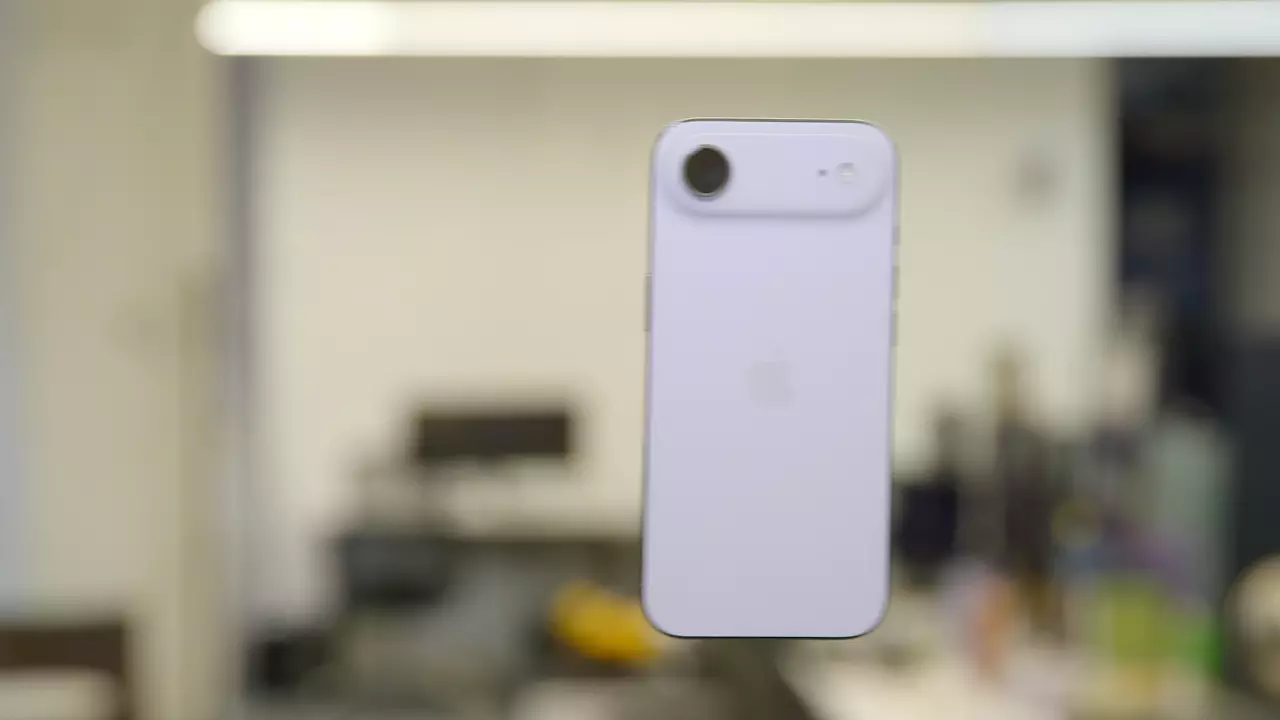
But despite its sleek build, the iPhone Air comes with some notable compromises. There’s just one rear 48-megapixel wide-angle camera, along with a single speaker at the top of the phone. Its slimmer profile leaves less room for a battery, which can mean reaching for a charger before the end of the day – and then having to make do with measly 20-watt charging. Samsung’s super-slim Galaxy S25 Edge, which debuted a few months before the iPhone Air for $1,100, also features scaled-back camera and battery specs. For many consumers, those caveats overshadowed the cool factor.
“Those trade-offs were not enough for someone to pay a premium price, just because it’s slightly thinner than a normal smartphone,” said Francisco Jeronimo, vice president of client devices at IDC. “It’s not that the normal smartphone is so thick or so heavy that consumers will have a much better value proposition with the Air or with the S25 Edge. The difference in thickness is not enough for consumers to compromise on the battery and the camera and to pay a premium just for that.”
While the iPhone Air and Galaxy S25 Edge made up a small percentage of phone sales for Apple and Samsung, the numbers indicate there was still notable interest in the fresh designs.
According to IDC, the iPhone Air sold 7.7 million units across four quarters, while the S25 Edge sold 2.3 million units over five quarters, through the second quarter of this year. That still makes up just a fraction of total phone sales for both brands: 1.8% in Q2 2026 for the iPhone Air and less than 1% during each quarter for the S25 Edge, with the exception of the first quarter of its release, during which it made up around 1.8% of Samsung’s phone sales, IDC reports.
“Very quickly, it became clear that even if both companies can deliver that kind of form factor, it doesn’t mean consumers rush to buy that kind of thinness on a smartphone,” Jeronimo said. Still, with a rumored foldable iPhone looming, it’s noteworthy that Apple could deliver a reimagined slim device to potentially set the stage.
A familiar roadmap
There’s precedent for the slim-bar-phone-to-foldable progression. Last year, following the debut of the 5.8mm-thick S25 Edge, Samsung launched the Galaxy Z Fold 7, measuring 4.2mm thick when open and 8.9mm when closed. It’s not a stretch to assume the iPhone Air and a foldable iPhone could follow a similar trajectory.
A foldable iPhone will likely improve upon the scaled-back camera and battery specs of the iPhone Air, but it still may not have to match the caliber of the Pro models.
As Samsung demonstrated with its passport-sized foldable, the Galaxy Z Fold 8 – which likely matches the rumored 4:3 aspect ratio of the foldable iPhone – most people can live without a telephoto camera, even at a sky-high $1,900 price. Similarly, during my time with the iPhone Air, the lack of an ultrawide camera felt restrictive at times, but for close-up shots, I could generally make do with sensor cropping and zoom. Sometimes, a phone’s design can be compelling enough to make you compromise on the features you think you need.
“With Apple, even when consumers are not getting the best value for money but it’s a novelty, they care less,” Jeronimo said. “For the iPhone ‘Fold,’ consumers will not compare specs; either they want the form factor or not. Either they can afford it or not. If they decide they can, the specs will be the second thing they will look into. … They will be willing to compromise on the camera because they want the foldable.”
Android phones don’t tend to have the same consumer advantage in that regard, he noted. “No other brand can carry the same love from consumers as Apple,” he said. “Even Samsung being a strong brand, consumers tend to compare specs a lot more.”
Possibilities for the iPhone Air 2
Rumors suggest Apple will split its upcoming iPhone releases, debuting the 18 Pro models and foldable iPhone in September, followed by the baseline model, lower-priced iPhone 18E and iPhone Air 2 in spring 2027.
“With the likely launch of the iPhone fold device in September, a spring release for the Air provides Apple more opportunity to let the Air have its own distinct space in marketing and promotions alongside the value-focused iPhone 18E – thus avoiding cannibalization and enabling more choice in consumers,” Padhi said.
This strategy could also alleviate supply chain pressures, especially amid the RAM crisis that’s leading to component shortages and higher prices for companies and consumers alike.
One key advantage Apple has over companies like Samsung is its greater control over the iPhone’s supply chain and manufacturing, spanning everything from the chipset to the operating system, Jeronimo notes. That way, it can more easily improve aspects like battery and camera performance on the next iPhone Air.
It’s unlikely Samsung will release a follow-up to the S25 Edge, because it occupies a more precarious position in the company’s portfolio, Jeronimo says. If someone’s willing to pay a bit more for a phone, they’re likely to opt for one of Samsung’s many foldables. A second-generation iPhone Air, on the other hand, is unlikely to cannibalize a single foldable iPhone. In fact, the Air could serve as a gateway to a foldable iPhone.
In that sense, the iPhone Air’s greatest value may be in bolstering Apple’s foldable iPhone roadmap.
“The challenge for Apple will be supplying the demand,” Jeronimo said. “We expect Apple to become one of the biggest foldable players this year, and by the end of next year to be the biggest brand in foldables, because they will do extremely well.”
In fact, IDC expects Apple will ship more than 17 million foldable iPhones by 2027, reaching nearly 40% global share by the end of next year.
That doesn’t sound like failure at all.


See full bio
Read the full article here


