



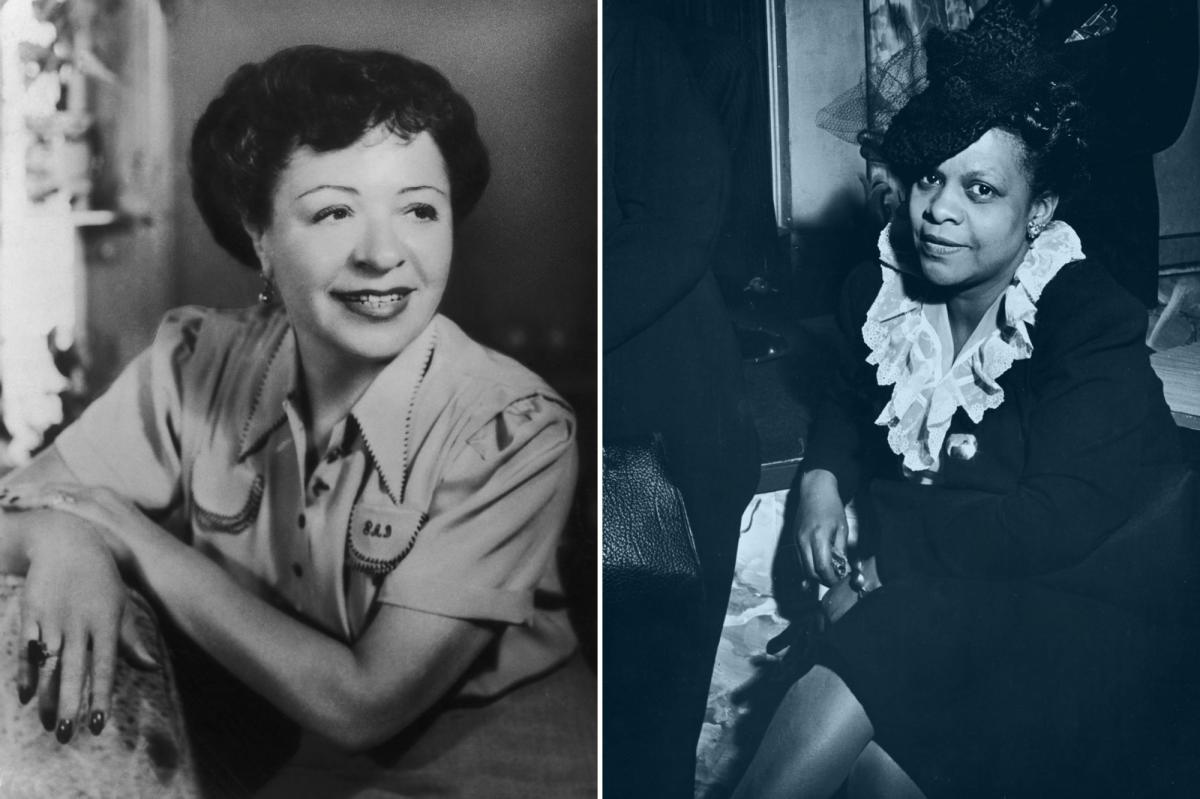
- Eunice Hunton Carter, NY’s first black female prosecutor, cracked the case that took down mob boss Charles “Lucky” Luciano.
- Carter noticed arrested prostitutes across the five boroughs shared lawyers and bail bondsmen, linking street crime to Luciano’s racket.
- A new novel, “A Pair of Aces,” finally gives Carter credit.
In the spring of 1935, Eunice Hunton Carter was given an assignment her male colleagues at the Manhattan District Attorney’s office considered beneath them.
Carter, the first black female prosecutor in the state of New York, was posted to the Women’s Court, the designated arena for prostitution cases. She was left more or less alone with the docket, prosecuting the ladies the city’s vice squad kept arresting.
What she found there turned out to be the key to taking down one of the most consequential organized crime conviction in American history, though Carter was largely cut out of the proceedings — and the history books.
A new novel, “A Pair of Aces” (Berkley, out now) by Marie Benedict and Victoria Christopher Murray, sets out to give Carter the reckoning she was denied.
The pioneering prosecutor noticed that women who were arrested for prostitution from all corners of the city kept showing up with the same lawyers and bail bondsmen. That pattern — invisible to the white men who’d considered the work unworthy of their attention — pointed to Charles “Lucky” Luciano, the most powerful gangster in New York.
He’d evaded serious prosecution for years by staying out of the crimes authorities thought to look for. Carter clocked that those lawyers and bail bondsmen were his people, evidence that what looked like scattered street-level crime was a centrally organized racket with one man at the top.
She brought the theory to special prosecutor Thomas Dewey, who was skeptical. But she pushed back, and on the night of Feb. 1, 1936, police simultaneously raided brothels across the five boroughs, arresting more than a hundred sex workers and madams in a single sweep. The trial that followed sent Luciano to prison on 61 counts of compulsory prostitution and launched Dewey’s political career.
Dewey got the monument. Carter got the footnote.
“We were astonished to discover that she’d been part of Thomas Dewey’s famous team assigned to take down the mob,” Benedict told The Post. “When we found out that she’d had the idea to craft a case using mob infiltration into prostitution, and that case brought down Lucky Luciano, we knew hers was a story we had to tell.”
Murray, who wrote Carter’s chapters in the novel, added, “We imagined what it was like for Eunice to spend hours poring over files, at first just searching for information, then seeing a few coincidences and finally coming to a realization that there was a system there.”
The authors paired Carter with another woman the history books largely ignored: Polly Adler. The most celebrated madam in New York City at the time, Adler’s brothels served everyone from Luciano and Dutch Schultz to Dorothy Parker and Robert Benchley.
The novel opens with Adler navigating a room she hadn’t been told would contain Schultz and an arsenal of tommy guns, keeping her smile fixed and her girls safe.
The real Adler was a Russian Jewish immigrant who arrived in New York at age 12 with no English and no money. She opened her first brothel in 1920, the same year Prohibition took effect, originally intending it as a temporary arrangement until she could “go legitimate.” She never quite did.
“She did what she had to to survive,” Benedict said. While she was part of an exploitative world, “she did operate on her own terms somewhat. This required moxie and a sense of justice, however unique.”
Luciano was convicted and sentenced to 30 to 50 years, though Dewey himself commuted the sentence a decade later, citing Luciano’s wartime cooperation with Naval Intelligence, and had him deported to Italy. Dewey became a three-term governor of New York and twice came close to the presidency. Adler retired to Burbank, wrote a memoir called “A House Is Not a Home” and died in 1962.
As for Carter, she was cut out of the trial she’d made possible, worked in relative obscurity for another decade and died in 1970 without ever receiving public credit for what she’d done.
The co-authors admit to inventing the relationship between Adler and Carter entirely, because “we have no evidence at all that Eunice and Polly ever met,” Murray said. “What we do know is that Eunice built a solid case against Luciano that wouldn’t have been possible without some inside help.”
Adler, for her part, always claimed publicly that she never cooperated with law enforcement. Murray sees that denial as its own kind of proof.
“She wanted to stay alive, didn’t she? And Eunice would never tell her sources. This is the beauty of historical fiction.”
Read the full article here


