



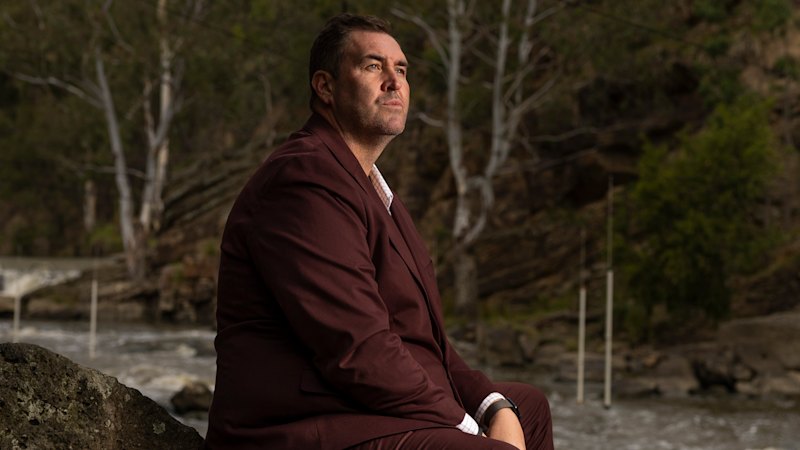
More than 840 long kilometres lie ahead as Indigenous leader Travis Lovett and thousands of determined walkers set off on Sunday to march from Melbourne to federal parliament in the cause of nationwide truth-telling about the colonisation of Australia.
More than 1100 people have already registered to follow Lovett on the first day of the trek as it wends its way from the steps of Victoria’s Parliament House through areas of significance to Aboriginal Australians around Melbourne.
One of the first stops will be at Dights Falls near the junction of the Merri Creek and the Yarra River, the site of many thousands of years of gatherings, trading and ceremonies by the Wurundjeri people of the Kulin Nation.
There, Wurundjeri elder and educator Uncle Bill Nicholson will speak to the crowd about his people’s history.
The walkers will continue to nearby Victoria Park for an evening ceremony organised by Lathan Lovett-Murray, former AFL footballer and great-grandson of pastor Sir Douglas Nicholls, who worked for decades in the interests of Aboriginal rights and recognition.
On Monday, 170 children from several schools will gather at the Aboriginal Advancement League headquarters and adjoining Sir Douglas Nicholls Sporting Complex in Thornbury, where the Mayor of Darebin, Cr Emily Dimitriadis, will host an event before the walk continues.
On Tuesday, Travis Lovett and his wife, Renata, will step out along the Hume Freeway to Wallan, a route considered too dangerous for a large group to tackle.
However, thousands more walkers are expected to attend special events and join short sections as the route wends its way past Seymour and Nagambie to Shepparton and enters NSW at Albury, continuing via Walla Walla and Henty to Wagga Wagga, and rejoining the Hume Highway near Gundagai.
The entire trek will take 29 days.
It will end at Parliament House in Canberra on May 27, the start of Reconciliation Week and the 59th anniversary of the 1967 referendum that changed the Constitution, enabling Aboriginal Australians to be counted as part of the nation’s population.
There, Lovett plans to deliver to Prime Minister Anthony Albanese a letter signed by thousands of Australians that calls for the development of “an agreed truth about our history”.
“Truth-telling is not about blame,” the letter says.
“It is about healing. It is about finally listening to those who have carried memory and hurt, culture and resistance, through invasion, frontier war, stolen children, stolen land, prisons and policies that have too often treated Aboriginal and Torres Strait Islander people as a problem to be managed rather than as sovereign peoples to be respected. Truth-telling is an act of respect and an act of national repair.”
Lovett said the purpose was not to reignite debate about the failed referendum on an Indigenous Voice to parliament.
Instead, it was simply a request that the prime minister continue to meet his pre-election promise to address the Uluru Statement from the Heart, which included a truth-telling process in partnership with Aboriginal Australia.
It is Lovett’s second marathon walk in less than a year.
He was the deputy chair of Victoria’s Yoorrook Justice Commission when he walked from Portland in Victoria’s far south-west to state parliament in Melbourne, joined on various stretches by almost 22,000 Victorians, last June.
It was part of the process that led to Victoria establishing the first treaty with Aboriginal Australians in the nation’s history.
Now the executive director of the Centre for Truth Telling at the University of Melbourne, Lovett wants to take the effort nationwide.
“We will be visiting many sites of significance to our people during this walk, including old missionary stations, places where massacres occurred, and areas of importance to the relationship between Aboriginal and white Australians,” he said.
At Gundagai, participants will honour the memory of two Wiradjuri men, known as Yarri and Jacky Jacky, who – among others of their people – rescued at least 69 white people from raging floodwaters in 1852, using traditional bark canoes.
“The walk may be literal, on the roads and tracks we travel as Walk For Truth,” Lovett said.
“It is also moral and political, choosing to hear what is hard to hear, to sit with discomfort and to stay at the table long enough for something better to be born.
“A nation that can tell the truth about itself is a nation strong enough to heal, to repair and to imagine a different future.”
Details of the trek and invitations for walkers to register and supporters to sign the open letter to the prime minister are on a Walk for Truth website.
Start the day with a summary of the day’s most important and interesting stories, analysis and insights. Sign up for our Morning Edition newsletter.


From our partners
Read the full article here


