



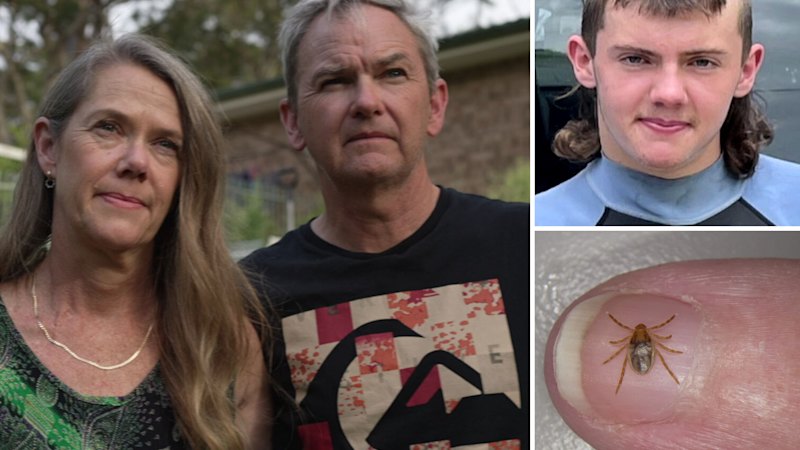
Adam Hegarty and Anne Worthington
When he was 16, Jeremy Webb went on a Central Coast camping trip with friends. They ate sausages and marshmallows. Feeling breathless and nauseous, he ran for help, but collapsed. His friends called an ambulance as they desperately tried to resuscitate him.
He died that night at Gosford Hospital. His parents were told Jeremy had a fatal attack of asthma, a condition he had suffered since a young child. But the explanation didn’t sit right. “It was just one of those things where you just don’t have a 16-year-old just drop dead,” his mother Myfanwy told 60 Minutes.
In February the NSW Deputy Coroner agreed, and concluded that Jeremy’s cause of death was not asthma but anaphylaxis due to Mammalian Meat Allergy, which is caused by ticks and triggers a reaction to red meat, pork or any other product from a mammal.
Sydney’s northern beaches and the Central Coast have become global hotspots for the disease, which Australia’s national science agency, the CSIRO, warns is on the rise and a “significant health concern”.
The link between Mammalian Meat Allergy and the Eastern Paralysis tick was discovered by immunologist and allergy physician Professor Sheryl Van Nunen in 2007, after dozens of patients on the northern beaches began presenting with life-threatening allergic reactions in the middle of the night.
Using the contents from their last meal, she did a skin test and found a reaction to mammalian meat or a derived product. She also discovered her patients had something else in common – bites from the Eastern Paralysis tick.
“So I’m thinking if the ticks are a parasite and the people have developed the meat allergy that hasn’t been happening in the last 20 years I’ve been here, then clearly there’s something new going on,” she told 60 Minutes (which is broadcast by Nine, the owner of this masthead).
Jeremy Webb was five when his family moved to their property on the Central Coast, a natural playground for a boy who loved the beach and bush. He’d spend hours in his outdoor cubby with his dog Wasp. As he got older, he built trails to ride his bike.
Myfanwy first noticed Jeremy was getting bitten by ticks from when he was about seven. By 10, he had started feeling “queasy” after eating red meat or pork. He became so sensitised that even the fumes from cooking them could make him feel unwell.
The symptoms persisted after Jeremy stopped eating red meat and pork; his eyes would be swollen and he’d often wake up through the night struggling to breathe. His parents assumed it was his asthma.
“The problem is when your kid has asthma and they wake up with nocturnal asthma, you don’t know the difference,” his father, Jonathan, said. “And that was certainly the case for us because I do remember once Jeremy woke up and we were giving him his Ventolin and he said, ‘It’s not working’.”
The Webbs had heard of Mammalian Meat Allergy or Alpha Gal Syndrome, but were not aware that it could be lethal or that symptoms could be brought on by consuming not just meat or pork, but any other product derived from a mammal such as dairy and gelatin.
Jonathan said he now thinks his son’s nighttime attacks were triggered by dairy. “Jeremy was still eating things like ice-cream, which could clearly trigger a reaction,” he said. “I suspect some of the nocturnal asthma might have been a response to eating ice-cream because he loved his ice-cream.”
It wasn’t just the Webbs who were unaware of the allergy’s potential deadly consequences.
In the years leading up to Jeremy’s death, he was admitted twice to Gosford Hospital with symptoms of anaphylaxis. On both occasions, the possibility was overlooked. Doctors said the likely culprit was his asthma and Jeremy was discharged without further investigation.
Jonathan believes the hospital admissions were missed opportunities.
“We should have gone home with an EpiPen and a letter of management that we needed to go and see an allergy specialist, but that was never done,” he said. “And unfortunately on the Central Coast, the paramedics, the doctors, the GPs didn’t know about [meat allergy]. And I want that to change.”
The allergy involves a reaction to a carbohydrate called alpha-galactose, which is found in the meat of all mammals but not in humans.
It is also found in the saliva of ticks. When the tick is disturbed while feeding, it injects its saliva, causing the immune system to make antibodies to fight the foreign presence. Van Nunen said after two tick bites, 50 per cent of people will make allergy antibodies to the alpha-gal molecule.
Van Nunen identified this antibody in blood samples taken from Jeremy Webb during his autopsy.
“The forensic pathologist had put aside some blood from Jeremy, and that was tested, and we were able to make the diagnosis,” she said.
Her evidence at the inquest into Jeremy’s death was critical. The teenager was the first documented death from MMA in Australia, but she suspects there have been more.
“I know more people have died from this. People who’ve been categorised as their mode of death being asthma where it’s actually been food allergy.”
MMA, though rare, is on the rise. A soon-to-be published report by the CSIRO for the first time documents the number of cases of the condition in Australia and maps hotspots along the east coast.
Dr Alex Gofton, the study lead, said the findings were a significant health concern. “There’s over 5000 people living with this condition,” he said. “We also found that, unfortunately, case numbers are on the rise. Since 2020, case numbers have increased 22 per cent year-on-year, which is a really concerning trend.”
Van Nunen hopes the finding into Jeremy’s death will compel governments to act. Since 2013, the federal and state government have been asked to produce “an effective campaign pitched somewhere between the Grim Reaper and Slip, Slop and Slap, warning people of the problems that tick bites can cause and teaching them how to deal with tick bites”.
The Webb family hopes the tragedy of Jeremy’s death will lead to greater awareness about MMA, among the public and medical profession alike, and a lesson on prevention. “If we’d known, my son would still be here today. I’m 100 per cent sure of that,” Jonathan said.
Start the day with a summary of the day’s most important and interesting stories, analysis and insights. Sign up for our Morning Edition newsletter.
From our partners
Read the full article here


