



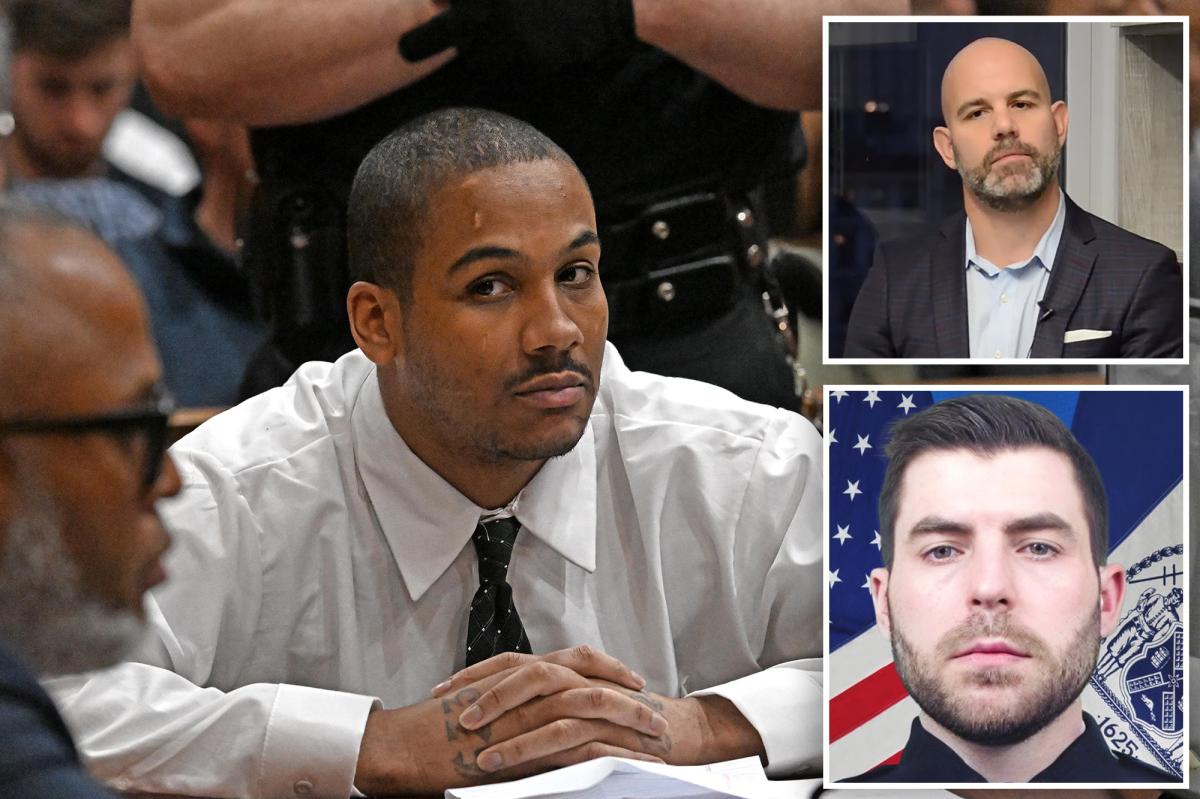
Defense lawyers told The Post on Thursday they are scratching their heads over the “odd” and extremely rare mixed verdict involving the career criminal who killed hero NYPD cop Jonathan Diller.
Cop-killer Guy Rivera was stunningly acquitted of first-degree murder Wednesday for fatally shooting the married dad and officer. He was instead convicted of the lesser charge of aggravated manslaughter in Diller’s death — and found guilty of attempted murder in the shooting of Diller’s partner, who survived the March 2024 carnage in Queens.
“In real time, in the moment, the jury found that the intent was to cause serious physical injury to officer number one [Diller], and moments later he tried to kill officer number two [the partner],” said Jeremy Saland, a defense lawyer and former prosecutor in the Manhattan District Attorney’s Office, told The Post.
“It seems like an odd verdict,” he said.
“They don’t believe the intent of the shooter was to kill Diller. It was intent to cause serious physical injury. At the same time, they find [Rivera] guilty for attempted murder. Why the difference? It’s an odd verdict,” he said.
The legal expert pointed out that even though prosecutors fell short on securing a guilty verdict on all charges, Rivera — who had 21 previous arrests — will still never “see the light of day” when sentenced April 27.
“I can’t fathom a situation that a cop killer could see a lenient sentencing from a judge where it’s not just one person who he caused the death of, but a jury found he intentionally tried to kill another officer,” Saland said.
“Juries are never predictable. Is this perfect justice? Probably not in the eyes of God or the families,” the lawyer said.
“But it’s some version of it, and there will be significant accountability for Rivera because state prison ain’t no fun place to be, whether it’s for 25 years or multiples of that.”
Top city defense lawyer Ron Kuby echoed Saland’s assurance that even with the acquittal on the most serious charge, Rivera’s conviction on the other charges would still effectively amount to a life sentence for Rivera.
Kuby also provided additional insight into the jury’s possible thinking.
“He was convicted of aggravated manslaughter, which carries 25 years [behind bars]. He was convicted of attempted first-degree murder which carries 25-to-life. The sentences will almost certainly run consecutively, and he’ll get a few more years for the gun,” Kuby said of Rivera, 36.
“So he will probably be eligible for parole for the first time when he’s 90 years old.”
Rivera was a passenger in a parked Kia Soul in Far Rockaway on March 25, 2024, as Diller and his partner, Sgt. Sasha Rosen, were investigating the suspicious vehicle.
The career criminal shot Diller and had a gun pointed at Rosen’s chest when another officer at the scene shot and wounded the thug, as seen in a heart-stopping caught-on-camera confrontation.
Rivera’s lawyer suggested at trial that surveillance camera footage showed his client didn’t have eyes on Diller when he shot him. He claimed Rosen reached into the car before the gun initially fired to grab Rivera’s firearm and argued that the ensuing struggle caused the gun to accidentally discharge at Diller.
The defense lawyer said Rivera could see the guns of other officers aimed at him — and knew he’d be a dead fool if he fired at a cop under those circumstances.
Ruby said of Rosen’s shooting, “[Rivera] was lawfully stopped, he was lawfully ordered out of the car, Officer Rosen was lawfully struggling with him over the gun, and the jury verdict shows that [Rivera] intentionally fired the shot.
“But under the circumstances the jury could not conclude that he intended to kill Officer Diller.
“They could conclude he intended to cause serious physical injury, and that was a function of how the scuffle played out,” Kuby said.
He said that although he couldn’t think of a similar verdict in a case involving cop-killers, prosecutors in such cases often bring charges they are certain they can make stick, rather than “over-charge like they did here” with the support of police, who will then inevitably blame the jurors if things don’t go their way.
“Given the murkiness of that — not what you want the evidence to be but what the evidence actually was — the top sustainable charge was the one for which he was convicted – aggravated manslaughter in the first degree,” Kuby said of Diller’s case.
Read the full article here


