



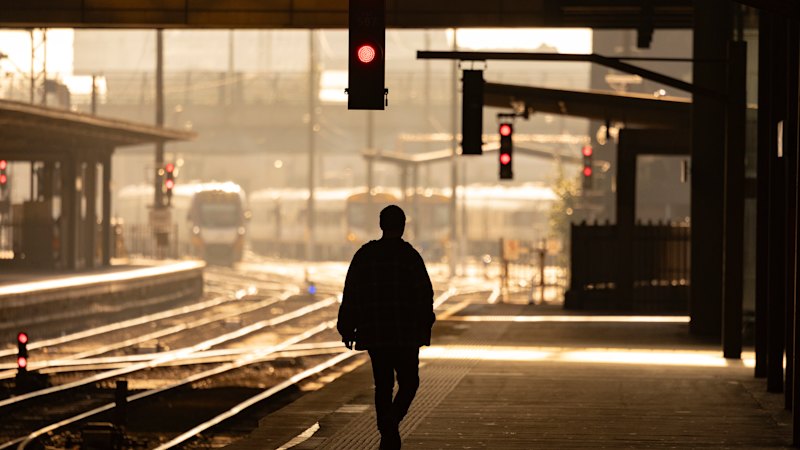
Regional train passengers will be left stranded without transport for a second day, after yet another major telco outage sparked nationwide chaos, resulting in dropped Triple Zero calls and downed infrastructure across the country.
Police were conducting welfare checks on Wednesday afternoon on 32 people in Victoria who had called Triple Zero but couldn’t get through during Telstra’s nationwide outage.
As of 4.30pm, police had checked on 20 of the callers and found no major issues, a spokesman said.
Wednesday’s outage ground trains to a halt on Victoria’s regional rail network, ultimately disrupting up to 10,000 passengers during school holidays after V/Line’s radio system, which relies on Telstra’s network, went down after 6am.
V/Line did not have enough buses to replace the more than 300 cancelled services, and it was further hampered by being unable to contact bus companies during the outage.
Speaking to reporters at lunchtime, V/Line chief executive William Tieppo said the operator was hoping to restore service by the afternoon peak, but by 5.05pm, V/Line advised passengers service would not be restored into tomorrow morning.
“Services continue to be impacted following the national Telstra outage,” the message read. “This includes all services tonight and tomorrow morning. Passengers are advised to defer travel where possible.”
Those passengers attempting to travel from Southern Cross on Wednesday evening were told there were not enough replacement buses and they would be on their own.
“We’re suggesting all customers make their own way home,” an announcement on a loudspeaker said. “It’s recommended you make your own way home with your own transport.”
Customers were told there would be a two- to three-hour wait for a replacement bus.
The rail operator has since announced customers who were delayed by at least 60 minutes can apply for compensation.
At his noon media conference, Tieppo explained the V/Line radio system pinpointed trains on the network and reported back to the control room.
“If we don’t see where that train is, we stop the train immediately, because that’s a safety measure that we put in place,” Tieppo said.
Most trains were about to continue to their next station after the network collapsed, but a few were stranded on tracks while they waited for the go-ahead to move on.
Tieppo conceded the rail network should consider branching out from Telstra, on which it relied without a back-up.
V/Line accessed Telstra’s network through a national contract between the telco and the Australian Rail Track Corporation, the federal government-owned body that manages the long-distance rail network, Tieppo explained.
Because of that contract, it couldn’t establish a back-up with other networks.
“That’s something that we rely on Telstra to do for us, and obviously, that hasn’t occurred this morning,” Tieppo said.
“We’ll do a deep dive with the [rail corporation] on what the other options are.”
Victorian minister Nick Staikos, too, said his government would investigate why V/Line did not have a back-up network during outages.
“I would expect that we would minimise disruptions to Victorians as much as we possibly can,” Staikos said.
V/Line’s promise to review its communications equipment was cold comfort to commuters like Campbell Ellis, whose travel time from Mount Duneed, near Geelong, blew out to four hours on Wednesday – more than double his usual 1.5-hour trip.
His train was held up outside Tarneit about 6.15am when communications collapsed, before staff announced it would stay there for the foreseeable future.
“They really didn’t know anything unfortunately, they could only tell us what they knew and that was clearly not much,” Ellis said.
Ellis, who works in vehicle financing, took a local bus to the metro station at Williams Landing and had to change trains twice more before finally reaching his office near Southern Cross.
Another passenger, Brodie Goss, was waiting to board a train at Southern Cross to Traralgon in Gippsland when he heard about the outage about 7am. Rather than pay $300 for an Uber – which was also contending with booking and connectivity issues – he decided to stay put. “We didn’t realise this might not be such a quick trip,” Goss said.
Compensation for delayed or cancelled V/Line trips is decided on a case-by-case basis.
Emergency services also grappled with communication issues due to the outage, with Ambulance Victoria facing difficulty connecting some Triple Zero callers with triage services.
Callers with lower-priority illnesses or injuries that did not immediately require lights and sirens were referred to triage or call-back services to determine next steps, Victorian Ambulance Union secretary Danny Hill explained.
“Someone who’s had a twisted ankle playing soccer, they don’t need an immediate response, but [operators] will call them back to ask further questions to see if they need either an ambulance, or it might be that they need to be referred off to virtual ED or recommend a taxi to hospital,” Hill told The Age.
“[Ambulance call takers are] saying they’re having some difficulty with some of those calls going back to the patients.”
Some paramedics also had issues with pagers – frustrating their ability to co-ordinate resources – as well as logging onto their systems, and relaying ECG transmissions to hospitals to give them a heads-up on the conditions of heart attack patients.
An Ambulance Victoria spokeswoman said the service was aware of intermittent service disruptions to the Telstra network, but it had “well-established processes in place for unexpected events such as this and ambulances continue to be dispatched to life-threatening and serious medical emergencies”.
Fire Rescue Victoria was also warned of possible issues with pagers.
Callers to Triple Zero from anywhere in Australia first speak to a Telstra Triple Zero emergency call person, who transfers the caller to the relevant emergency service in the requested state or territory.
The legal onus is on telecommunications providers to ensure those calls go through.
Deakin University also told students its elevators were down Wednesday, as the lifts’ emergency intercom systems relied on Telstra’s network.
Start the day with a summary of the day’s most important and interesting stories, analysis and insights. Sign up for our Morning Edition newsletter.


From our partners
Read the full article here


