



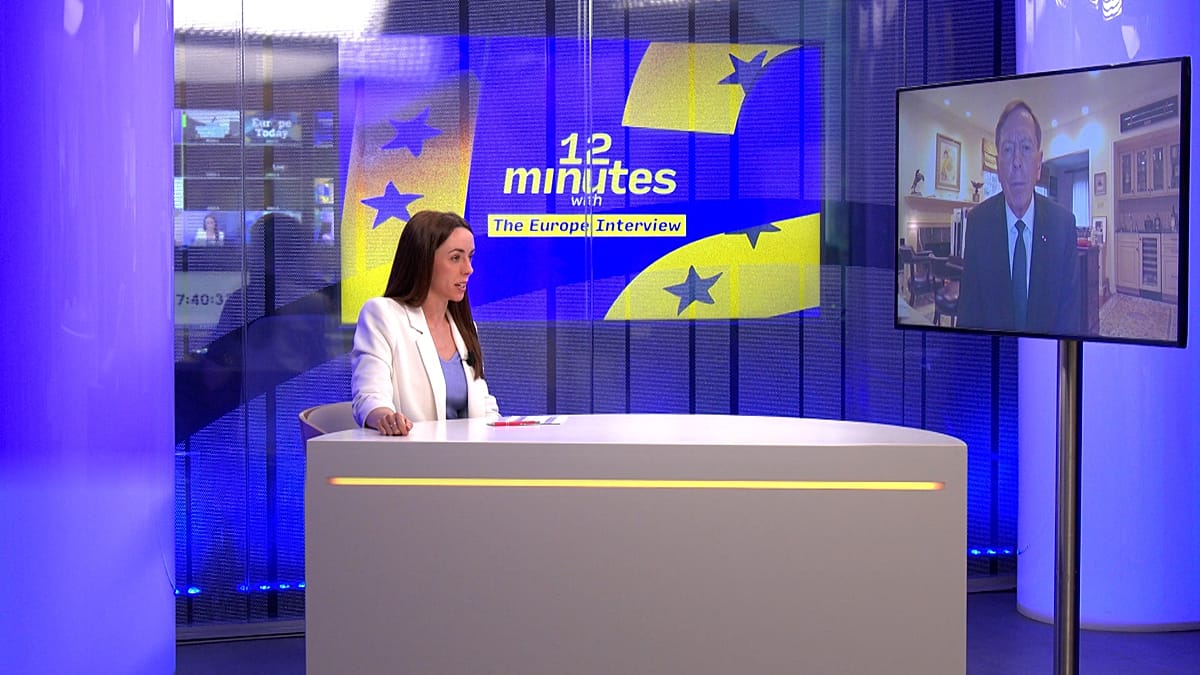
Former CIA Director and retired US Army General David Petraeus told Euronews he believes US President Donald Trump could accept a Venezuela-like situation, where a moderate figure from Iran’s existing regime seeks to “get along” with the US, following the killing of Ayatollah Ali Khamenei in the opening wave of joint US-Israeli strikes on Iran.
“The possibility is there that someone could emerge who might say, look, Mr President, you’re right. What the nuclear programme, the arming of proxies and our killing of Americans, Arabs and Israelis has brought us is ruin. And we see the error of our ways, and we want to sail straight, we want to get along with our neighbours and with you,” Petraeus said in an interview with Euronews’ 12 Minutes With.
Venezuela’s long-time leader, Nicolas Maduro, was removed in a dramatic US intervention in January this year, and replaced by his deputy and regime figurehead Delcy Rodríguez, who Trump has described as “terrific.” The rest of the Venezuelan administration was also retained.
Petraeus conceded that this scenario would be a “very dramatic departure” from the current regime’s positioning.
He added that he “does not think this is the most likely outcome”, given that an interim three-person Leadership Council was already formed on Sunday, comprising the president, the head of the judiciary, and a senior cleric to steer the country following Khamenei’s death.
Foreign Minister Abbas Araghchi suggested a new Supreme Leader could be appointed in just days. Khamenei’s successor will be appointed by a clerical body of Islamic scholars loyal to the Supreme Leader.
“Generally, as you look at the candidates for this, they tend to be pretty hardline ideologues similar to the most recent Supreme Leader. So, I think we have to be cautious about our hopes that a pragmatic figure could emerge.”
As he set out his goals for the conflict with Iran on Monday, President Trump refrained from endorsing regime change, despite initially framing the conflict as an opportunity for Iranians to “take back” their government.
Petraeus noted that while President Trump wants to create “the conditions for regime change that would be capitalised upon by the Iranian people”, he doesn’t believe those goals have been achieved.
“The challenge there, of course, (is that) the guys with the most guns and the most willingness to be brutal prevail. And in this situation, of course, the Iranian regime forces, which total nearly a million when you add them all up, (…) are armed. They are brutal,” he explained.
“So the question is, is there someone who can break away from that, who has real capability, real weapons with large numbers, and leadership capacity that can mobilise the people and together take on the regime? Unfortunately, I don’t think that is the case right now.”
‘No boots on ground’
President Donald Trump’s war aims and vision for Iran’s future remain unclear, as does a timeline. However, both President Trump and his Secretary of War Pete Hegseth refused to rule out the use of ground troops in statements made on Monday.
In an interview with the New York Post, Trump said he “probably” doesn’t need troops on the ground but would use them if needed.
Still, Petraeus said he doesn’t believe the US will put “boots on the ground”, citing a degradation of Iran’s abilities to continue retaliatory strikes at the current pace.
“I think that as the days go by (…) there will be a degradation of the ability of Iran to retaliate,” Petraeus explained. “We’ll continue to reduce their missile stocks, the launchers, the short-range missiles, and even the drones. So I think they will be hard-pressed to maintain even remotely what the pace has been so far.”
Iran has launched a raft of retaliatory drone and missile attacks targeting US assets and allies in the region since the initial US-Israeli strikes started on Saturday.
When Hegseth was asked on Monday about the war spiralling into a long-term conflict, he said, “We’re ensuring the mission gets accomplished, but we are very clear-eyed (…) about the foolish policies in the past that recklessly pulled us into things that were not tethered to actual, clear objectives,” he said.
Petraeus said that the US has learned from the “catastrophically bad decisions” made during its 2003 invasion of Iraq, when the US completely wiped out Saddam Hussein’s government and administration.
“We were cut off at the knees when the decision was made to fire the entire Iraqi military without telling them how we were going to enable them to provide for themselves and their families,” Petraeus said.
“Then we fired the Ba’ath Party (Hussein’s party) down to the level of tens of thousands of bureaucrats, many Western-educated, who we needed and were already using to help us in a country that we didn’t sufficiently understand.”
He added that the US could have “brought back major elements” of the Hussein administration and “had a sort of ‘Venezuela lite’, because the top levels were clearly gone.”
European involvement ‘a possibility’
Asked whether he thinks President Trump expected the support of European allies, Petraeus said European involvement, particularly in a defensive capacity, “would have been wise from the beginning”.
“Because it should have been clear from the outset that Iran is not going to limit its targets to just US and Israeli bases. It’s going after civilian targets, airfields and ports in the Gulf States and beyond, and reaching as far as Cyprus,” Petraeus said.
A suspected drone hit a British air base on the island nation’s southern coastline. In response, Greece ordered the deployment of two frigates and a pair of F-16 fighter jets.
Petraeus did stress that no assumption had initially been made that European countries would join the operation.
On the possibility of further European involvement in the US and Israeli-led operations, including in an offensive capacity, Petraeus said: “My understanding is that it has been discussed.”
“I don’t know that I’d predict what the outcome would be, but the fact that it’s being discussed indicates that it is certainly a possibility.”
Watch the full interview on Euronews on Tuesday, 3 March at 14.45 CET.
Read the full article here


