



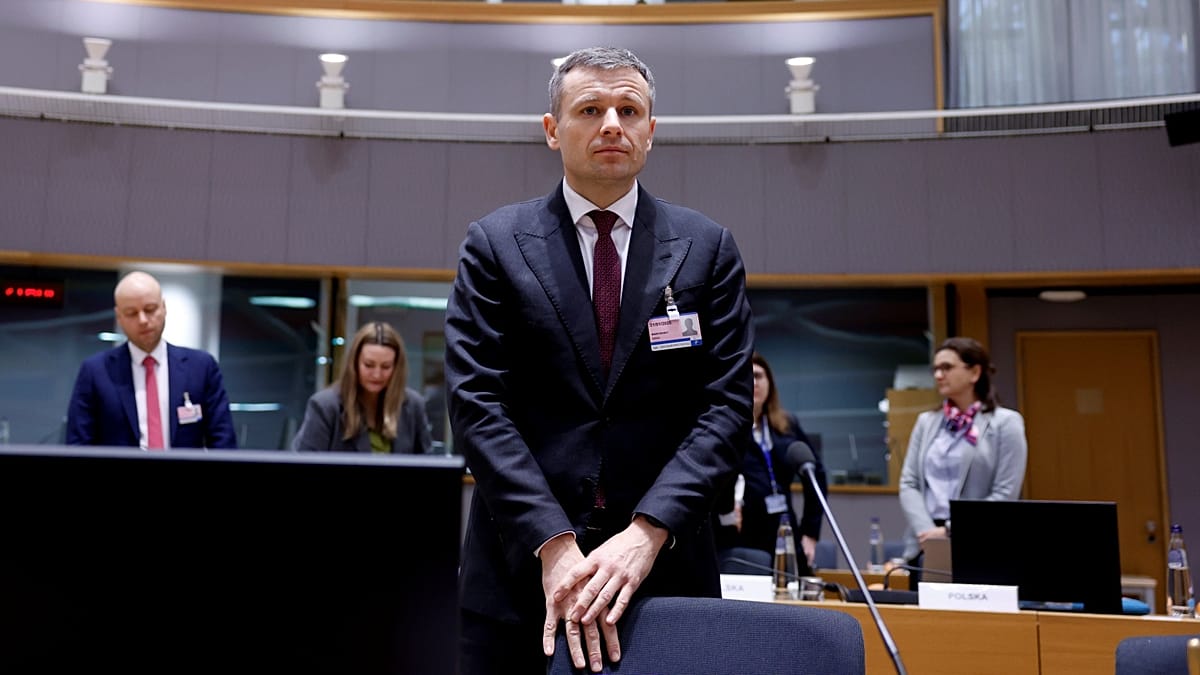
Ukraine has urged the European Union to tap into the immobilised Russian assets to help plug the country’s financial and military shortfall next year, which could hit a staggering $78 billion (€68.77 billion) if allies fail to step up their contributions.
Sergii Marchenko, Ukraine’s finance minister, made the push on Tuesday as he met with representatives from international donors and financial institutions in Brussels.
During the gathering, Marchenko argued that using the pool of Russian assets would be both a practical and fair solution to meet Ukraine’s extraordinary wartime costs, protect its debt sustainability and ensure accountability for Moscow’s aggression, according to officials with knowledge of the private discussions.
The EU holds €210 billion of these assets, most of it in Euroclear, a depository in Brussels.
The minister recognised the topic was politically difficult and encouraged the bloc to consider a centralised, legally sound framework.
Marchenko delivered a similar message on Monday at a panel hosted by the European Policy Centre (EPC) that examined the idea of transferring the assets from Euroclear into an EU-owned custodian to mitigate risks for Belgium.
“We need our friends, our European politicians, to be brave enough and to make some bold actions,” the minister said in his remarks.
“Unfortunately, the war is longer, the war is harder, and we need to provide some resolution of frozen Russian assets or provide other means for us to survive.”
Marchenko provided an overview of the dire financial situation that Ukraine faces in 2027.
From the $52.6 billion in financial aid needed from donors, only $20 billion has been covered so far, leaving a $32.6 billion gap. Meanwhile, there is roughly $45 billion in defence expenditure for which allies have not provided guarantees.
Altogether, this creates a $78 billion hole.
The budget crunch, Marchenko explained, is further aggravated by Russia’s non-stop attacks, which have severely disrupted ordinary activity, crippled power grids, destroyed factories and impeded tax collection. Moscow has recently begun to target Ukraine’s data centres to impair its digital economy and communications system.
At the same time, the blockade in the Black Sea has left Ukrainian farmers without the sea routes they need to sell their grain to clients worldwide. Losses mount with each day maritime trade remains closed off.
“It’s the first time since 2022 we realised that we have underperformance in our tax and customs administrations,” the minister said.
Loan under pressure
This is not the first time that the assets of the Russian Central Bank, immobilised since February 2022, have come under scrutiny.
Last year, the European Commission tried to channel the assets into a zero-interest credit line for Ukraine. The inventive proposal fell apart in December at a dramatic summit, where Belgium, the chief opponent, mobilised a majority against it.
As a Plan B, EU leaders agreed to set up a €90 billion support loan based on joint debt. The loan has been evenly halved: €45 billion for 2026 and €45 billion for 2027.
But Russia’s escalation has rapidly added to the bill.
“We’re very happy with the €90 billion,” Marchenko said. “But it’s not sufficient.”
Sweden, the Netherlands, Spain and Poland, backed by the Baltics, have also warned the loan would not be enough and called for “new options” to tap the Russian assets.
Belgium immediately pushed back against the move. Italy and France, two key votes, remain sceptical about touching the sovereign funds, according to diplomats.
The Commission is keen to avoid another defeat and insists the “primary focus” is the disbursement of the €90 billion loan, which has been hampered by the slow pace of reforms in the Ukrainian parliament.
EU officials are frustrated that Ukraine is asking for fresh money when it is not doing the necessary work to unlock the assistance already agreed.
Marta Kos, the European Commissioner for Enlargement, drove the point home during Tuesday’s donors’ conference.
“Our message to our Ukrainian friends is clear: deliver the agreed reforms, so we can continue supporting you financially,” she said in her opening remarks.
“The government, the Rada and institutions across Ukraine need to unite around this collective effort and act with determination to deliver the reforms.”
For the past month, the Commission has engaged in intense talks with Ukraine and the International Monetary Fund to pin down the exact scope of the financial shortfall.
The country initially flagged a $27 billion gap in its Ministry of Defence for this year, but this figure has since been downgraded. Marchenko focused his intervention on the needs for 2027, rather than 2026.
The Commission is yet to validate the numbers shared by Kyiv.
Read the full article here


