



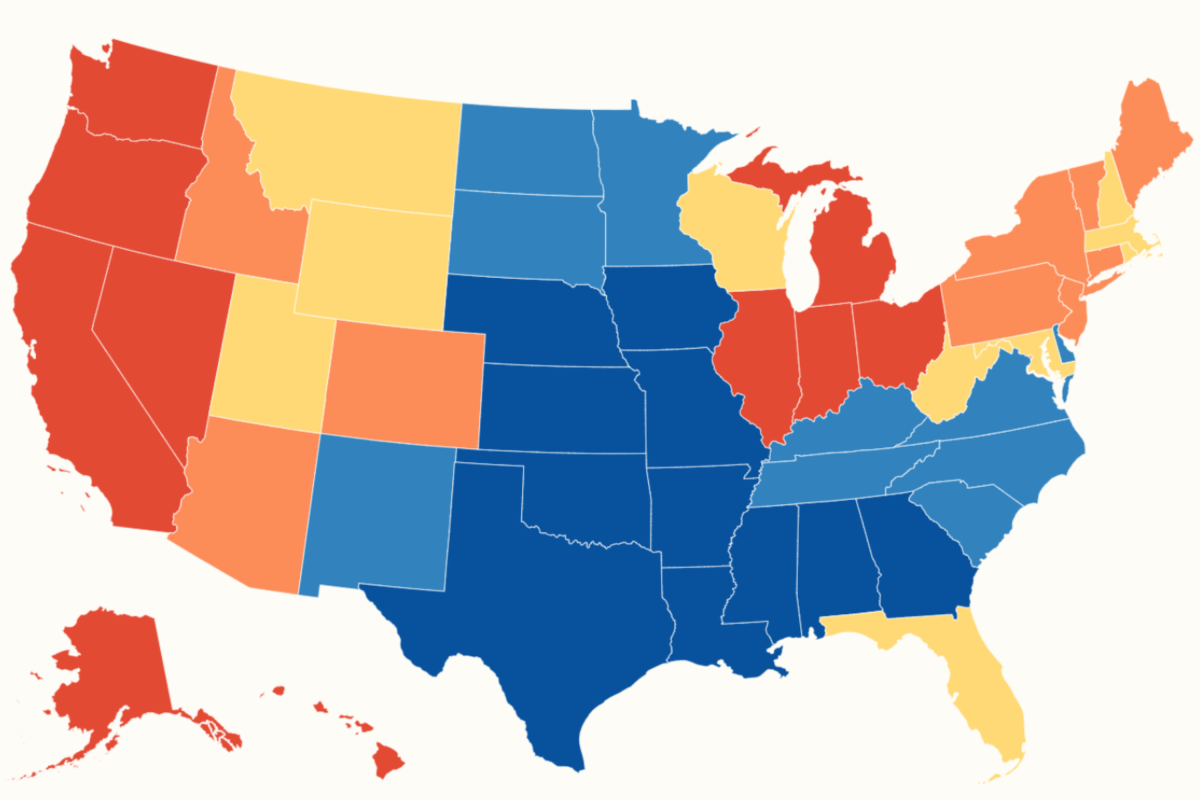
Drivers in parts of the country are facing a sharp rise in fuel costs amid the Iran war, with six states now recording average gas prices above $5 per gallon, according to the American Automobile Association (AAA).
Since the start of the war in late February, Iran has effectively closed the Strait of Hormuz—a chokepoint for roughly a fifth of the world’s oil—that has caused prices at the pump to steadily rise.
The states currently exceeding the $5 threshold are California, Oregon, Washington, Alaska, Hawaii and Nevada. As reported by Newsweek, in California, where drivers are paying the highest prices in the nation at the pump, gas goes for over $6 a gallon.
More States Near the $5 Mark
Several other states are rapidly approaching the $5 mark, signaling the pressure at the pump could soon spread further. These include Connecticut, Vermont, Idaho, Arizona, Colorado, Pennsylvania, New York, New Jersey, Maine as well as Washington, DC. Analysts warn continued upward pressure could push more regions into the $5 range in the coming weeks.
Nationally, the average price of gas has climbed to around $4.45 per gallon, reflecting wider economic strain linked to rising oil costs. A year ago, the average was $3.16. The surge has been partly driven by geopolitical tensions, particularly the ongoing U.S. conflict with Iran, which has disrupted global energy markets and increased supply concerns.
States with the lowest average prices are located primarily in the South and Midwest, with Georgia currently the lowest at $3.859.
Political Pressure Builds Ahead of Midterms
The political implications are already becoming clear. With the midterm elections approaching this November, rising fuel costs are seen as a potential liability for President Donald Trump, whose administration has frequently pointed to economic strength as a key achievement. Higher energy prices are now challenging that narrative, particularly as inflation remains persistent and household costs continue to rise.
According to a recent survey by Quinnipiac University, 65 percent of voters say they blame Trump either “a lot” or “somewhat” for the increase in gas prices, compared to 45 percent who said they blame him little or not at all. The findings suggest growing public frustration as everyday expenses climb.
Adding to concerns, the Energy Secretary Chris Wright has indicated that a return to $3-per-gallon gas prices may not happen until 2027, a projection that could further dampen voter sentiment. The continued strain on energy costs comes as the Federal Reserve considers whether persistent inflation and rising fuel prices will prevent any interest rate cuts this year.
As prices continue to rise, the issue is expected to remain a central economic and political concern, with both policymakers and voters closely watching developments at the pump.
Read the full article here


