



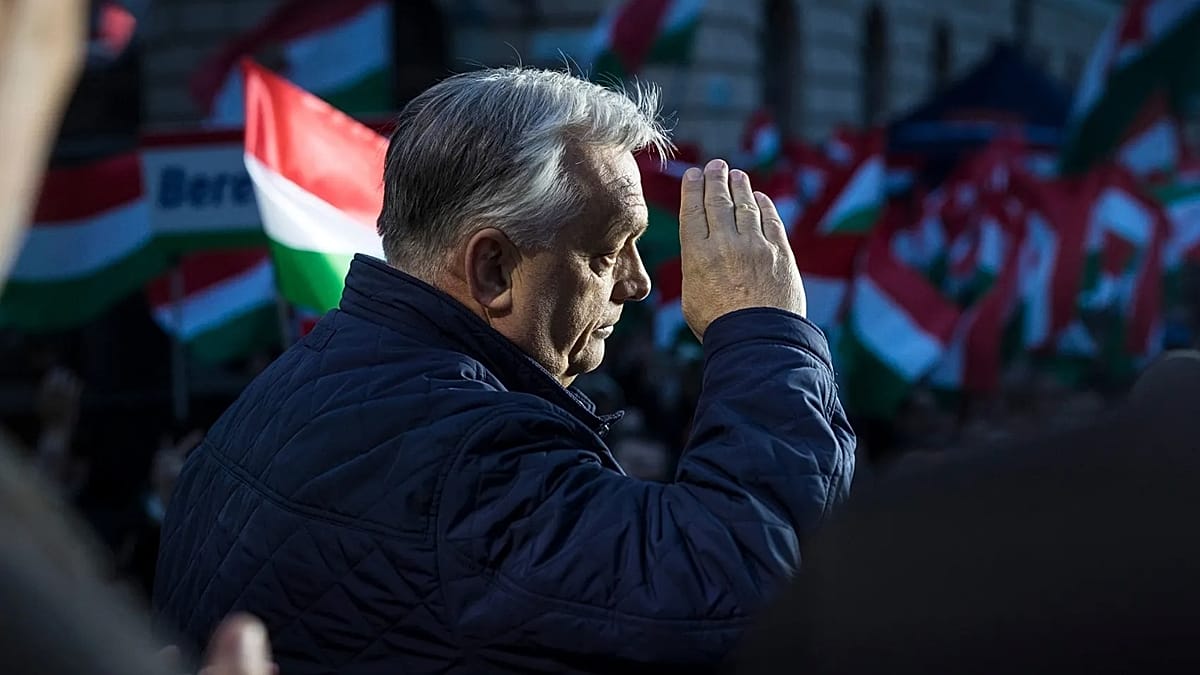
Prime Minister Viktor Orbán has governed Hungary for nearly 16 years, reshaping its institutions, challenging EU norms and positioning himself as the leading voice of nationalist conservatism on the continent.
His trajectory from liberal student activist to self-described champion of “illiberal democracy,” is one of the most striking — and polarising — political reinventions in post-communist central and eastern Europe.
Orbán first came to public attention in June 1989, when as a 26-year-old student he addressed the crowd at the state reburial of Imre Nagy and other victims of the 1956 anti-Soviet uprising.
His call for the withdrawal of Soviet troops — delivered at a moment when many opposition figures remained cautious — made him a voice of a new political generation.
The party he helped lead, Fidesz, began as a liberal youth movement. Over the following decade, Orbán transformed it into a centre-right nationalist force, as post-communist Hungary made its shift from a planned to a market economy.
Sharpening his message
Orbán first became premier in 1998 at the age of 35, making him one of the youngest leaders to hold the office in central Europe at the time.
His first government oversaw Hungary’s accession to NATO in March 1999 and advanced the country’s EU membership path, completed under a subsequent administration in 2004.
But then, Fidesz lost both the 2002 and 2006 elections to the Hungarian Socialist Party. During his years in opposition, Orbán sharpened a political argument focused on national sovereignty, arguing that liberal dominance in media and public institutions constrained Hungary’s self-determination.
Critics describe that framing as the precursor to a systematic challenge to democratic checks and balances.
Orbán won the 2010 election with a two-thirds supermajority, giving Fidesz the parliamentary votes to amend the constitution.
His government introduced a new Fundamental Law — Hungary’s replacement constitution — along with a series of electoral and institutional reforms.
Supporters argued these measures restored political stability and asserted national sovereignty; opponents said they concentrated power in the executive and weakened judicial and media independence.
Fidesz has won every parliamentary election since. The government has faced repeated legal challenges from EU institutions over the rule of law, press freedom and judicial independence. Budapest has consistently rejected those characterisations.
‘Illiberal state’ shift
In a July 2014 speech at Băile Tușnad in Romania, Orbán set out his governing philosophy explicitly, arguing that Hungary should move beyond liberal democratic frameworks while preserving core freedoms. He described his model as an “illiberal state.”
The term drew criticism from Western governments and EU institutions but became a favourite among nationalist movements across Europe and beyond.
Orbán has since promoted Hungary as a model for right-wing and far-right parties in France, Italy, Spain, the US and elsewhere. His annual speech at Băile Tușnad draws European conservatives every summer.
Hungary under Orbán has maintained membership of NATO and the EU while simultaneously cultivating relationships with Russia, China and Turkey that have repeatedly brought it into conflict with partners in both blocs.
Orbán met Russian President Vladimir Putin on multiple occasions before the full-scale invasion of Ukraine in February 2022 and has maintained economic ties — including a major gas supply contract and a nuclear energy agreement with the Russian state company Rosatom — since then.
Since 2022, Hungary has been the most prominent EU member state to resist the 27-member bloc’s consensus on military support for Ukraine as it continues to defend itself from Russia’s all-out war.
Orbán has argued that arms transfers prolong the war and that Hungary’s priority is keeping the country out of the war.
Other EU governments and NATO allies have described that position as effectively providing diplomatic cover for Moscow, a charge Budapest rejects.
Support from US, trouble with EU
Meanwhile, Orbán’s governance has drawn sustained interest from the American right.
US Vice President JD Vance travelled to Budapest earlier this week and addressed a rally days before the Hungarian parliamentary election, urging voters, “we have got to get Viktor Orbán re-elected as prime minister of Hungary.”
US President Donald Trump, whom Vance called by phone during the event, told the crowd that Orbán “kept your country good” and that the US was “with him all the way.”
Vance had previously said in 2024 that Orbán “made some smart decisions that we could learn from in the United States.”
Other prominent US conservatives, like Marco Rubio, Steve Bannon and CPAC chairman Matt Schlapp have all visited Budapest.
Former Fox News host and influential right-wing commentator Tucker Carlson devoted a week of broadcasts from Budapest, and Orbán keynoted the Conservative Political Action Conference (CPAC) in 2023, while Hungary hosts its European spinoff.
The Heritage Foundation described Hungary’s institutional model as a governing template, and analysts have documented links between architects of the Project 2025 policy blueprint and Fidesz-aligned think tanks.
As his star power grew in the US, Orbán and his policies were met with significant pushback from Europe and its leadership.
The European Parliament triggered the Article 7 rule of law procedure against Hungary in 2018 — the mechanism that can strip a member state of voting rights, although the European Council never brought it to a vote.
The European Commission has frozen around €18 billion in EU funds over rule of law concerns, and Hungary forfeited more than €1 billion in cohesion funding at the end of 2025 after failing to implement required anti-corruption reforms by the deadline.
Fidesz left the centre-right European People’s Party (EPP) grouping in 2021.
The tensions came to a head in October 2024, when European Commission President Ursula von der Leyen confronted Orbán directly at the European Parliament in Strasbourg, asking whether he would “blame the Hungarians for the Soviet invasion of 1956” — drawing a parallel to his position on Ukraine.
Orbán called the comparison “a humiliation” and rejected it outright.
What comes next
Orbán, now 62, wants to extend a political dominance that has lasted more than a quarter century.
After more than 15 years of continuous government, Fidesz faces a domestic political challenge that analysts and opposition figures say is more competitive than at any point since 2010, among economic pressures and the emergence of a more consolidated opposition embodied in the Tisza Party.
Yet Orbán remains one of the most influential figures in European conservative politics — and one of the most contested.
Read the full article here


