



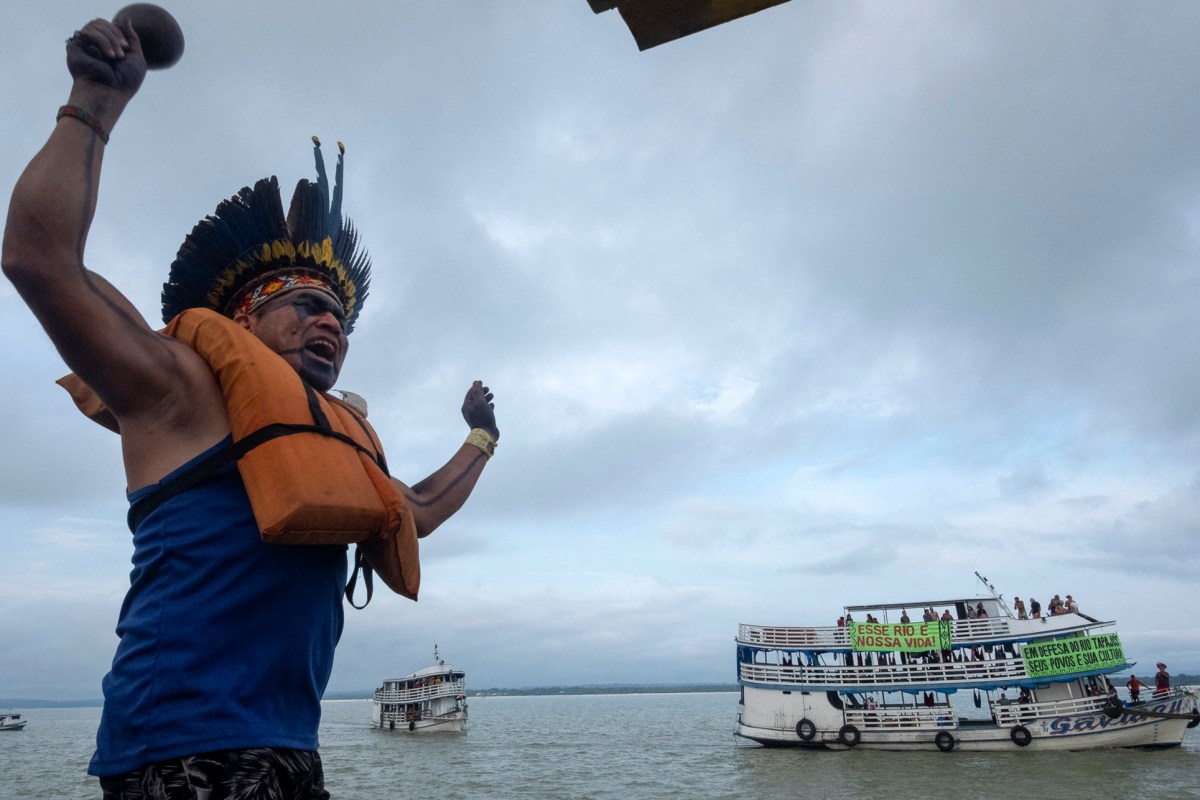
The Tapajós River is not a route for ships. It is where we live. It is where we fish, where our children grow, where our ancestors remain. But today, it is being treated as a corridor to export soy to the world.
In February, we occupied the Cargill grain terminal in Santarém, Brazil. For weeks, Indigenous peoples from across the region stood together under the sun and the rain, blocking trucks and refusing to leave. We were there because the Brazilian government had decided to hand over our rivers to agribusiness, opening them to dredging, private concessions and more soy barges—without listening to us.
We were told this was development. But we know what it brings. It brings deeper waterways for ships, new ports along our rivers, railways like Ferrogrão cutting through the forest, and more soy expanding into our territories. It brings contamination, invasion and violence.
We did not accept this. And we won. The government was forced to revoke the decree that would have privatized our rivers.
That victory showed something important. When people stand together and apply enough pressure, even powerful institutions can be made to step back. But it also showed something else: The system driving the destruction of the Amazon is growing larger and more coordinated.
The push to expand soy in the Amazon is not happening in one place. It is happening everywhere at once. Rivers are being opened for export. Railways are being planned to carry more grain. Ports are expanding along the Amazon and its tributaries. Laws that protect forests are being weakened. Indigenous rights are being attacked, including through efforts to erase our claims to our own territories.
At the same time, one of the most important protections for the forest is being dismantled.
For nearly two decades, the Amazon Soy Moratorium helped draw a line. It stopped major traders from buying soy grown on land deforested after 2008 in the Amazon biome. It was not perfect, but it helped reduce deforestation. Now, that rule is being weakened.
If this protection disappears, the consequences will reach our rivers, our forests and our homes. Soy does not grow under trees. It replaces them and brings pesticides that run into the water. It brings land grabbing and invasion and still more violence. We know, because we already live it.
We do not eat soy, gold or iron ore. We eat fish. We eat the fruits of the forest. We depend on the river and the land to live. When they are destroyed, we are destroyed with them.
But this is not only a problem of Brazil. The soy that destroys our territories does not stay here. It feeds global markets. It moves through ports like the one in Santarém—built on our history and still operating without proper licensing—and through new terminals planned across the Amazon. It is carried on barges along rivers that companies want to deepen and control. And all of this expansion is financed far from the forest.
Banks cannot say they are not involved. They support the companies building ports, expanding railways like Ferrogrão and pushing deeper into the Amazon. They finance traders who profit when protections are weakened. They help make possible a model that treats the forest as empty land and the river as infrastructure.
Banks often distance themselves from the harms linked to their clients, but they play a major role—especially now, as safeguards are being dismantled at the same time.
We have already seen that pressure works. On the Tapajós, Indigenous peoples forced the government to reverse a decision that threatened our river. We did this with very little power compared with the corporations and institutions we were facing. But we had something stronger: unity, clarity and the knowledge that we were defending life.
Banks have a lot of power in deciding who receives financing and under what conditions. They can require that companies respect the rules that protect the forest and its peoples. They can refuse to support those who violate them. They must use that power now.
Financial institutions should make clear that they will only support companies that maintain the core protections of the Amazon Soy Moratorium: no deforestation after 2008, full traceability and respect for the Amazon and its peoples. They should refuse to finance expansion—new ports, railways, waterways—that depends on destroying forests or violating Indigenous rights.
This is not a radical demand. It is the minimum necessary to prevent the situation from becoming much worse. Because what is happening now is not only about soy. It is about a model that is expanding in every direction at once—through rivers, through forests, through laws—without respecting the people who live here.
We know what this model brings. We have seen the contamination, the abuses of human rights, the loss. And we have also seen that when we resist together, change is possible.
So I ask those reading this—in financial centers, in governments, in companies—to look at what your institutions are doing. What are your banks financing? What are your companies supporting? Are you paying attention to what is happening in the Amazon?
Because we are. We are watching the river change. We are watching the forest disappear. And we are standing in the way of that destruction with our bodies, our voices and our lives.
The Amazon is not an empty space. It is alive. It has peoples, histories and futures that depend on it. The river is a relative—one that needs to be protected. It nourishes us and quenches our thirst, but it is also a spirit that watches over the forest and our people, and our spirits are under threat. Banks must stop financing the destructive expansion of the soy sector now, before one of the last lines of defense disappears.
Read the full article here


