



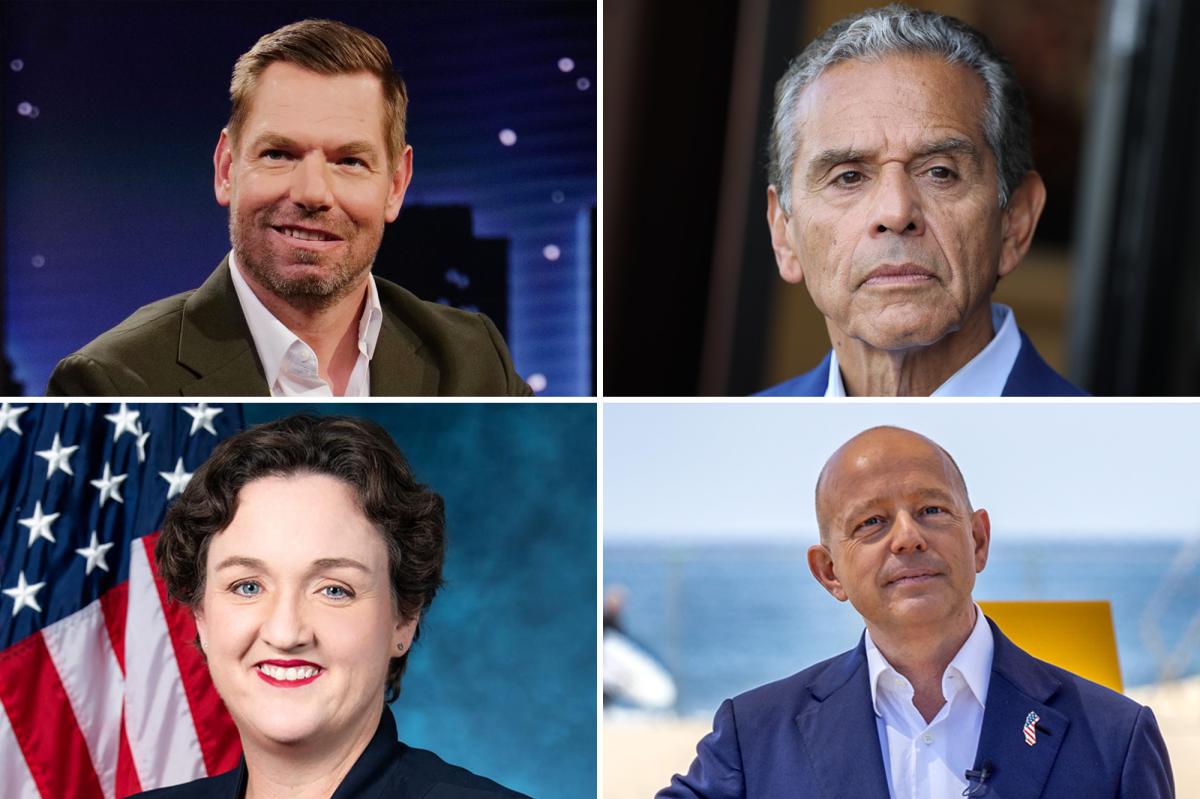
California’s race for governor is an imperfect 10.
No fewer than eight Democrats and two Republicans are vying to succeed Gov. Gavin Newsom, and Californians are starting to take stock of what’s on the menu for the June 2 primary election.
The Golden State is facing crises on multiple fronts, from housing and homelessness to an intractable cost-of-living conundrum that has caused thousands of residents to flee the state in recent years.
All of the candidates are trying to carve out a lane with distinctive policy positions, some with varying results. Here’s how the candidates say they’ll lead California into the future.
Eric Swalwell
Voters could be forgiven for thinking the lefty East Bay congressman — who may not actually live in California — is running against President Trump in the race for governor.
Like Newsom, Swalwell has been carrying the resistance baton by framing himself as the strongest candidate to fight back against Trump’s policies on immigration and tariffs.
He’s vowed to ban ICE agents from state employment and even bar them from getting California divers’ licenses.
But while he brands himself as a fighter, Swalwell seems just as comfortable playing the victim, repeatedly noting he faces death threats and his children can’t even play outside — while he frequently posts social media videos of his children, sometimes playing outside.
The 45-year-old former Alameda County prosecutor was first elected to the House in 2012, when he surprisingly knocked out 20-term incumbent Pete Stark through an attack line accusing the then-congressman of not focusing on local issues and failing to live in the district.
It’s an ironic full circle moment for Swalwell, whose own neighbors say they have never seen him in the nine years he has claimed to live on their small cul-de-sac in Livermore.
Swalwell missed more votes than any active member of Congress last year, and much of that time was spent hitting up A-list celebrities for campaign cash. He’s used that money to blast out platitudes on the affordability crisis, which he says would be his second priority as governor.
The campaign has been light on economic policy beyond tax hikes on corporations, tax breaks for small business and a pledge to build more affordable homes — a goal that many Californian support but has proven to do little in tackling the issue when the math on constructing such projects rarely pencils out.
Democratic Party insiders have expressed anxiety over Swalwell being the Democratic frontrunner. His policy chops beyond hitting Trump on TV and social media is one concern, but some worry the congressman may have more baggage than just his residency issues and still-unexplained connection to a Chinese honeytrap spy named “Fang Fang.”
Steve Hilton
The former Fox News host, who more than a decade ago served as an adviser to then-U.K. Prime Minister David Cameron, sits on the opposite end of the political spectrum from Swalwell.
Hilton is bald, British and has embraced the Make America Great Again agenda. His campaign has released hundreds of policy papers detailing how he intends to DOGE California’s government and root out waste, fraud, and abuse.
The plans not only include slashing the state’s bloated budget — California’s total spending has grown by about $150 billion since Newsom took office — but Hilton also has detailed policies to eliminate environmental regulations to increase state oil production and reduce gas prices.
Beyond that he wants to crack down on crime with harsher penalties and more privatized prisons, and work hand in glove with the White House on immigration enforcement.
Hilton’s signature economic policy would eliminate California’s income tax on the first $100,000. He also wants to cut gas costs to $3 a gallon and remove red tape on housing construction.
Hilton has embraced his lane as an unconventional gubernatorial candidate in a state that has been under one-party rule since Arnold Schwarzenegger left the governor’s office in 2011. He argues that California has become unaffordable, overregulated and poorly governed, and an outsider is better positioned to shake things up than another career Democrat.
Polling has shown Hilton’s message is resonating, as he often places first or second. But it’s still a long shot deep-blue California will rally around an unabashed MAGA candidate in the runoff.
Tom Steyer
The 68-year-old progressive billionaire ran a hedge fund to make his fortune, and now he’s casting himself as the only candidate strong enough — and wealthy enough — to take on other billionaires.
Such a campaign slogan is a tightrope to walk when many Californians are turning on the wealthy elite, but Steyer has leaned on support from the far left and gained ground in the polls, consistently finishing in the top three of Democratic candidates along with Swalwell and former Congresswoman Katie Porter.
Download The California Post App, follow us on social, and subscribe to our newsletters
California Post News: Facebook, Instagram, TikTok, X, YouTube, WhatsApp, LinkedIn
California Post Sports Facebook, Instagram, TikTok, YouTube, X
California Post Opinion
California Post Newsletters: Sign up here!
California Post App: Download here!
Home delivery: Sign up here!
Page Six Hollywood: Sign up here!
How’s he doing it? Money talks, and Steyer never stops talking. He has already plunked down $88.3 million into his campaign to fund an avalanche of ads — it’s almost as if he’s paying his campaign based on the word count.
But few, if any, of the Democratic candidates in the race have stayed on message as doggedly as Steyer, who continues to bang the table on affordability, housing and utility costs.
He has promised to build one million affordable homes by lowering construction costs, unlocking land and investing in subsidized housing. (For what it’s worth, Newsom once vowed to help build 3.5 million new homes, only to walk back the number as an “aspirational” goal.)
Steyer’s campaign has stressed the need to end utility monopolies to lower electric bills, while also calling for climate investment and a more aggressive state role in regulating technology and artificial intelligence.
Earlier this month, Steyer floated a “Golden State Sovereign Wealth Fund” that would place stricter regulations on AI and data centers to help fund education, training and job opportunities.
Steyer’s backstory has its holes, of course. He founded Farallon Capital in 1986 and turned it into a pioneering hedge fund making big investments in the fossil fuel industry before stepping down in 2012. He then reinvented himself as a climate activist and Democratic mega-donor, and he launched a failed presidential campaign in 2020 that cost him $343 million. (That was frugal compared to Michael Bloomberg blowing a billion dollars the same year.)
The golden elephant in the room is how much cash Steyer is willing to burn in his quest to be California governor, and whether that number will begin to turn off voters if they think he is buying the race. Steyer is on track to demolish Former HP CEO Meg Whitman’s state gubernatorial campaign spending record of $144 million.
Chad Bianco
Riverside County’s sheriff is the most visible law-and-order figure in the race and he has the mustache to prove it.
Bianco, 58, has centered his gubernatorial campaign on public safety, immigration and affordability, while also taking aim at Newsom on immigration and the state’s handling of Covid. The sheriff is an outlier on the campaign trail with his anti-vaccine stance, going so far as to brag about his own refusal to get the jab while hiring officers who also abstained.
A key source of criticism Bianco has faced from his fellow conservative on the campaign trail is a viral moment in which he took a knee with Black Lives Matter protesters.
Some called it a “beautiful moment” of solidarity that de-escalated a tense situation with protesters, while Hilton and others accused Bianco of kowtowing to California’s woke mob.
Bianco also has faced pushback over his past association with the Oath Keepers, a far-right anti-government group, and government watchdogs have raised concerns about his low clearance rate in solving crimes while an “epidemic of deaths“ have occurred in his county jails.
In a tight race among the top five candidates, Bianco’s polling has remained relatively consistent in the teens, raising fears among California Democrats that the leading Republicans in the race could be the top two finalists to emerge from the primary.
But don’t expect any type of love fest between Bianco and Hilton to box out Democrats.
After a February debate in which Hilton called out Bianco for taking a knee with BLM protesters, Bianco’s wife reportedly sent an email calling Hilton “a piece of sh—.”
Katie Porter
After an unsuccessful run for the U.S. Senate in 2024, Porter pivoted to the governor’s race and she has suggested California needs “a little bit of hope and a whole lot of grit.”
But how much grit is, like, way too much grit?
Viral blowups and reports of Porter berating and abusing her ex-husband may make it tough for her to shed her prickly image. A clip of the former congresswoman cursing out a staffer tanked Porter’s polling and she has yet to recover, frequently coming in second or third among Democrats.
Porter’s campaign has attempted to distance the single mom of three from the embarrassing spectacle — an awkward TV interview clip was the first video to leak — and her top campaign pledge is to lower health care costs and make California more affordable for families.
She wants to raise corporate taxes to offer free tuition at University of California and California State University schools, while also offering free childcare for all.
But at the recent Democratic Party convention, Porter’s signature moment wasn’t a populist agenda but rather holding up a sign that read “F— Trump” while cursing like a sailor. It’s perhaps no coincidence that one of Porter’s donors is David Mandel, executive producer of the HBO show “Veep,” whose foul-mouthed lead character Selina Meyer — played by Julia Louis-Dreyfus — frequently scolds aides with withering profanity.
Porter, 52, rose from academia to national politics in 2018, winning a House seat in purple Orange County before becoming a progressive darling with her white board-assisted line of questioning to roast the banking and healthcare industries. Porter frequently leans on her “messy minivan” and the white board as props, which feels increasingly antiquated in the age of AI. The minivan just sounds like it sucks.
Her tax plan has been called thin if not risky for the state’s budget, and her policies calling for more housing and a cleaner environment have hewed to the Democratic mainstream.
Critics suggest Porter’s close relationship with labor unions — she has endorsements from the National Union of Health Care Workers, the Teamsters and United Auto Workers — would maintain the swamp in Sacramento.
Matt Mahan
San Jose’s mayor is running on a “back to basics” agenda that offers a notable departure from never-Trumpers like Swalwell. Suggesting that fights with the White House are usually political theater, Mahan prefers a wonkish, YIMBY-like approach to housing, homelessness and government accountability.
Mahan, a moderate Democrat, has broken from the party orthodoxy by publicly criticizing Newsom and suggesting the governor’s tit-for-tat with Trump on social media are a distraction from the urgent crises California is facing.
His signature policy is a 15-part plan on housing that would create a two-year “tax holiday” for new construction.
While the 43-year-old’s polling remains sluggish after joining the race late in January, Mahan has taken the political fast-track in his run for governor. A former school teacher and tech founder, he served just two years on the San Jose City Council before scoring an upset victory in the 2022 mayor’s race.
He then won re-election two years later with a staggering 87% of the vote, prompting comedian Jon Stewart to jokingly call him “Little Putin” in a recent interview that sounded the alarm on too many Dems staying in the race.
Unlike the current governor, Mahan supported 2024’s tough-on-crime ballot measure Proposition 36, which passed with more than 68% of voters in support.
Mahan has deviated from leaders of other major cities in the state by drawing a sharp line on homelessness, arguing that people who repeatedly refuse shelter or treatment for drug addiction and/or mental illness should be arrested. He also jumped into the gas price crisis by calling on California to waive the state’s excise tax, which was adding $0.61 cents to the cost of a gallon as of December 2025.
Mahan has become a magnet for Silicon Valley donors, in part due to his opposition to the proposed billionaires tax measure. But while campaign cash is helpful, Mahan has major ground to make up between now and June 2.
Xavier Becerra
The former U.S. Secretary of Human Health and Services is well known in California and has built his campaign around six policy pillars, which may be why Becerra has failed to break through in the crowded race but is polling strong enough to eat up crucial Dem votes.
Becerra, 68, has perhaps the deepest resume in the race after serving two years in the state Assembly and then spending nearly a quarter-century in Congress. In 2016, former Gov. Jerry Brown appointed him California attorney general before he received a promotion to serve in ex-President Joe Biden’s cabinet.
Casting himself as the “Health Care Governor,” Becerra is pushing a universal, single-payer system but he hedges that such an overhaul will take time. He also wants to fight Trump (he sued the administration 122 times as attorney general), build more housing (his father was a union construction worker), address the affordability crisis, encourage the transition to green energy and improve resiliency for wildfires and earthquakes.
If there is a mainstream Democratic policy position that’s feeling left out of the conversation, Becerra will gladly incorporate it and squeeze it tightly to his bosom.
For all his accomplishments, however, Becerra also has some recent baggage.
Last year, it was discovered that close aides on his prior campaigns had siphoned roughly $225,000. Becerra was not accused of wrongdoing, but questions have been raised about his absent management and oversight.
Becerra was one of several candidates who blasted Democratic Party leadership for calling low-polling candidates of color to drop out of the race.
Antonio Villaraigosa
On paper, a former Los Angeles mayor and California speaker would seem to be a strong contender for California governor.
But eight years after Villaraigosa’s last bid for governor, when he finished third behind Newsom and Republican John Cox, the 73-year-old’s campaign has struggled to gain traction and Democratic Party insiders have suggested this may be his last political gasp.
Of all the Democratic Party candidates, Villaraigosa has been the most aggressive in calling for urgent action on gas prices.
Californians historically pay about $1.40 more per gallon than the national average. Villaraigosa argues his plan could cut that gap in half, saving households more than $700 annually, by preserving refinery capacity, boosting in-state production and reducing regulatory costs.
He’s also got the most detailed plan in confronting the Trump administration on ICE raids and immigration enforcement. One proposal would create a multi-agency task force to conduct unannounced inspections of immigration detention facilities, issuing fines and potential closure orders for violations.
A companion plan would declare a child welfare emergency for minors in federal custody, requiring 48-hour abuse investigations, court-appointed guardians and possible state court intervention if facilities fail to meet California standards.
But as it is with many storied political careers, Villaraigosa has Louis Vuitton-level baggage.
He had multiple ethics and state political watchdog probes, and also had a scandalous affair with a TV journalist while mayor in 2007 — a very Newsom-esque indiscretion. In one ethics inquiry over unreported tickets to entertainment and sporting events, Villaraigosa paid around $42,000 in fines.
Tony Thurmond
As the state superintendent of public instruction since 2019, it should be expected Thurmond would make education a calling card in his campaign for governor.
California schools have improved on completion and campus climate metrics during his tenure, but student achievement remains below pre-pandemic levels. Statewide test scores in math and reading still trail where they stood when Thurmond took over.
He has focused on utilizing school district properties for affordable housing development, which can sidestep zoning rules that often stymie projects from breaking ground.
Thurmond leans on his hard-scrabble backstory, as both he and his brother were orphaned after their mother died of cancer. The candidate, who is Black and Latino, was just six years old. He started his career as a social worker before serving on the Richmond City Council and then rising to the state Assembly in 2014.
He terms out of his current role overseeing California schools at the end of this year, which could explain why he’s running for governor despite having no real path to victory. Thurmond’s campaign has reported raising just $21,000 since the start of the year, according to state records, although he likely has scooped up smaller donations.
Thurmond was among the loudest candidates pushing back on the Democratic Party’s chair, Rusty Hicks, who penned a letter this month calling on trailing candidates to bow out of the race.
Betty Yee
The former state controller is calm and collected and knows the problems California is facing as well as anyone in the race. Unfortunately for Yee, her boldest remarks often leave something to be desired.
“Some worry we have no power over our future in California,” Yee says on her website. “But I know we do.”
Yee is a finance expert after serving on the California Board of Equalization starting in 2004 and then becoming state controller from 2015 to 2023. She has a reputation as a shrewd, competent politician and understands tax policy after conducting state oversight and audits.
But she also has her own question marks.
Early in the pandemic, Yee was involved in a $600 million no-bid contract for masks in which she advised a politically connected company to help secure a deal. The state ended up clawing back the money from Blue Flame, which stood to profit $134 million from price markups. Lawmakers grumbled about an inquiry into Yee’s actions but nothing came of it.
Yee’s top policy ideas include creating a “war room” to deal with federal cuts to health care, which would revise the way the state and its 58 counties keep people enrolled in Medi-Cal and improve services.
The chances of Yee becoming California’s next governor are decidedly lower than her playing a spoiler role for one or more Democrats.
Read the full article here


