



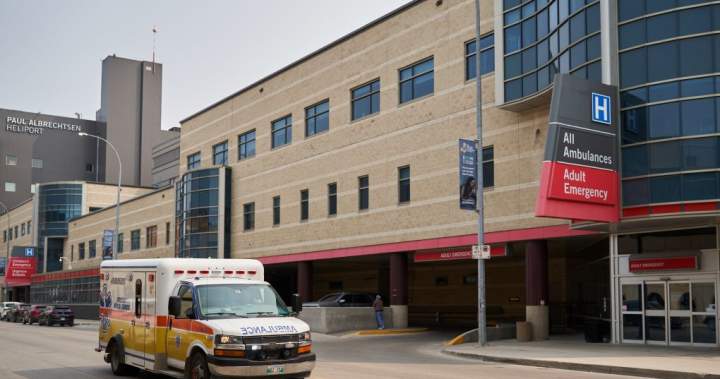
A Winnipeg woman who waited nearly 26 hours in a hospital emergency department in 2025 says she is disappointed by what she sees as a lack of progress in reducing wait times.
Beverley Masters, 73, was first diagnosed with breast cancer in 1996. Following a breast cancer diagnosis that year, she had treatments, including chemotherapy and radiation, performed. They were successful for some years until the cancer returned, and later, spread.
After the Grace Hospital’s Cancer Care Manitoba ward was temporarily shut down, she said she began going to the Health Science Centre (HSC) in Winnipeg.
In October of 2025, while she was a patient at the centre, Masters said she began taking a new medication and ended up in the emergency department weeks later.
“HSC wouldn’t let me come into the urgent care. They advised I had to go by ambulance to HSC emergency. And that’s when things went downhill dramatically.”
Masters waited almost 26 hours to see a doctor while in that emergency ward, she said.
“I wasn’t even actually in the ER for the first 14 hours,” Masters said. Instead, she said she was sitting on a stretcher in a hallway between the ambulance bay and emergency room.
Several other people on stretchers joined her in the hallway, where they sat “foot-to-head,” with nowhere to put their belongings or use the washroom, she recounted, adding that she used a bedpan in “what looked like a janitorial closet.”


Get weekly health news
Receive the latest medical news and health information delivered to you every Sunday.
Eventually, Masters said she received medical care in the form of a 15 minute ultrasound, followed by blood thinners – the exact treatment she received at Grace after a few hours of waiting.
“For me, all I needed was an ultrasound. It could have been easily solved. There must have been at least one facility in the six hospitals that could have squeezed me in somewhere, as they did in September of 2023,” she said.
The experience also inspired her to send a letter to Manitoba’s government, and health minister, asking for a cancer care-specific emergency department in 2025. She said she has never heard back from the province.
“There are people willing to die at home alone, rather than ever subject themselves to the HSC emergency room again,” Masters said as she read the letter she sent.
She said she felt prompted to contact Global News after its story last week.
Global News spoke with Theresa Chanowski, the daughter of Colleen Titanich, a terminally ill woman, was left on a stretcher in the hallway of the HSC in Winnipeg for 20 hours in the emergency room.
“Something should have been done to start this process in place so that Colleen didn’t wind up back there,” she said.
“When I saw her story, I thought there is absolutely no reason for this lady to have suffered what she suffered when the government was made aware of how traumatic it was for another cancer patient.
“It’s like we’re screaming into a blackhole and nobody’s paying attention. And I don’t know what it’s going to take to change it.”
In response to Global News’ earlier story, Manitoba Health Minister Uzoma Asagwara said fixing the system to address extended wait times will take time.
Dr. Shawn Young is the chief medical officer at HSC. He said what he hears about extended wait times for patients is “awful.”
“There’s a lot of haste in the work that we need to do. We have been responding to open up some extra capacity here at the site,” the doctor told 680 CJOB Thursday, noting additional beds have opened at HSC in recent weeks.
“The goal of health care is to keep people healthy” and the emphasis being placed on preventative and community care will help them achieve that goal, he said.
“Unfortunately, we were behind. We had several years where we just didn’t have that primary care base and those connections and that’s resulted in a lot of advanced disease,” Young continued.
“Building that primary care base, and those community resources, is the game plan. It is the real solution to this. It doesn’t fix our challenge today, but it prevents it from getting worse tomorrow.”
Improving home care and long-term care capacity would help free hospital beds for people with emergent medical needs, he continued.
Ray Sanchez, vice-president of acute services at the Winnipeg Regional Health Authority (WRHA) said it will take a multitude of programs to address wait times at the emergency department.
“This will not be solved by one thing. We’re going to have to do about 30 or 40 different things all at once in order to continue to improve,” Sanchez told 680 CJOB.
Both men told said the health-care system has improved in the past couple of years, in terms of capacity and the flow of care — but the demand for its services is simultaneously growing.
“It’s been tough to keep up with,” Young said. “It’s just a matter of staying ahead of the demand.”
Read the full article here


