



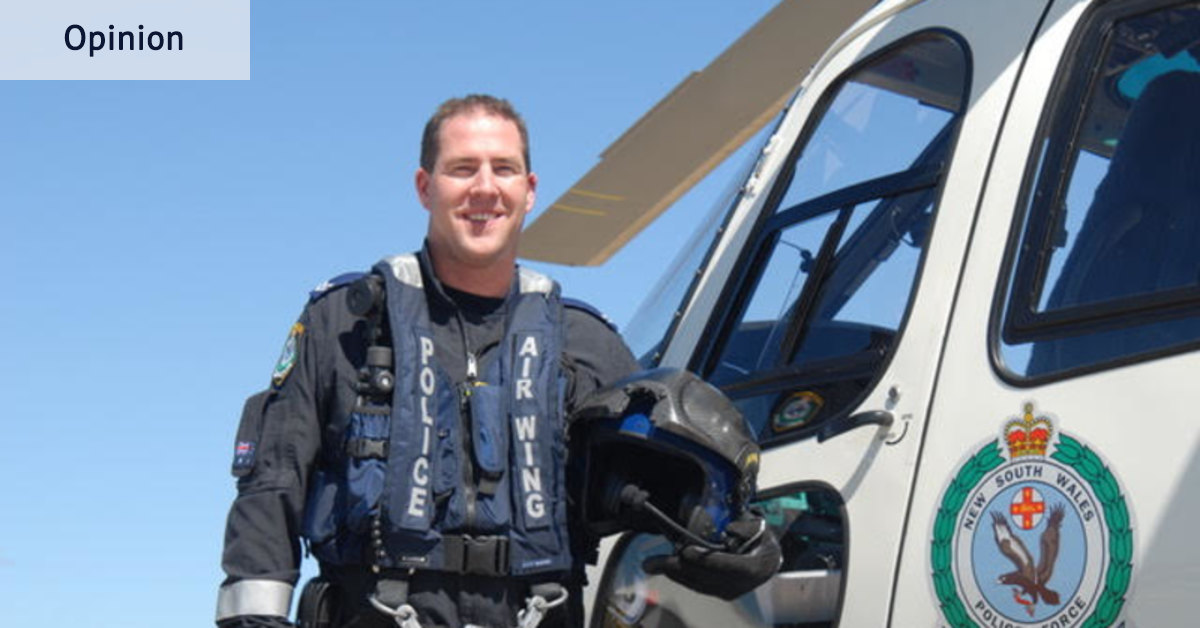
I loved being a cop, but the job nearly killed me. Allow me to explain.
Five years ago, I was in a really bad place. Living on the edge of panic, I was exhausted by nightmares and flashbacks. Feeling anxious and sick by day; an insomniac by night. I lost confidence, was easily startled by crowds and loud noises, and was often angry with no warning.
But I wasn’t always like this. To understand the present, you need to look at the past. For a long time, I lived and breathed blue.
There was a time, maybe 10 years ago, when I could barely have imagined doing anything else with my life. You know the feeling. You’re in that sweet spot in your career: still keen, motivated, fuelled by challenge, and yet with the skill and experience to be comfortable in the role. The growth zone.
I was an experienced police officer by then; a sergeant working in a highly specialised area. If I had introduced myself, I would have told you I was a tactical flight officer at PolAir. The state’s cops in the sky. It’s quite a mouthful, but it became central to my life and my inner purpose.
In the end, I did 25 years in the NSW Police Force. After several years on the beat and on the road, I decided my future lay in the sky. I never looked back.
My mind ran back through years of horrible jobs. Road trauma, violent assaults … the gut punch of seeing death up close.
Flying above the city, responding to violent crime and exciting search-and-rescue jobs, I absolutely loved what I did. It was a rare opportunity to support police on the ground, and serve the community from the air. There were times I could hardly believe I was paid to do the job. It really was that good.
Then, little by little, everything began to fall apart. If I look back now, the warning signs were there. I just didn’t see it coming.
Some of the work started to bother me. I’d be driving home from a shift or playing with the kids at home and my mind would wander back to the jobs. The challenging searches, the dynamic and fast-paced pursuits. All the mental health-related work: it seemed so much of modern-day policing had some link to mental health.
Helicopters are unique in their ability to access difficult terrain. We responded to urgent and desperate calls for help. Some people were located safe and well, many weren’t. We recovered bodies. The numbers and the faces added up, and eventually they took a toll.
I began suffering panic attacks at work, and even in the car on the commute. My mind ran back through years of horrible jobs. Road trauma, violent assaults, near-misses at work, the gut punch of seeing death up close. In denial and trying desperately to save my career, I pushed on until I could take no more. Then, one day I asked for help.
In 2022, I was medically retired from policing. Not the stellar ending to my career I had hoped for, but by then I realised the choice was to walk away or stay in and maybe not come out alive. I looked in my children’s eyes and I knew the answer.
The years since have been tough-going. A lot of therapy, medications and hard work. But I’m still here, and I’m starting to see some light at the end of the tunnel. Along the way, I’ve met other former police and first-responders who have walked a similar path. There are a lot of us.
Only a few months ago, I became anxious in a chicken shop. I was ordering dinner with kids in tow when I began to spiral. There was a cacophony in the small space, and two little hands were tugging on my sleeve desperate to place their orders. I suddenly became aware of the growing Friday night queue behind me, and I wanted out.
In an instant, my fight-or-flight response kicked in and I could no longer focus on what the shopkeeper was saying. My mind was busily analysing threats and running scenarios: escape plans to ensure a fast exit with offspring and maybe even dinner. Or not.
With time I have improved, and days like that are less common now. I’m truly grateful for the love and support of two beautiful and empathetic children and a wonderful wife. And a handful of trusted friends, some of whom have shared experience in this dark world. I have a first-grade treatment team beside me: experienced, kind and dedicated professionals who I can never repay enough. So, I have a fighting chance of improving even more in time.
I don’t share this to shock, or because I’m looking for sympathy. I was proud to be a copper, I loved what I did, and I respected the people who worked alongside me. I just couldn’t do it any longer.
I think the reason I write, and talk openly about PTSD, is because I want other first-responders to know they are not alone. I want to take some of the stigma out of asking for help. It’s OK to put your hand up – to admit you need support. We need to look out for each other, to listen to and support our workmates.
We only get one life. I’m determined to live the rest of mine with happiness. Looking forward, not back.
Justyn Backhouse is a former police sergeant and a mental health advocate. He is the author of a memoir, Hidden Scars.


From our partners
Read the full article here


