



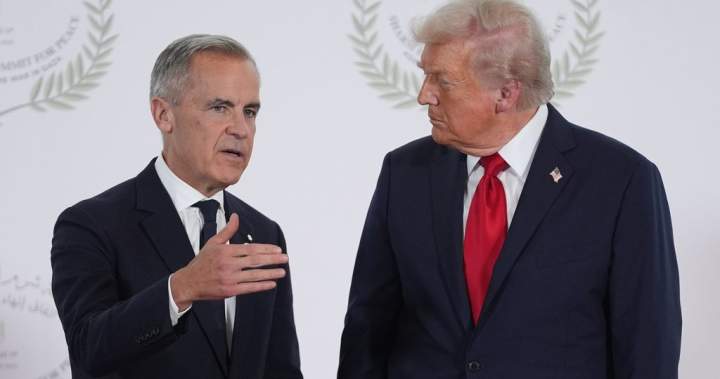
Prime Minister Mark Carney says the old “rules-based” international order, which allowed Canada to remain secure and prosperous for generations, is gone.
And while Carney told the crowd of international elites in Davos, Switzerland, that the old order should not be mourned, that doesn’t mean that Canada won’t feel its absence.
“Over the past two decades, a series of crises in finance, health, energy and geopolitics have laid bare the risks of extreme global integration. But more recently, great powers have begun using economic integration as weapons, tariffs as leverage, financial infrastructure as coercion, supply chains as vulnerabilities to be exploited,” Carney said, without naming U.S. President Donald Trump.
“You cannot live within the lie of mutual benefit through integration when integration becomes the source of your subordination.”
One year into Trump’s second term in office, the Canadian government now appears to be thinking the unthinkable.
That the “rules-based” international order is collapsing — a collapse driven primarily by the United States, which for generations championed that order — will not come as news to the people of Venezuela, Greenland or Denmark. But it’s noteworthy that it’s an opinion shared by the prime minister of Canada, given the two countries’ close security and economic ties.
The kind of subordination Carney was referring to was helpfully illustrated by a doctored image posted to social media by Trump early Tuesday morning, depicting European leaders in the Oval Office while Trump sits behind the Resolute Desk.
To Trump’s left was a map of the Americas, with Canada — along with Venezuela and Greenland — pictured with the stars and stripes of the American flag grafted over them.

Get breaking National news
For news impacting Canada and around the world, sign up for breaking news alerts delivered directly to you when they happen.
Then came the news, first reported by The Economist and emphatically underlined in the Globe and Mail on Tuesday, that Canada’s military planners have gamed out what an American military invasion could look like — and how long the Canadian side could hold out.
“This is what they’re paid to do. They look at various scenarios, who could be a threat, who could do something to Canada … and then what role might the Canadian Armed Forces have in responding to those threats,” said Vincent Rigby, a former National Security and Intelligence Advisor who spent 15 years working at the Department of National Defence.
“The fact of the matter is, no matter how you slice or dice this, the United States has been acting like a hostile state actor towards us. I do not see a U.S. invasion of Canada as a realistic possibility any time soon … but the military are paid to look at various scenarios and come up with plans to respond to those scenarios.”
While Canadians may not need to start organizing into well-mannered militias just yet, it’s not surprising that the Canadian Armed Forces is “contingency planning,” according to retired vice-admiral Mark Norman.
In an interview with Global News, Norman said it’s normal practice for militaries to “war-game” out various scenarios and potential conflicts.
“What is clearly abnormal in this particular circumstance is that we would be openly considering possible military conflict with our, up to now, closest friend and neighbour,” Norman said.
“So this is disturbing, not because of the nature of the reporting, but because we are finding ourselves in this circumstance.”
The Department of National Defence (DND) and Defence Minister David McGuinty did not respond to Global News’ request for comment Tuesday.
Both Carney’s speech and DND’s reported contingency planning, however, point to an increasingly unavoidable fact: that the U.S. is a threat to Canadian security and sovereignty.
It remains to be seen if the Carney government’s actions will match the prime minister’s rhetoric in Davos. Global Affairs Canada, the department responsible for both developing and implementing Canada’s foreign policy, is in the process of cutting 15 per cent of its budget as part of Carney’s government-wide belt-tightening exercise.
“But the very idea that middle powers can’t just go along complying with the United States, they can’t go along to get along, they have to speak up. Well, Mark Carney himself said little, if anything, when the United States was killing people in speedboats in international waters, apparently against international law,” said Roland Paris, the director of the University of Ottawa’s Graduate School of Public and International Affairs and a former foreign policy adviser to then-prime minister Justin Trudeau.
“And Canada’s response to the U.S. military action in Venezuela was very muted, too, for obvious reasons. He wanted to avoid economic retaliation from Donald Trump.”
But Trump’s repeated threats to annex Greenland have been a “wake-up call” for many countries, particularly in Europe, Paris noted. Those “middle power” countries are actively working to respond to Trump’s threat and his economic retaliation against the continent for their opposition to his plans.
“So does (Carney’s) speech indicate a recalibration of Canada pushing back against the United States? We’ll see,” said Paris.
Read the full article here


