



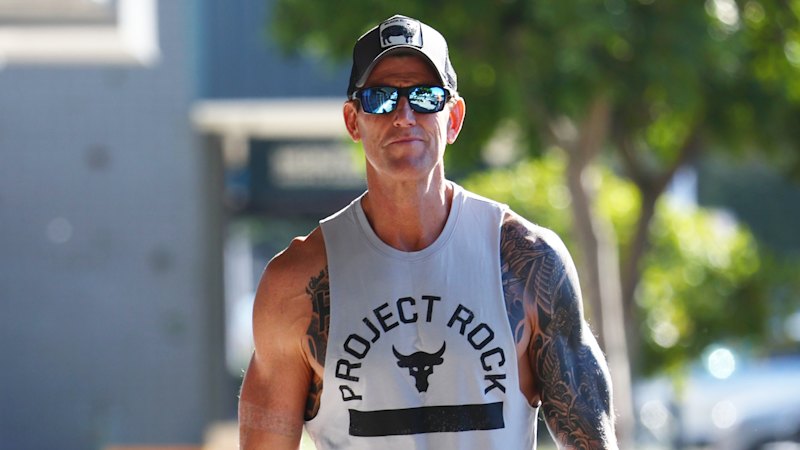
In the months before his dramatic airport arrest in Sydney, Ben Roberts-Smith had vacated his Brisbane apartment, paid thousands of dollars to an immigration lawyer, and booked flights to Spain, newly released court documents reveal.
That’s when the Australian Federal Police swooped in, taking the former SAS soldier into custody and charging him with five counts of war crime – murder over the alleged executions of Afghan detainees. It was five days before his scheduled Qantas flight out of the country.
The arrest on April 7 came after a five-year investigation by the Australian Federal Police (AFP) and Office of the Special Investigator (OSI). Roberts-Smith denies the allegations and has been released on bail.
Court documents released on Thursday, following an application by this masthead, reveal the prosecutor’s unsuccessful application to keep Roberts-Smith in custody, citing concerns about his history of witness interference, allegations of evidence destruction, and his plan to move abroad.
Roberts-Smith was first officially made aware of the OSI’s investigation on November 25, 2025, when senior investigating officer for the Australian Federal Police and OSI Stephen McIntyre wrote to Roberts-Smith’s lawyer, Karen Espiner, requesting an interview with Roberts-Smith.
That same month, the OSI had intercepted information that he was seeking financial advice on paying his partner a wage to help her obtain a visa to live and work in Spain, court documents reveal.
Two weeks later, Roberts-Smith paid a Spanish law firm $5400 for immigration advice, information intercepted by the OSI revealed.
By March, Roberts-Smith had vacated his rented Brisbane apartment and booked flights departing on April 11 to Singapore, before travelling on to Spain. He had return tickets for June of this year.
“The OSI holds concerns that Roberts-Smith is attempting to relocate to reside in a jurisdiction outside of Australia … the possibility that [he] has attempted to disguise his travel plans cannot be excluded,” McIntyre’s statement provided to the court reads.
McIntyre also raised concerns about Roberts-Smith interfering with and harassing witnesses during the defamation case he brought against this masthead, and ultimately lost.
He was found to have made a false report to the Australian Federal Police and organised for threatening letters to be sent to a witness to have them retract evidence; colluded with another witness to put forward false evidence about an eyewitnesses’ presence at an alleged execution; and there were allegations he buried USBs in his backyard, erased digital media, and used burner phones and encrypted devices to evade monitoring by the police.
“OSI also holds evidence of the supply of a ‘burner phone’ to a separate witness appearing on [his] behalf,” McIntyre wrote.
Roberts-Smith’s legal team argued that the former soldier’s life could not be put on hold while the OSI built its case. They said he had been aware of investigations for eight years, including knowing about the OSI’s investigation since 2023, and maintained a consistent record of returning to Australia.
The defence also pointed to the two occasions in 2025 that Espiner wrote to the AFP requesting that if charges were brought, arrangements be made in advance for him to be arrested and charged at a police station.
“He has been living an open and law-abiding life, including last week when he was arrested without notice,” the defence’s statement reads.
“Frankly, the applicant was entitled to get on with his life and not sit around waiting for the OSI to decide to charge. The OSI’s imminent decision to charge him could not have been known by the applicant when he started planning to move overseas.”
The defence also argued that the risk of Roberts-Smith interfering with witnesses was low, as there was no evidence that he knew where the witnesses lived or how to contact them.
Roberts-Smith was granted bail and released from Silverwater Correctional Complex last Friday after spending 10 days in custody. In chaotic scenes, Corrective Services officers attempted to block the media from photographing him.
Roberts-Smith’s bail conditions require him to report to police three times a week, surrender his passport, and not contact prosecution witnesses. He was permitted to reside in Queensland.
Court documents released after the bail hearing reveal prosecutors will allege five people killed by, or on the orders of, the decorated soldier had been unarmed and handcuffed, and evidence was then staged to portray their deaths as legal.
Start the day with a summary of the day’s most important and interesting stories, analysis and insights. Sign up for our Morning Edition newsletter.


From our partners
Read the full article here


