



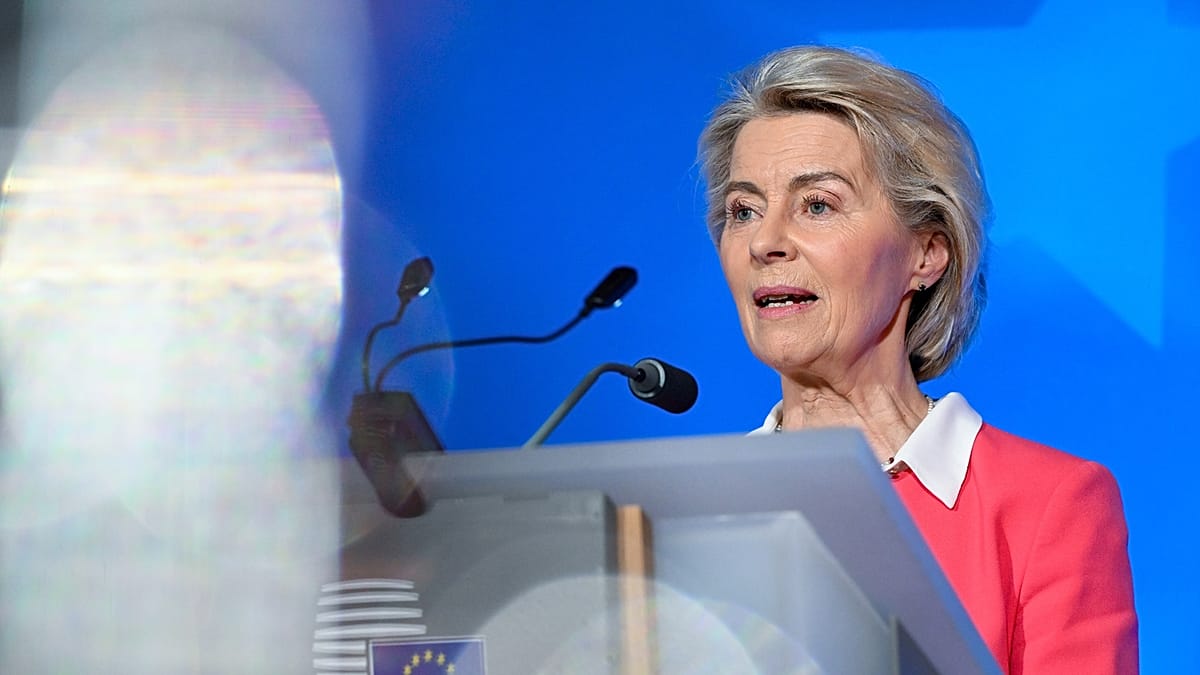
European Commission President Ursula von der Leyen has said the European Union will continue to work closely with the United States to strengthen security in the Arctic even as US President Donald Trump persists with his threats to seize Greenland from Denmark.
“The European Union has a very good reputation in Greenland, and we are counting very much on the excellent cooperation that we have,” von der Leyen said on Thursday on an official visit to Limassol, Cyprus.
“We will thus continue our work on Arctic security with our allies (and) our partners, including the United States,” she added.
Trump has framed his expansionist agenda as a national security goal.
On Wednesday, the American president said that NATO would become “more formidable and effective with Greenland in the hands of the United States”. Otherwise, he said, Russia and China would stand to benefit in the strategic region.
“Anything less than that is unacceptable,” he wrote on his social media platform, Truth Social.
His remarks coincided with a meeting in Washington between the foreign ministers of Denmark and Greenland, US Secretary Marco Rubio, and US Vice President JD Vance.
The Danish minister, Lars Løkke Rasmussen,said the tone had been frank and constructive, but conceded there remained a “fundamental disagreement” between the two sides.
“We didn’t manage to change the American position,” he said at the end of the meeting. “It’s clear that the president has this wish of conquering over Greenland.”
Rasmussen added that Denmark and the US had agreed to set up a high-level “working group” to find a “common way forward” on the matter of Greenland. He also countered Trump’s claims that Chinese warships had gained ground around the island.
At the same time, several European countries began to publicly announce their intention to send military officers as part of a reconnaissance mission to the mineral-rich territory, a stark reflection of the sky-high tensions fuelled by Trump’s vision.
France, Germany, Sweden, Norway and the Netherlands are among those that have committed to joining the mission at Copenhagen’s request.
Speaking as she marked the start of the Cypriot presidency of the EU Council, von der Leyen promised to “double down” on investments and cooperation in Greenland.
“What is clear is that Greenland can count on us politically, economically, and financially,” she said at a press conference, standing next to the Cypriot President Nikos Christodoulides.
“When it comes to its security, the discussions on Arctic security are, first and foremost, a core issue of NATO. But I also want to emphasise that the Arctic and Arctic security, both topics, are core topics for the European Union and matter enormously for us.”
Mutual assistance
Separately, the European Commission confirmed that Denmark would be able to invoke the EU’s mutual assistance clause in the event of an armed attack against Greenland, even though the semi-autonomous island is not part of the bloc.
The Commission had recently avoided clarifying the legal application.
“Greenland is part of the territory of the Kingdom of Denmark and therefore in principle covered by the mutual solidarity clause in Article 42.7 TEU,” a Commission spokesperson told Euronews in a statement.
“However, currently the question doesn’t ask itself,” the spokesperson added, referring to the fact that Trump’s threats have not yet been translated into action.
The mutual assistance clause is enshrined in Article 42.7 of the EU treaties, which says that if a country is “the victim of armed aggression on its territory”, the other member states will have an “obligation of aid and assistance by all the means in their power” in accordance with the right of collective self-defence recognised by the UN Charter.
The article does not spell out what measures qualify as “aid and assistance” in practice.
According to an explanatory memo from the Commission, member states should have ample margin to decide their support, which could be of a diplomatic, technical, medical or civilian nature. Military assistance is also envisioned.
Activating the article requires an attack “from abroad” carried out by state or non-state actors, the memo says. The decision to activate rests solely on the member state under assault. Once triggered, the duty to assist becomes “legally binding”.
Since its introduction in 2007, Article 42.7 has been invoked only once, when France fell victim to the terrorist attacks of November 2015 and asked other member states to contribute manpower to its Opération Sentinelle.
Notably, Article 42.7 establishes a direct connection with NATO’s Article 5, which is the bedrock of the transatlantic alliance’s collective defence. Most EU countries are members of NATO, creating an overlap of commitments and obligations.
Unlike the EU provision, which is broadly worded, NATO’s Article 5 is more explicit, compelling allies to take necessary action “including the use of armed force” to “restore and maintain the security of the North Atlantic area”.
However, given that both the US and Denmark are members of NATO, there is no precedent to determine how Article 5 would apply in a scenario where the American military violated Danish sovereignty and seized Greenland by force.
Such a dilemma emerged in 2020 when Turkey and Greece were involved in a standoff over Ankara’s contested gas exploration in waters claimed by Athens. In response, Greece put its army on alert, bringing two NATO members to the brink of war.
Read the full article here


