



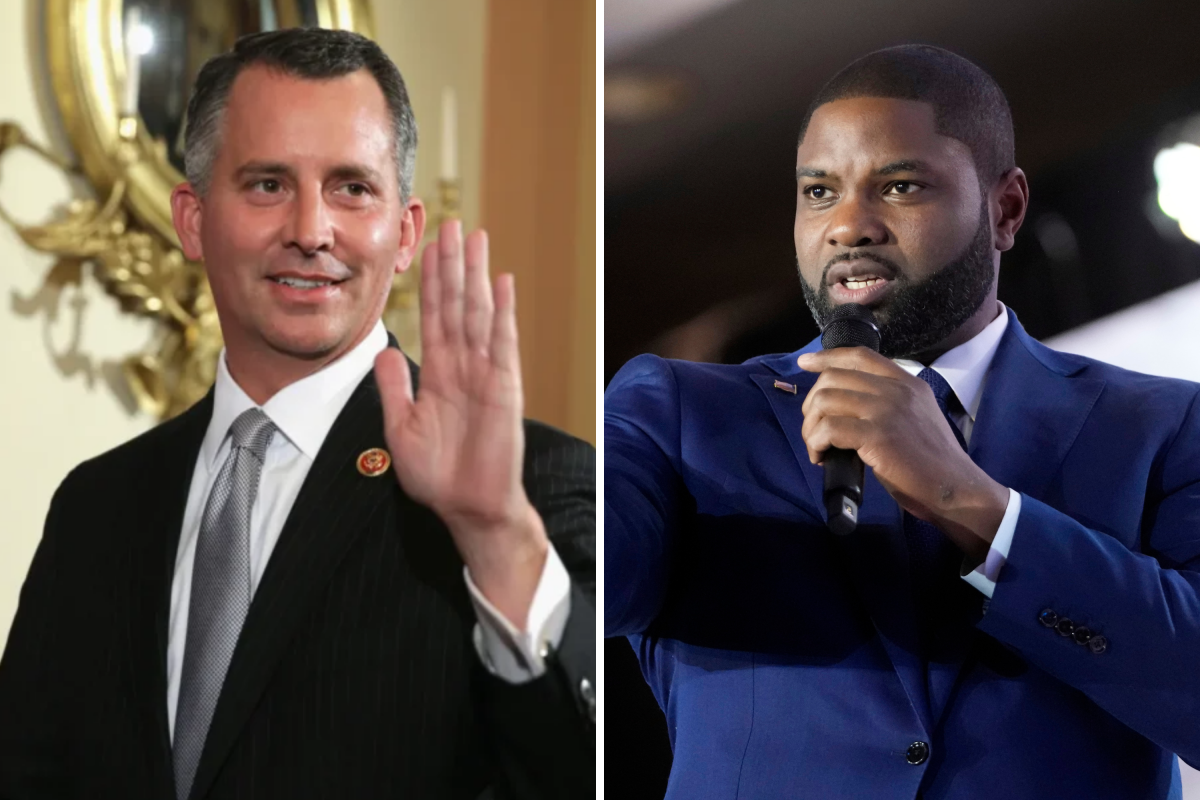
Florida has trended decisively Republican in recent elections, but a new poll of the 2026 governor race suggests Democrats could still mount a competitive challenge for the state’s top office.
A survey commissioned by Freedom Project USA and conducted online by Change Research, a Democratic-aligned polling firm, shows Democrat David Jolly narrowly leading Republican Byron Donalds in a potential general election matchup, offering an early signal that the race may be tighter than Florida’s recent Republican dominance might imply.
Newsweek contacted both campaigns for comment outside of regular working hours on Tuesday morning.
Key Points
- Jolly leads Donalds 46 percent to 42 percent among likely voters, according to the new survey
- Democratic voter motivation is 13 points higher than Republicans (88 percent to 75 percent), the poll finds
- Independents break heavily toward Democrats, giving Jolly an 18-point edge, according to the new research
- Cost of living dominates voter concerns, with 70 percent saying they are falling behind
- Other recent polls still show Republicans ahead and favored overall
What To Know
A May 2026 Change Research poll found a Democrat leading Florida’s governor race amid shifting independents and rising economic dissatisfaction.
It points to a possible opening for Democrats in a state that has trended Republican at both the state and national level.
Both parties may need to refocus their strategies on independents, turnout and economic concerns as the midterm race takes shape.
Why It Matters
Florida was one of the country’s defining swing states as recently as the early 2010s, but has since moved firmly into the Republican column, delivering increasingly large GOP margins in recent elections.
Any sign of renewed competitiveness has national implications in a midterm cycle where control of key offices—and broader political momentum—is at stake.
What The New Poll Shows
The Change Research poll was conducted from May 13 to May 16, surveying 2,070 registered voters, including 1,593 who say they are likely to vote in the 2026 midterms, with a 2.3 percent margin of error.
In a hypothetical head-to-head matchup, Jolly leads Donalds 46 percent to 42 percent among likely voters.
After respondents were given more detailed information about the candidates, including their policy positions and critiques raised by opponents, that lead widened to 48 percent to 41 percent.
Much of that advantage is driven by nonparty-affiliated voters.
Among independents—who number in the millions in Florida—Jolly leads by 18 points, 46 percent to 28 percent, giving Democrats a potential path in a state where partisan voting is otherwise entrenched.
The poll also shows a notable enthusiasm gap. Democratic voters report motivation levels at 88 percent, compared with 75 percent among Republicans, a difference that could become decisive if it translates into turnout.
Economic conditions dominate the political environment. Seventy percent of respondents say they are falling behind the cost of living, and 65 percent say Florida is not affordable for their family.
Everyday expenses—from gas and groceries to insurance—are cited as major sources of financial pressure.
How It Compares With Other Polling
Other recent surveys have presented a more familiar picture, with Republicans maintaining an edge.
A Florida Chamber of Commerce poll conducted by Cherry Communications between May 1 and May 9 among 604 voters, with a margin of error of plus or minus 4 percentage points, found Donalds leading Jolly 47 percent to 39 percent.
Stetson University polling of 848 likely voters, conducted from March 15 to April 13, with a plus or minus 4.1 percentage point margin of error, also showed Donalds ahead 47 percent to 40 percent, while an Emerson College poll of 1,125 likely voters, conducted from March 29 to 31, with a plus or minus 2.8 percentage point margin of error, put the Republican up 44 percent to 39 percent.
Prediction markets reflect that broader trend, with Republicans still favored to hold the governorship despite signs of a tighter race.
On U.S.-regulated prediction market Kalshi, Republicans are priced at roughly a 78 percent chance of winning, compared with about 21 percent for Democrats. On Polymarket, the GOP is given a similar edge, at around 80 percent to 21 percent.
Prediction markets offer a snapshot of collective expectations, but can be thinly traded and are sensitive to narrative shifts rather than hard voter data.
Read the full article here


