



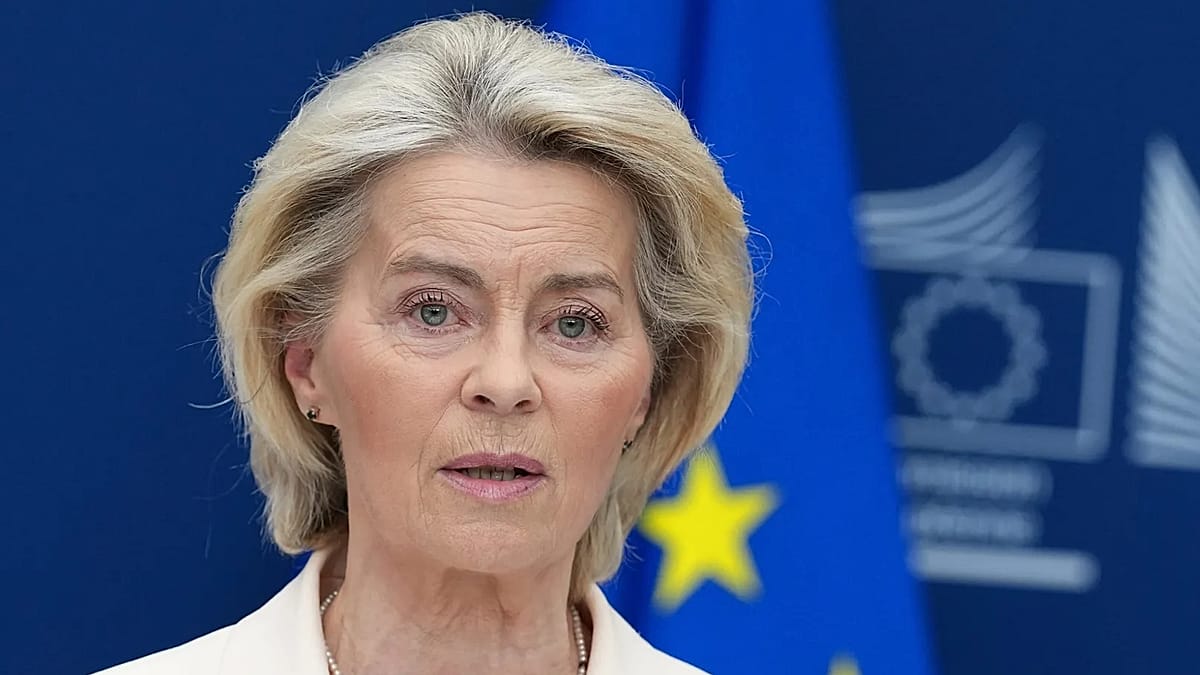
Critics of European Commission President Ursula von der Leyen are casting her reaction to the US-Israeli war in Iran as the latest example of a foreign policy “power grab” – even as the commission’s formal diplomatic powers are limited and member states themselves are still grappling with how to respond.
When the war began with US strikes on Iran last Saturday, von der Leyen was the first leader across Europe to issue a reaction, calling the developments in Iran “greatly concerning”.
Since then, she has issued 12 posts involving Iran on X and held talks with at least 12 EU and gulf leaders, including the Crown Princes of Saudi Arabia and Bahrain.
She was also the first European leader to call for a “credible transition” in Iran – a stance not endorsed by the 27 member states, and one that aligns with the US and Israel in favouring regime change.
Speaking to Euronews, Israel’s foreign minister, Gideon Sa’ar, said that neither his country nor the US intends to impose a specific candidate, but indicated that they seek to “create the conditions on the ground” that would enable the Iranian people to rise up against the regime.
Three days after the first strikes, von der Leyen convened a “special Security College” meeting bringing together all 27 commissioners, including those with portfolios not traditionally associated with security policy, such as intergenerational fairness and social rights.
The Security College, created last year, was ostensibly intended to help the Commission “switch into a preparedness mindset” and improve understanding of emerging threats, including hybrid threats. However, the concept remains unclear to many in Brussels.
“We still don’t understand what it is,” one Commission official told Euronews.
The repercussions of the US-Israeli war in Iran are expected to take centre stage this week when von der Leyen chairs the meeting of the College of Commissioners on Wednesday and meets with Fatih Birol, Executive Director of the International Energy Agency, on Thursday.
‘A treaty mutation is taking place’
Von der Leyen’s critics argue that the emphasis on preparedness has become a vehicle for expanding institutional authority and projecting EU influence in foreign policy.
Under EU rules, neither the Commission nor its president has any formal foreign policy role. The Commission’s main duties are to propose legislation, ensure member states implement it, and manage the EU budget, while also negotiating international agreements.
The EU’s diplomatic coordination is formally led by High Representative for Foreign Affairs and Security Policy Kaja Kallas, while European Council president António Costa is responsible for representing the EU externally among heads of state and government, including on common foreign and security policy.
Von der Leyen’s tweet announcing her phone call with United Arab Emirates president Mohamed bin Zayed Al Nahyan drew intense outrage on social media.
“She tries to take the lead in a field that should not be her field,” said Marc Botenga, a Belgian MEP from The Left. “She tries to concentrate power. If she does these things without mandate, this is not going to strengthen her position”
“There’s an unease about the way she’s doing her job,” Botenga added.
Spanish socialist MEP Nacho Sánchez Amor poked fun at the “special Security College” and questioned whether the Commission was unilaterally reshaping EU treaties.
“What is a ‘security college’?” he asked on X. “The lack of reaction from the legitimate constitutional holders of EU security and defence competences is quite strange. A treaty mutation is taking place without discussion or assessment.”
Besides MEPs, numerous political analysts have also accused the commission president of overstepping her remit.
“When von der Leyen calls Gulf leaders to discuss regime change in Iran, she is operating well outside her lane and against the treaties,” Alberto Alemanno, a professor of EU Law at the HEC Paris Business School, told Euronews.
Preparedness as a foreign policy tool
Alemanno and others contend that von der Leyen has progressively moved into foreign-policy domains that EU treaties formally reserve for other actors, especially regarding Russia’s war in Ukraine, the conflict between Israel and Gaza, and the US’ decision to impose tariffs on the EU.
When she took office in 2019, von der Leyen was a compromise choice, relatively unknown in Brussels and with limited European-level visibility.
Since then, she has turned successive emergencies – the COVID-19 pandemic, for example, or Russia’s full-scale invasion of Ukraine – into opportunities to consolidate the Commission’s authority and position herself as the bloc’s most recognisable figure.
Von der Leyen’s ability to elbow her way to into the top tier of diplomacy was particularly striking last summer, when she sat next to European leaders and heads of state at a meeting on Ukraine hosted by US President Donald Trump.
Her position at a gathering at that level – where the head of the EU executive was placed on the same footing as the President of the French Republic – was highly unusual. In Brussels’ institutional hierarchy, the Commission serves the national governments; the two are not formally equals.
As for Trump, who has described von der Leyen as “a very powerful leader”, she has appeared to seize an opportunity – though not without cost.
While the US president praised her in public, he also forced the EU into an unfavourable trade deal, tripling tariffs on European imports to the US under the threat of further duties. Von der Leyen became the face of a “moment of humiliation for Europe”, photographed with her thumbs up besides the president.
After the Hamas attack on Israel in October 2023, von der Leyen quickly spoke out in defence of Israel and Prime Minister Benjamin Netanyahu, a move that drew strong criticism from MEPs and some member states for not reflecting the EU 27’s agreed position. She later visited Israel and held talks with Netanyahu.
“The problem is that no one is stopping her, which says as much about the weakness of the current High Representative Kaja Kallas and the passivity of member states,” Alemanno said.
The decider
But Guntram Wolff, a senior fellow at Bruegel, played down the criticism, arguing that von der Leyen’s responsiveness can at times be an asset.
“She is filling a vacuum when some member states find it difficult to react, and they are sometimes really slow to react to political developments,” Wolff said. “In the case of Ukraine, she has been really taking a very important leadership role, which I think one has to appreciate and evaluate positively.”
For Wolff, von der Leyen’s expansion of influence in foreign policy reflects a wider institutional issue.
“It’s not the Commission President who can achieve that” he said, referring to von der Leyen’s early call for a regime change in Iran. “This is a hard, narrow foreign policy question where it is up to the member states, the High Representative, and the Council to take a position.”
“Right now, there are two presidents plus a High Representative,” Wolff added. “From an institutional standpoint, it would be preferable to have essentially a single president making the key decisions.”
Read the full article here


