



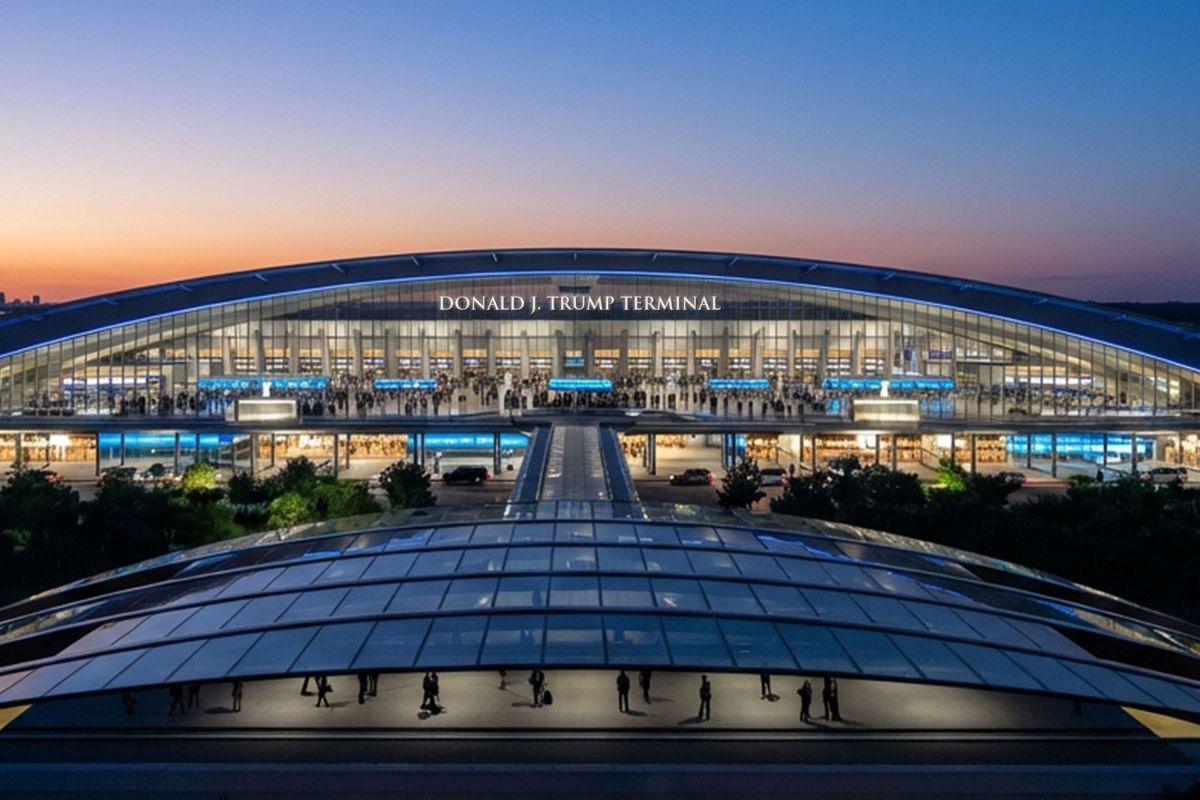
Washington Dulles International Airport (IAD), the primary international gateway serving the Washington, D.C. area, may be headed toward a dramatic transformation following a proposal submitted by Bermello Ajamil & Partners, a Woolpert Company in partnership with Zaha Hadid Architects.
The design was one of several submitted in response to a U.S. Department of Transportation (DOT) call-out in December seeking bold ideas to “refresh” the iconic airport.
Zaha Hadid Architects is the London-based firm founded by the late Iraqi British architect Zaha Hadid, who was renowned for her futuristic design esthetics. The collaboration with American architectural firm Bermello Ajamil & Partners outlines a sweeping redesign that blends monumental civic expression with contemporary passenger needs. The proposal frames Dulles not just as a travel hub, but also as a symbol of national identity.
“The Washington Dulles International Airport is the symbolic international gateway to the United States,” the proposal states. “More than transportation infrastructure, it is a civic space which celebrates the moment of arrival into the nation…our vision is to restore the sense of dignity and grandeur to the process of entering the United States—and Make Airports Great Again.”
White House spokesperson Kush Desai told Newsweek: “A country’s infrastructure should reflect national culture, leadership, and achievement—and that is especially true of the international gateway to our capital city, Dulles Airport.”
A Monumental ‘Donald J. Trump Terminal’
Central to the vision of the proposed airport revamp is a new “Donald J. Trump Terminal,” depicted in renderings with a vast arched profile reminiscent of the Gateway Arch in St. Louis, Missouri, a work of Eero Saarinen—the same architect who designed IAD’s original main terminal.
Architect Rolando Mendoza, director of design for Bermello Ajamil & Partners, told Newsweek, “The design concept consists of a monumental arched departure hall—reminiscent of Eero Saarinen’s Gateway Arch in St. Louis—which provides a bold statement…serves as both the first and last impression for the traveling public, and that arched structure proposes carrying the name of our 47th president.”
With its sweeping curves and imposing “monumental curtain wall,” the arched departure hall “frames the view of Eero Saarinen’s terminal and preserves it in perpetuity by repurposing it into an airside retail concessions and food courts mall” that all passengers will walk through en route to the departure gates.
The architecture relies on proportion, symmetry, and light rather than ornament. A grove of trees frames the entry, grounding the scale and reinforcing the building’s intended role as a public institution. “The building stands with quiet authority—neither imposing nor recessive—projecting stability, aspiration, and welcome,” according to the proposal.
A ‘Civic Spine’ for International Arrivals
Another focal point is the treatment of international arrivals. Mendoza said: “Arriving international passengers will enjoy moving through the skylight ‘civic spine’ accessed from sterile corridors on the third level that then converges via escalators and elevators.” This lower‑level spine is “a dignified and sacred awe‑inspiring space where the international passenger experiences messaging of America’s core values and founding principles,” the director added.
The proposal further explains that, conceptually, this “arrivals spine” embodies the project’s central idea of “many people, many origins, moving together through one ordered space,” operating as a “threshold between arrival and belonging, past ideals and future participation, expressed through light, proportion, and purposeful sequence rather than spectacle.”
Light‑Filled Interior Spaces
Inside the departures hall, the proposal describes “a large, uncluttered interior volume defined by clarity, structure, and controlled daylight.” A continuous skylight introduces natural light deep into the hall, creating a sense of time and rhythm. Vertical mullions form a structural colonnade, while the smooth ceiling reinforces themes of lift and flight.
Materials are intentionally restrained—“light-toned floors, pale structural elements, and clear glazing”—ensuring a timeless, civic character.
The baggage hall, meanwhile, is designed as a broad, horizontally organized space illuminated by oculus skylights. Mendoza told Newsweek: “The baggage hall and access to ground transportation are also skylit, providing gracious verticality and high ceilings all washed with natural skylight.” Below the skylights, softly contoured ceiling surfaces and branching columns evoke Saarinen’s expressive language.
The proposal states that skylight cutouts “provide both functional illumination and a symbolic connection to the sky,” emphasizing the project’s broader ambition “to treat arrival as a civic experience.”
According to the company behind the latest proposal, the DOT is awaiting feedback from the Metropolitan Washington Airports Authority on the various responses received since the call-out, and the firm anticipates an update in the next week or so.
White House spokesperson Desai told Newsweek: “The American people should stay tuned for new developments to follow in short order on this historic undertaking for America’s renewed greatness.”
Do you have a travel-related story to share? Let us know via life@newsweek.com, and your story could be featured on Newsweek.
Read the full article here


