



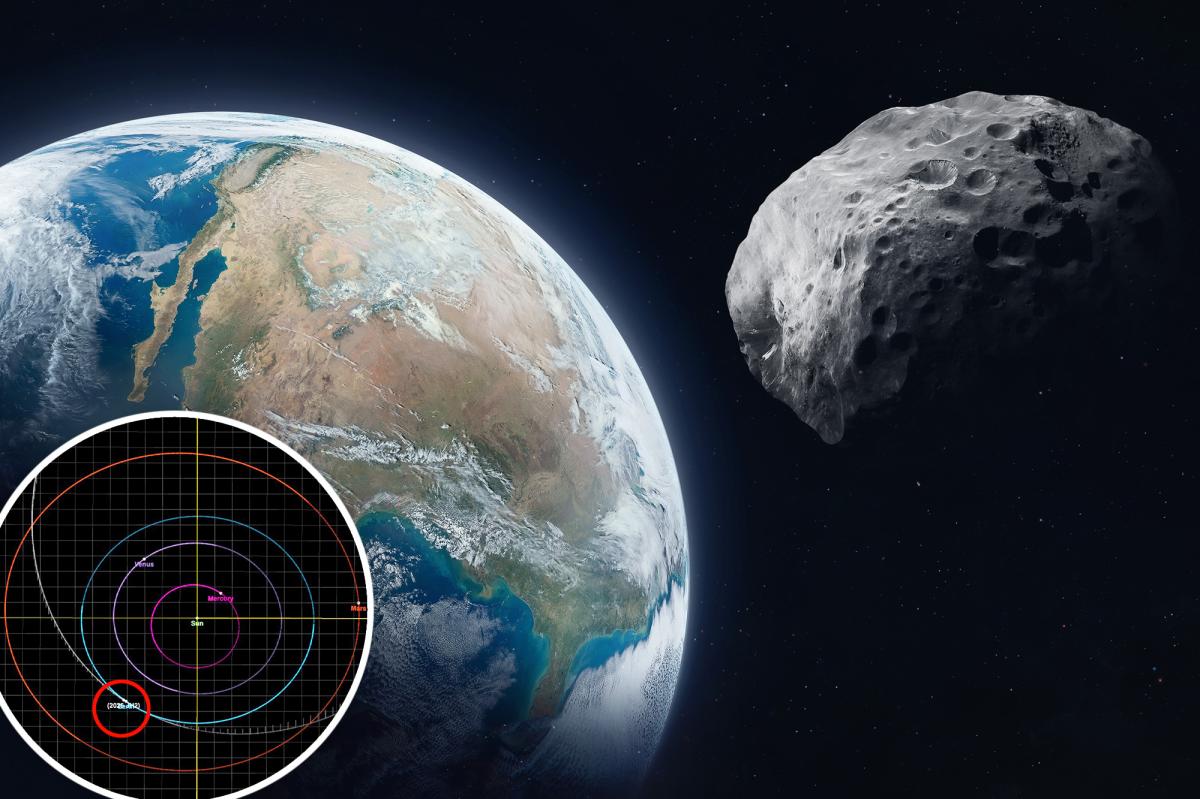
Don’t look up! But if you do, you might be able to see a bus-sized asteroid passing Earth.
The newly discovered space rock is said to make a close call early next week, flying by Earth, but rather than panic, scientists say this could be a great chance to study the event up close.
Dubbed 2026 JH2, the asteroid is expected to pass within 56,000 miles of Earth this Monday, May 18th, according to astronomers tracking its flight. Shockingly, that distance is just about a quarter of the length between Earth and the moon, making it not entirely out of this world, and scientists say the closeness is uncanny.
“In astronomical terms, it’s as close as you can get without hitting,” astrophysicist Mark Norris told New Scientist. “It’s the kind of thing that would ruin a city quite efficiently, if it hit.”
Researchers estimate the rock has a diameter of 52 to 115 ft and is traveling at just over 5 miles per second relative to earth—a mass comparable to the 2013 Chelyabinsk explosion over Russia. While that meteor was reportedly over 60 feet, it was less than 19 miles from Earth when it exploded. It’s impact was 30 times stronger than the atomic bomb in Hiroshima and sent over 1,500 curious onlookers to hospitals with injuries. Had it been any closer, it would have been the most catastrophic event in human history, according to reports.
But despite its astonishing size and speed, simulations show there is no chance of impact; still, its proximity to Earth is worth pausing on, and scientists are eager to examine this near-earth object in real time as it flies past our planet.
The asteroid was only recently discovered days before its close approach by several groups of astronomers, including observers at Mount Lemmon Survey in Arizona, Farpoint Observatory in Kansas, and Magdalena Ridge Observatory in New Mexico, according to data. Because they’re relatively small and hard to detect against the darkness of deep space, Near-Earth Objects often remain hidden, according to the BBC.
JH2 is the ninth-closest known asteroid flyby within one lunar distance recorded so far this year, according to AstroPhilesz. But this isn’t a solo flight — 73 known asteroids will pass within one lunar distance of Earth in 2026, which is actually the number to pay attention to.
“This is not a rare event. Space rocks pass through our neighborhood regularly. Most are discovered with very little warning,” AstroPhilesz wrote on Facebook. “That is not enough time to do anything about it if the trajectory had been different.”
But even with that scare, the reality is that high-speed rocks are constantly circulating through our solar system. The good news is that our defenses, like NASA’s DART mission, have improved dramatically, proving we can alter asteroids’ orbits and deflect them from hitting Earth.
Some amateur skywatchers may even be able to glimpse the asteroid using high-powered binoculars or small telescopes near Ursa Major and Leo, but scientists say it remains too faint to see with the naked eye.
For those eager to witness, The Virtual Telescope Project is planning a livestream of the flyby on Monday afternoon, beginning at 3:45 pm from Italy.
Read the full article here


