



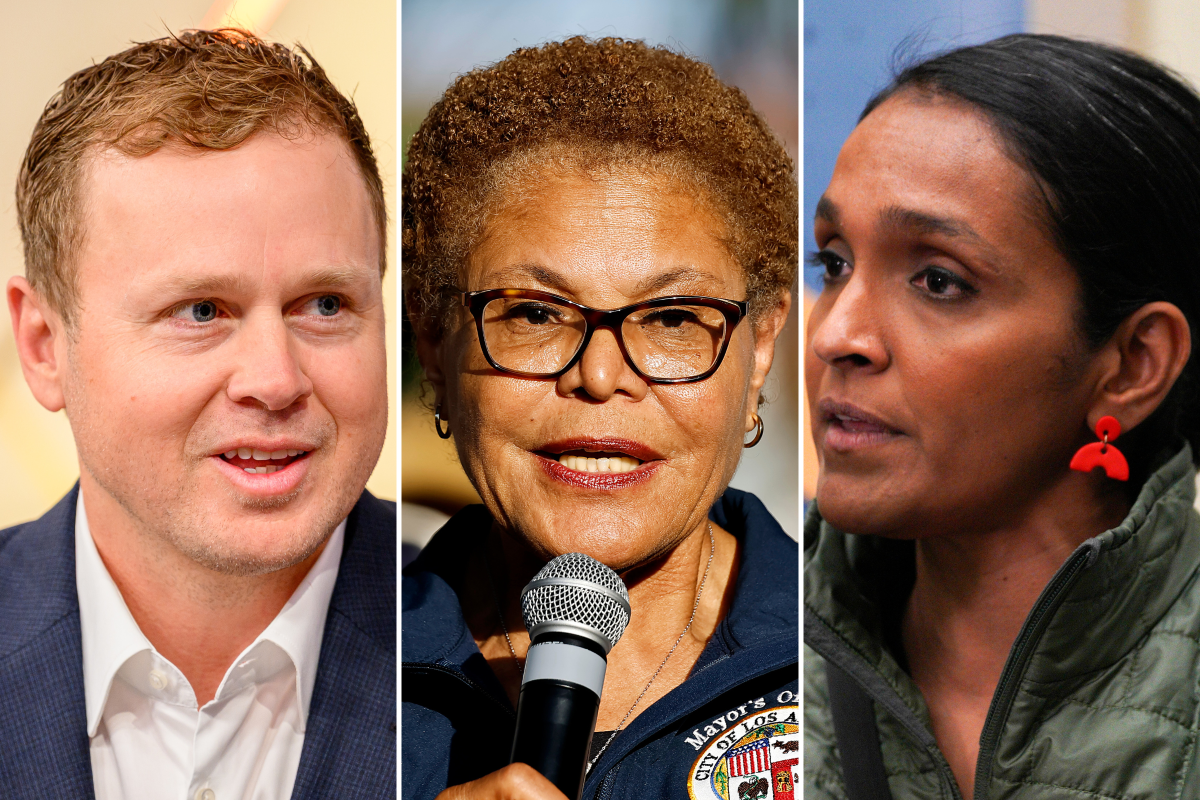
A high-stakes Los Angeles mayoral debate has intensified a tight three-way contest just weeks before voting begins.
Following the bruising showdown on May 6, Polymarket, a blockchain-based prediction market where users trade on real-world outcomes using cryptocurrency, puts Kamala Harris-endorsed incumbent Karen Bass’ chances of winning the election at 45 percent, compared with 38 percent for City Councilmember Nithya Raman and 18 percent for television personality Spencer Pratt ahead of the June 2 primary.
Meanwhile, U.S.-regulated prediction market Kalshi prices the result similarly, with Bass leading at around 49 percent, Raman in the low 30s and Pratt in the low 20s.
The most notable change in recent odds comes from Raman, whose chances dropped sharply after the debate, falling from around 55 percent to 38 percent on Polymarket and from roughly 50.7 percent to the low 30s on Kalshi—declines of about 17 to 19 points in under 24 hours.
Newsweek has reached out to the leading campaigns for comment.
Why It Matters
The race has tightened against a backdrop of voter frustration with city leadership and an unusually high share of undecided voters heading into the homestretch.
A UCLA Luskin poll of 813 likely voters conducted March 15–29, with a plus or minus 4 percentage-point margin of error, found 40 percent undecided, underscoring how late swings may prove decisive.
A volatile three-way race means late campaign moments—like debates—could still reshape who reaches the runoff.
Bass and Pratt Press Attack Lines as Raman Struggles to Break Through
Wednesday night’s debate at the Skirball Cultural Center marked the first time the three leading candidates shared a stage.
It quickly took on a two-against-one dynamic, with both Bass and Pratt directing much of their criticism at Raman.
Los Angeles Times columnist Gustavo Arellano described the debate as producing “two winners, one loser,” arguing Raman “came off as inexperienced, touchy and unprepared.”
Bass and Pratt repeatedly targeted Raman, scrutinizing her record and positioning her as responsible for many of the same problems she criticizes.
Raman pushed back, accusing both rivals of effectively working in tandem to sideline her and secure spots in a November runoff.
Sharper exchanges often overshadowed policy disputes. Pratt accused Bass of mismanagement during the 2025 Palisades fire and labeled her an “incredible liar,” drawing a warning from moderators, per NBC Los Angeles.
Bass defended her record while acknowledging mistakes, calling her absence during the wildfire crisis one of the worst moments of her tenure.
Raman sought to present herself as a reform candidate, arguing Los Angeles needs greater urgency on homelessness, housing and infrastructure.
Yet her debate performance appeared uneven, at times struggling to deliver concise answers and maintain control of the exchange, according to Arellano, who wrote in the LA Times that she was “tongue-tied trying to answer simple questions.”
Pratt, by contrast, relied heavily on anecdotal storytelling and a focus on public safety while remaining light on policy specifics, Arellano wrote.
Bass largely emphasized experience and continuity, pointing to progress on homelessness and economic issues as she defended her record in office.
Prediction Markets Signal Drift Away From Raman’s Peak
The immediate aftermath of the debate appears to coincide with a shift in market sentiment.
Prediction markets turn expectations into tradable probabilities, often reacting faster than polls, but can be distorted by thin trading, participant bias, or strategic betting.
On the Polymarket prediction market, Bass remains the clear front-runner, with traders also pricing a competitive race for second between Raman and Pratt, as total market volume has climbed above $1.1 million—unusually high for a municipal contest.
That distribution reflects a notable reversal from earlier in the spring, when Raman had been priced as the front-runner in some snapshots of trading.
This suggests a classic momentum stall: a candidate who surged early but struggles to consolidate broader coalition support once scrutiny intensifies.
Bass’ lead, while clear, remains below the 50 percent threshold required to avoid a runoff, reinforcing expectations that the contest will extend into November.
Pratt’s 18 percent share, meanwhile, signals continued interest in a protest or outsider candidacy, particularly among voters dissatisfied with the political establishment.
What Polls Say
Recent polling points to a fragmented race with no clear majority support for any candidate, underscoring how much remains in flux ahead of the June primary.
A UCLA Luskin poll of 813 likely voters conducted between March 15 and March 29 showed Bass leading with 25 percent support, followed by Pratt and Raman in the low double and single digits, respectively, while 40 percent of respondents remained undecided.
An Emerson College poll conducted March 7–9 similarly found Bass leading a crowded field but with support below 20 percent, alongside a large pool of undecided voters—just over half those surveyed. It also showed weak job approval ratings for the incumbent, with more voters disapproving than approving of her performance.
Meanwhile, a UC Berkeley Institute of Governmental Studies/Los Angeles Times poll conducted March 9–15 placed Bass at 25 percent, with Raman and Pratt trailing but still within striking distance. That survey also found a substantial share of voters either undecided or unfamiliar with much of the field.
Taken together, the polls suggest a race defined by low support for all candidates and a large bloc of undecided voters, leaving the contest highly fluid heading into the final weeks.
Two Advance, One Falls Short
Los Angeles uses a nonpartisan top-two primary system, meaning only the two highest vote-getters on June 2 will advance to the November runoff if no candidate wins a majority.
Prediction markets and debate dynamics alike now point to a narrowing contest between Bass and Pratt for one slot, and Bass and Raman for another, with Raman’s position looking less secure than it did even weeks ago.
If the debate represented a turning point, it was not because it transformed the front-runner—but because it clarified the stakes for second place.
Read the full article here


